Review: Nanamica Opens Wukang Store in Shanghai With a Gentle Focus

March 25, 2026
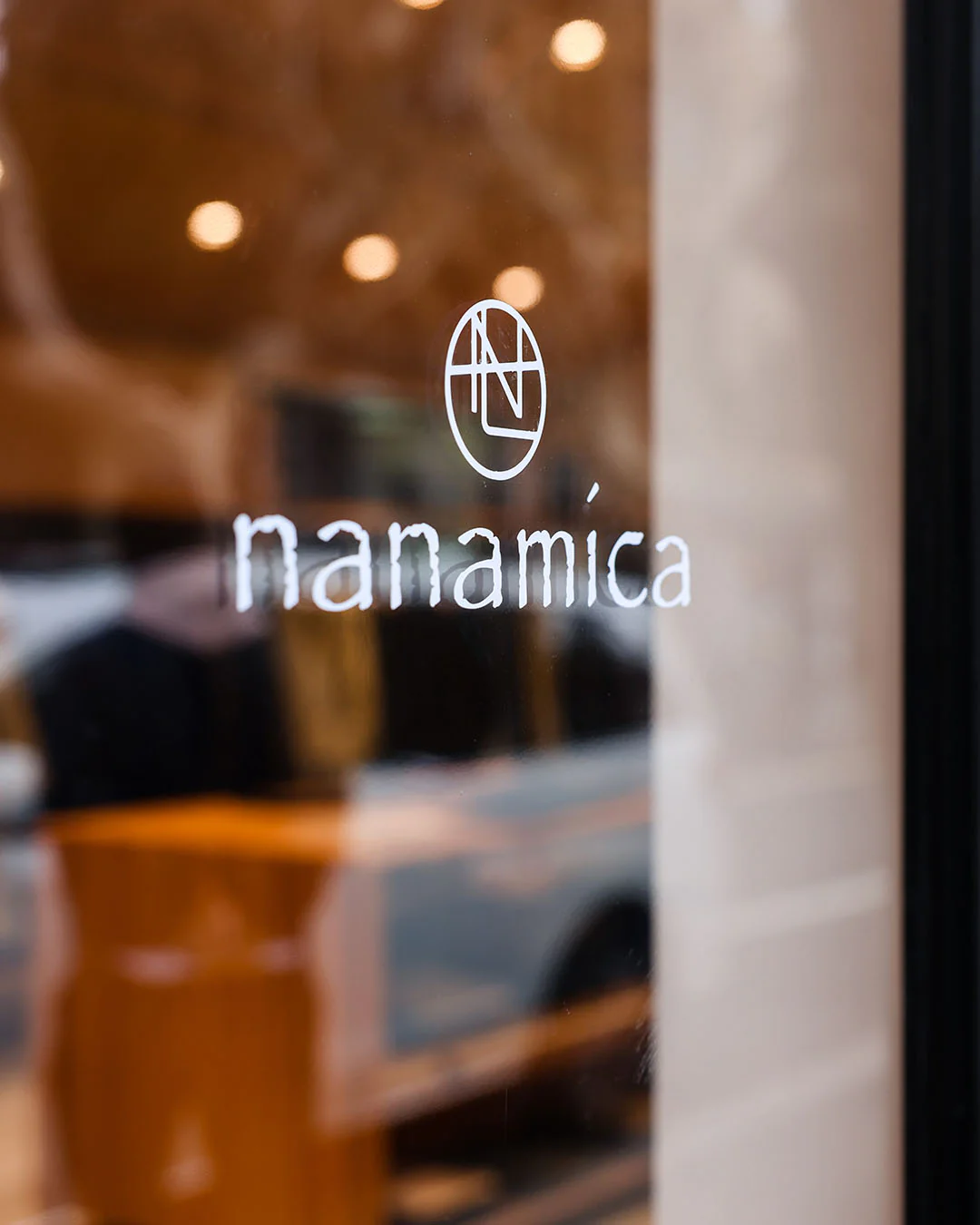

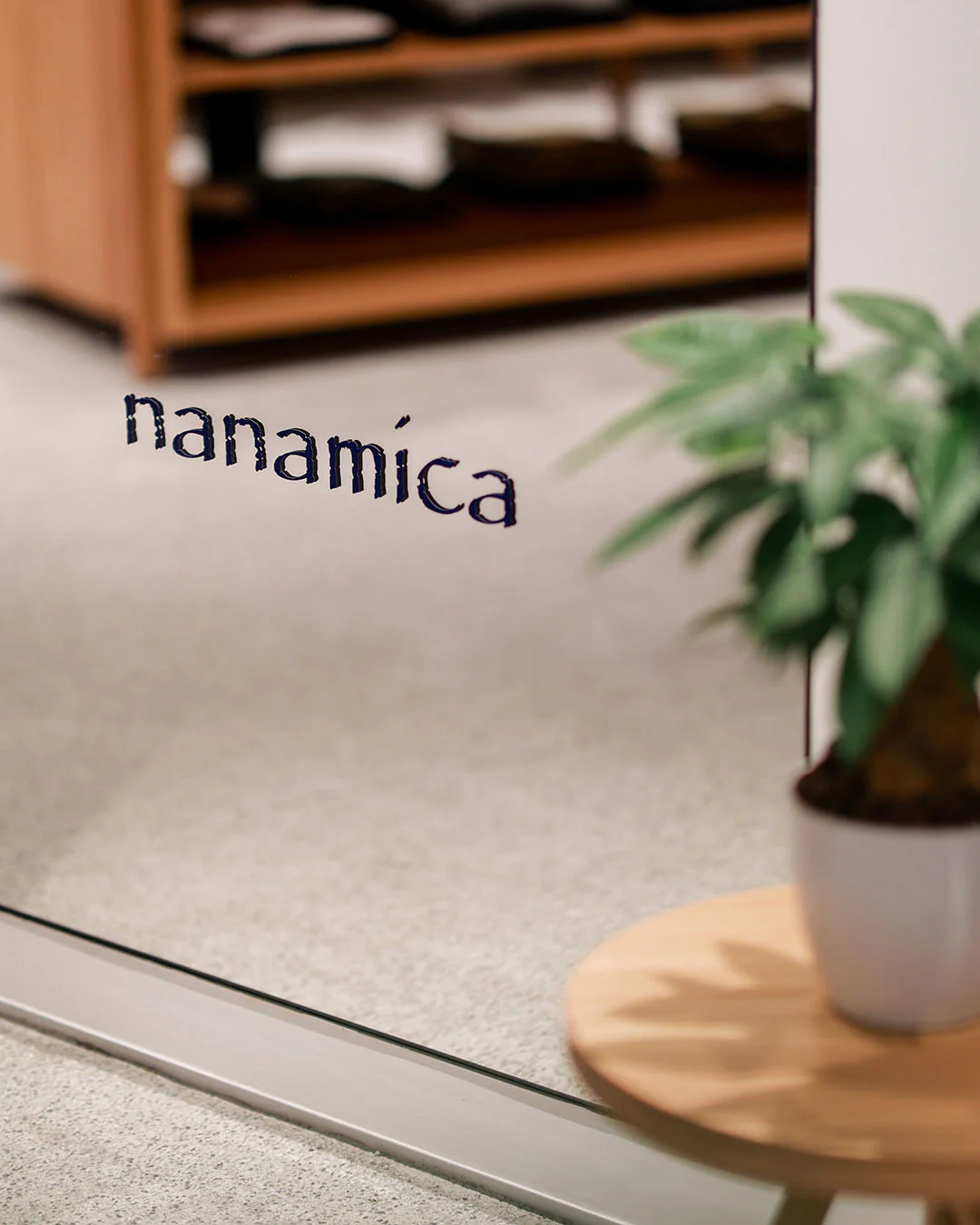
There are retail openings that announce themselves loudly, and then there are those that embed quietly into the rhythm of a city. The new Nanamica Wukang store in Shanghai belongs firmly to the latter category. Positioned along the historically layered Wukang Road—a stretch of the former French Concession that has evolved into one of the city’s most architecturally intact and culturally textured corridors—the store does not attempt to interrupt its surroundings. Instead, it absorbs them.
Wukang Road itself is less a commercial strip than a palimpsest of architectural periods. Early 20th-century villas, plane trees that filter light into a subdued green haze, and a pedestrian rhythm that privileges wandering over destination all create a context that resists spectacle. For a brand like Nanamica, whose philosophy is rooted in restraint, utility, and environmental continuity, the location offers not just visibility but alignment.
The decision to open in Shanghai is not incidental. The city has become a central node in the evolving relationship between Japanese design sensibilities and Chinese consumer culture. Where Tokyo offers a domestic clarity for Nanamica’s ethos, Shanghai provides a testing ground—an environment where heritage, rapid urbanization, and global fashion literacy intersect in ways that demand precision rather than excess.
stir
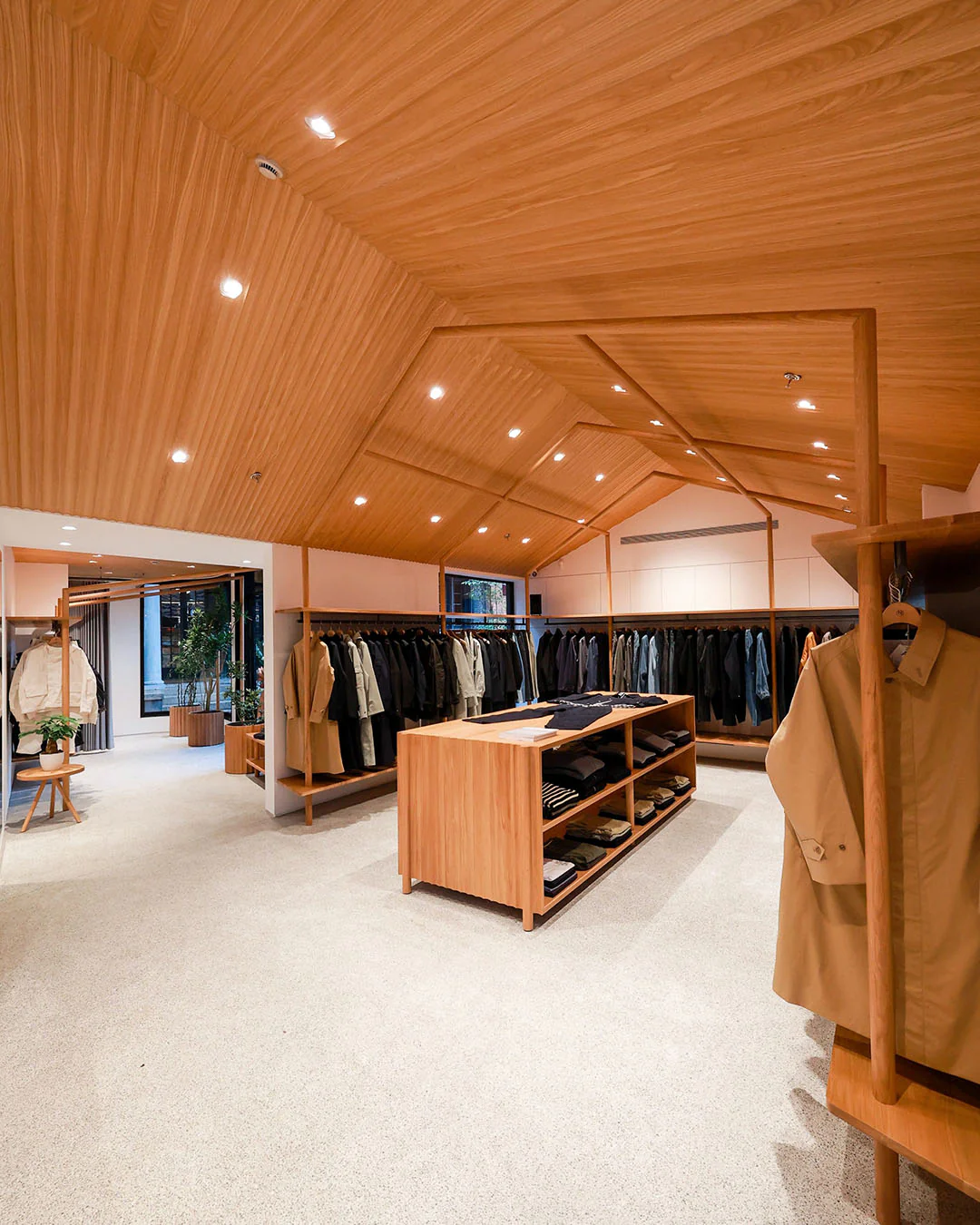
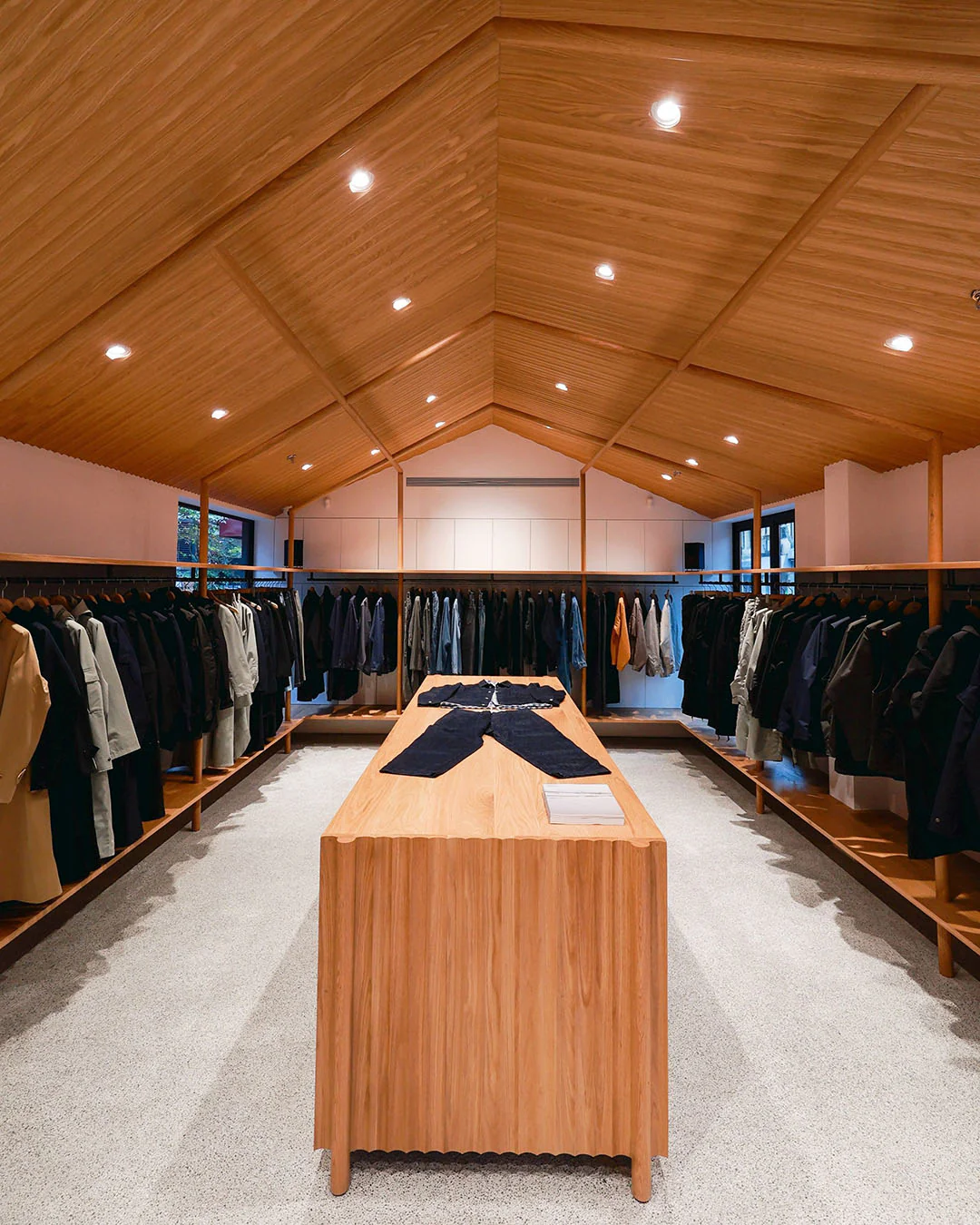
The architecture of Nanamica Wukang resists the now-familiar tropes of haute retail. There is no overt theatricality, no exaggerated material contrasts, no attempt to produce an instantly “Instagrammable” interior. Instead, the store operates through subtraction.
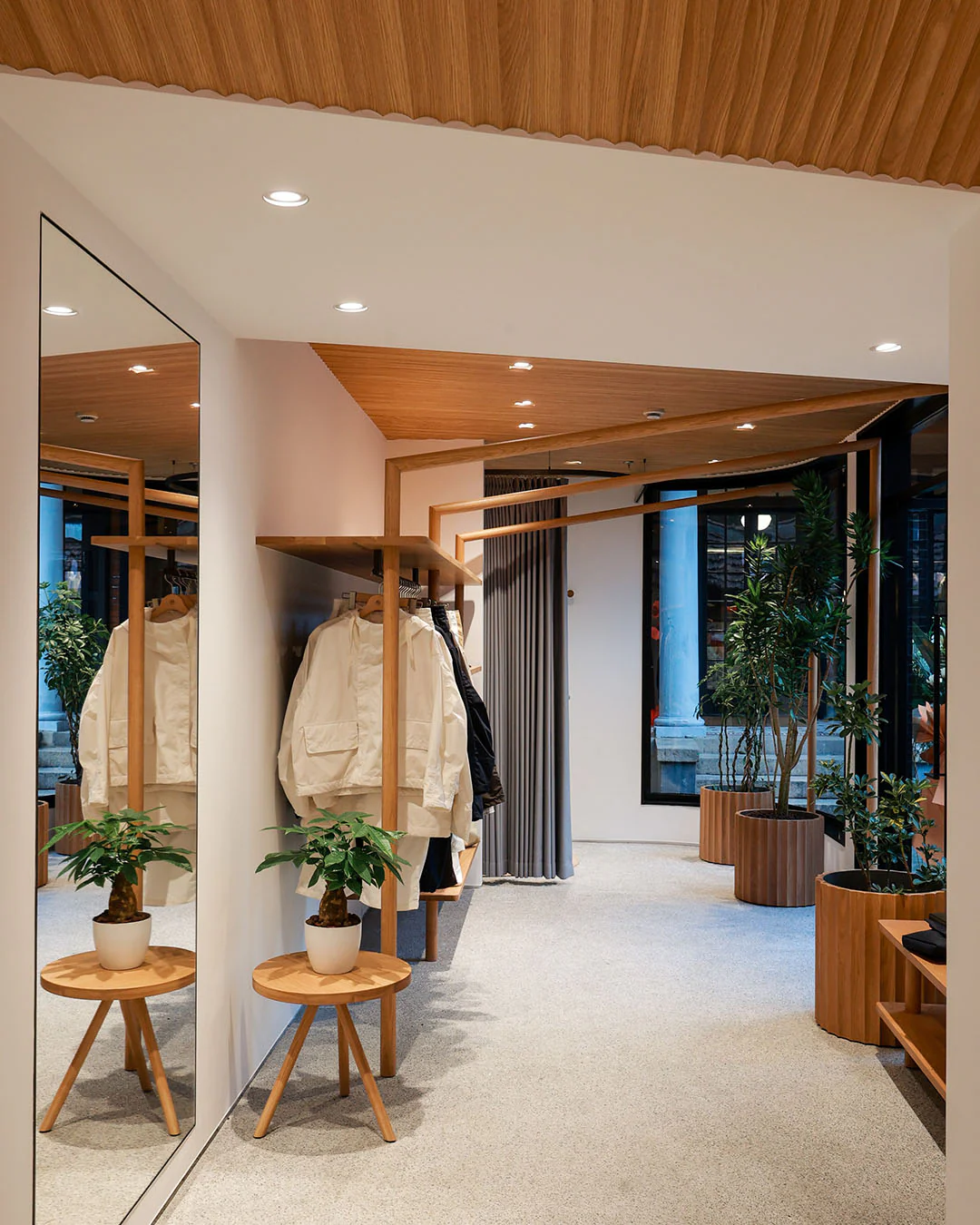
Surfaces are rendered in a controlled palette—muted woods, soft mineral tones, and a careful calibration of light that privileges shadow as much as illumination. The effect is not austerity for its own sake, but a kind of spatial clarity that allows garments to exist without competition.
This approach echoes the broader architectural logic associated with Japanese retail design, where the boundary between object and environment is intentionally softened. Fixtures do not dominate; they recede. Clothing is not framed as spectacle but as extension—of daily life, of climate, of movement.
In this sense, the store functions less as a container for product and more as a medium through which Nanamica’s material philosophy can be understood. The absence of visual noise is not minimalism as trend, but minimalism as method.
mat
Nanamica has long positioned itself at the intersection of technical performance and everyday wearability. Founded in 2003 by Eiichiro Homma, the brand’s guiding principle—“utility and sports”—has remained remarkably consistent, even as the global fashion landscape has shifted toward cycles of rapid novelty.
At Nanamica Wukang, this philosophy is not explained; it is embedded.
Garments are presented with an emphasis on their construction rather than their surface appeal. A GORE-TEX shell is not simply displayed as outerwear, but as a system—its seams, its layering logic, its adaptability to changing climates subtly foregrounded through how it is hung, spaced, and lit.
There is a quiet insistence on durability. Fabrics are chosen not for seasonal impact but for long-term performance. Cotton blends are engineered for breathability without sacrificing structure. Outerwear silhouettes are designed to accommodate layering across seasons rather than dictating a fixed use case.
This is where Nanamica diverges from many of its contemporaries. In an industry increasingly driven by narrative volatility—collaborations, limited drops, rapid trend cycles—the brand maintains a slower tempo. The Wukang store reinforces this position, offering a space where time feels extended rather than compressed.
shanghai
The city has, over the past decade, evolved into one of the most sophisticated fashion markets globally. Consumers here are not only receptive to international brands but are increasingly attuned to nuance—material quality, design lineage, and spatial experience. The success of a retail space in Shanghai is no longer determined solely by brand recognition, but by the coherence of its cultural proposition.
Wukang Road, in particular, has emerged as a micro-district where this proposition is tested. Unlike the high-density commercial zones of Nanjing Road or the hyper-curated luxury clusters of IFC Mall, Wukang offers a more granular form of engagement. Stores here are encountered rather than sought out. Their success depends on how naturally they integrate into the street’s existing cadence.
Nanamica’s entry into this environment suggests a confidence in its own vocabulary. Rather than adapting to local expectations through overt localization, the brand brings its existing language into dialogue with the city. The result is not a hybrid, but a conversation—between Japanese material discipline and Shanghai’s layered urban identity.
xp
The contemporary retail landscape has increasingly shifted toward experiential models. Flagship stores are designed as destinations, often incorporating elements of exhibition, hospitality, and digital interactivity. While Nanamica Wukang does engage with this paradigm, it does so on its own terms.
The experience here is not one of spectacle but of attention.
Movement through the space is deliberately unforced. Sightlines are open but not expansive, encouraging a slower pace of exploration. There are no overt focal points; instead, the store unfolds incrementally, allowing visitors to discover garments in relation to one another rather than in isolation.
This approach aligns with a broader shift within certain segments of the fashion industry—a move away from high-impact retail environments toward spaces that prioritize longevity and repeat engagement. In this context, Nanamica Wukang can be understood as a counterpoint to the more transient forms of retail experience that dominate contemporary urban centers.
sustain
Nanamica’s commitment to sustainability is not articulated through overt messaging within the Wukang store. There are no didactic displays, no explicit calls to action. Instead, sustainability is embedded within the brand’s operational logic.
The emphasis on durability, the avoidance of seasonal excess, and the prioritization of materials that age well all contribute to a model of consumption that resists disposability. In this sense, the store itself becomes a site of quiet resistance—offering an alternative to the accelerated cycles that define much of modern fashion.
This approach resonates particularly strongly within Shanghai, where conversations around sustainability are becoming increasingly central to consumer behavior. The city’s fashion audience is not only aware of environmental concerns but is beginning to demand more nuanced responses from brands.
Nanamica’s response is not to amplify its sustainability credentials, but to normalize them—to integrate them so seamlessly into its products and spaces that they become implicit rather than explicit.
evolve
The opening of Nanamica Wukang can also be read as part of a broader trajectory within the brand’s evolution. While its core philosophy has remained stable, its retail strategy has gradually expanded beyond Japan, positioning Nanamica within a global network of culturally specific yet philosophically consistent spaces.
Each store functions as a localized interpretation of a central idea. Tokyo locations emphasize precision and familiarity; international outposts, like Wukang, introduce a degree of contextual adaptation without compromising the brand’s identity.
This balance is not easily achieved. Many brands, in their expansion, dilute their core principles in favor of broader appeal. Nanamica’s approach suggests a different model—one in which consistency is maintained not through replication, but through disciplined variation.
contempo
In an era defined by visual saturation, restraint has become a form of distinction. Nanamica Wukang embodies this principle at every level—from its architectural language to its product presentation to its broader cultural positioning.
This is not restraint as absence, but restraint as precision. Every element within the store appears considered, calibrated, and intentional. Nothing is added for effect; nothing is removed for simplicity alone. The result is a space that feels complete without being overwhelming.
For a contemporary audience, particularly in a city like Shanghai where visual and commercial stimuli are abundant, this form of restraint offers a different kind of luxury—one that is defined not by excess, but by clarity.
fin
The opening of Nanamica Wukang signals more than a single retail expansion. It reflects a broader confidence in the brand’s ability to operate across cultural contexts without losing its identity.
As global fashion continues to navigate the tensions between speed and sustainability, spectacle and substance, Nanamica’s model offers a compelling alternative. It suggests that growth does not require amplification, that relevance can be achieved through consistency, and that retail spaces can function as sites of reflection rather than distraction.
In Shanghai, a city that thrives on movement and transformation, Nanamica has chosen to slow the tempo. The Wukang store does not seek to redefine the urban landscape, but to exist within it—quietly, precisely, and with a clear sense of purpose.
In doing so, it establishes a presence that is likely to endure not because it demands attention, but because it rewards it.