New Beverly Cinema and the Return of the Eros: Quentin Tarantino’s Adults-Only Repertory Experiment

March 3, 2026
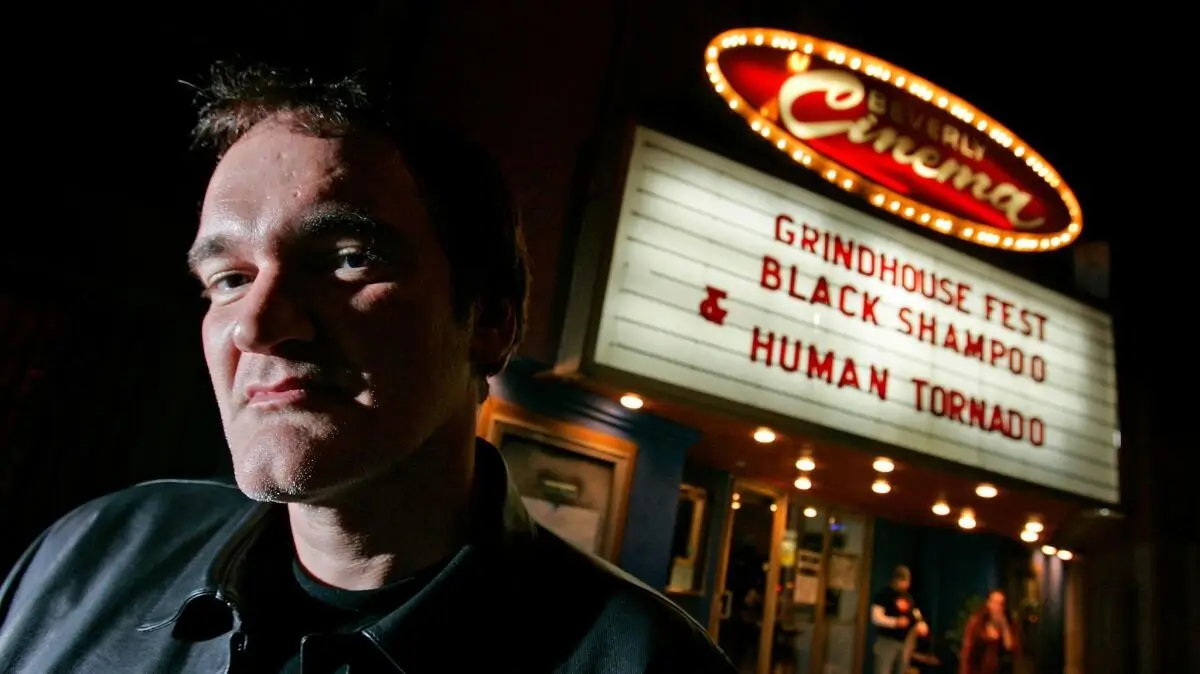
There are few filmmakers alive who treat cinema not merely as an art form but as a living organism. Quentin Tarantinohas long positioned himself as both archivist and evangelist, someone who understands that film history is not confined to museum vitrines or streaming menus but flickers through projectors in dark rooms. Last month, he staged one of his most audacious curatorial gestures yet: transforming the New Beverly Cinema back into the Eros, the adult movie house it operated as for seven years in the 1970s.
The gesture was not ironic. Nor was it purely nostalgic. It was historiographic.
For a month, the New Beverly’s façade and programming echoed its former life as the Eros Theatre, screening a heady mix of porno classics like Deep Throat, exploitation oddities, European imports, and boundary-pushing curios such as The Fireworks Woman directed by Wes Craven. If the experiment felt like a provocation, it was also a reclamation. The adult cinema era, long relegated to the footnotes of film history, was briefly restored to marquee prominence.
Now, in March, Tarantino is doubling down with another month of adults-only entertainment. The question is not merely why, but what it means.
stir
To understand the magnitude of the gesture, one must revisit the New Beverly’s own layered past. Before it became a revival house under the stewardship of film lover Sherman Torgan, the building functioned as the Eros Theatre—a grindhouse-adjacent adult cinema during a decade when pornography flirted with mainstream visibility.
The 1970s were the so-called “Golden Age of Porn,” a period when adult films briefly enjoyed critical attention, theatrical runs, and even celebrity viewership. Deep Throat became a cultural lightning rod. Behind the Green Door and The Devil in Miss Jones were discussed as if they were art-house provocations rather than clandestine indulgences. In that cultural climate, the Eros was not an anomaly—it was part of a thriving ecosystem of adult exhibition.
When Torgan took over and rebranded the venue as the New Beverly Cinema, it shifted toward repertory programming: double features, 35mm prints, midnight screenings of cult classics. Respectability, in this context, meant cinephilia. It meant film culture with a capital F.
Tarantino, who purchased the theater in 2007 to preserve its 35mm projection and repertory spirit, has always understood that “respectability” is a relative term. His own films—steeped in grindhouse, exploitation, and pulp—testify to that lineage.
By resurrecting the Eros identity, he collapses the hierarchy between art cinema and adult cinema. He suggests that both belong in the same historical frame.
flow
The programming choices during the first Eros revival month were telling. Yes, there were canonical porno titles. But there were also films like The Fireworks Woman, directed by a young Wes Craven before he became synonymous with horror landmarks like A Nightmare on Elm Street.
By including Craven’s adult feature, Tarantino reframed pornographic cinema as a training ground for future auteurs. The adult industry in the 1970s was not isolated from mainstream film culture; it was porous. Directors moved between genres. Craft techniques—lighting, editing, narrative experimentation—cross-pollinated.
Tarantino’s curatorial logic mirrors his filmmaking ethos. In works like Pulp Fiction or Once Upon a Time in Hollywood, he gleefully elevates B-movie textures into high art. The Eros revival does something similar in exhibition form. It insists that pornography and exploitation are not detours in cinema history but integral threads.
This is not to romanticize the adult industry’s exploitative aspects. Rather, it is to historicize them. To screen these films in 2026 Los Angeles, in a curated, contextualized environment, is to invite analysis rather than titillation alone.
stream
There is also something defiant about staging adults-only theatrical programming in the streaming era. Today, explicit material is ubiquitous online. Pornography has migrated from theaters to private screens, from collective spaces to algorithmic feeds.
By contrast, the New Beverly’s Eros month reasserts the communal dimension of adult viewing. It restores the awkwardness, the charged atmosphere, the shared gasp. In doing so, it complicates the assumption that adult content is purely solitary consumption.
Tarantino’s insistence on 35mm projection heightens this defiance. These films are not digitized clips but celluloid artifacts. They carry scratches, grain, physical history. Watching Deep Throat in a theater with an audience is radically different from streaming it in anonymity.
The adults-only framing also functions as a reminder that cinema once demarcated age boundaries more visibly. The signage, the ticket booth warnings, the ritual of entry—all become part of the performance.
show
Beyond American porno classics, the programming reportedly included European erotica and exploitation imports. This aligns with Tarantino’s long-standing fascination with transnational genre cinema—Italian giallo, French policiers, Japanese samurai epics.
In the 1970s, adult theaters often screened a mélange of hardcore features, softcore European art erotica, and low-budget exploitation thrillers. The lines between categories blurred. An evening at the Eros might oscillate between explicit sex and lurid violence.
Such eclecticism is central to Tarantino’s own cinematic DNA. Consider how Kill Bill: Volume 1 channels Japanese chanbara while Inglourious Basterds riffs on European war exploitation. His repertory programming becomes an extension of his filmography: a curated map of influences.
By reviving the Eros model, he acknowledges that the grindhouse and the art house once shared real estate. The same neighborhoods hosted Bergman retrospectives and sexploitation double bills. Film culture was less siloed.
revive
Inevitably, the experiment raises ethical questions. What does it mean to celebrate films that may reflect dated attitudes toward gender, consent, and representation? Can historical appreciation coexist with critical awareness?
Tarantino’s answer appears to lie in context. The New Beverly does not present these screenings as unexamined nostalgia. They are framed as historical artifacts. The adults-only label signals that viewers are entering a specific archive, one that demands maturity and discernment.
Moreover, the revival underscores how far exhibition norms have shifted. In the 1970s, adult theaters dotted urban landscapes. By the 1990s, many had shuttered, casualties of zoning laws, home video, and changing mores. The New Beverly’s temporary return to the Eros is thus less about eroticism per se and more about architectural memory.
It asks: What stories do buildings hold? What eras have they survived?
march
That Tarantino is extending the experiment into March suggests more than novelty. It indicates audience appetite. The first month was not a curiosity but a draw.
In doubling down, Tarantino positions the New Beverly as a site of cinematic archaeology. Each themed month becomes a chapter in the theater’s autobiography. One month might celebrate noir. Another might foreground 1970s kung fu. The Eros revival becomes part of that rotating canon.
The move also reinforces Tarantino’s broader mission: to protect theatrical exhibition from homogenization. In an industry dominated by franchise tentpoles and IP recycling, the New Beverly stands as a stubborn outpost of idiosyncratic programming.
Adults-only repertory may seem niche. But niche is precisely the point.
idea
There is something refreshingly unapologetic about the gesture. Tarantino does not sanitize the New Beverly’s past. He foregrounds it. He acknowledges that cinema history includes the disreputable alongside the revered.
In doing so, he aligns with a strain of film criticism that refuses to rank genres by moral prestige. Horror, exploitation, pornography, melodrama—they are all part of the same medium’s evolution.
The Eros revival also resonates with Tarantino’s oft-stated belief that cinema is best experienced in a theater. The adults-only month becomes a litmus test: can audiences still gather for challenging, controversial material? The answer, apparently, is yes.
fin
Ultimately, the New Beverly’s temporary transformation into the Eros is less about shock value and more about stewardship. Tarantino treats the theater as a living archive. Instead of preserving it in amber, he activates its history.
The adults-only month reminds us that film culture was once messier, more tactile, more communal. It invites contemporary viewers to confront that past—not through sanitized retrospectives but through the films themselves.
In March, as the marquee once again signals adults-only fare, the New Beverly becomes a time machine. It bridges decades, collapses hierarchies, and reasserts that cinema’s margins are as instructive as its masterpieces.
For Tarantino, this is not a stunt. It is an argument.
An argument that film history is indivisible. That porno classics and auteur breakthroughs can share a screen. That a theater’s sordid chapter deserves as much attention as its respectable one.
And above all, that in a culture increasingly mediated by personal screens, there is still power in sitting together in the dark—no matter what flickers on the projector beam.



No comments yet.