Nick’s Joke Tattoo Painting — Eddie Love’s Tattoo Lang on Canvas

April 5, 2026
3 hours ago
unresolve
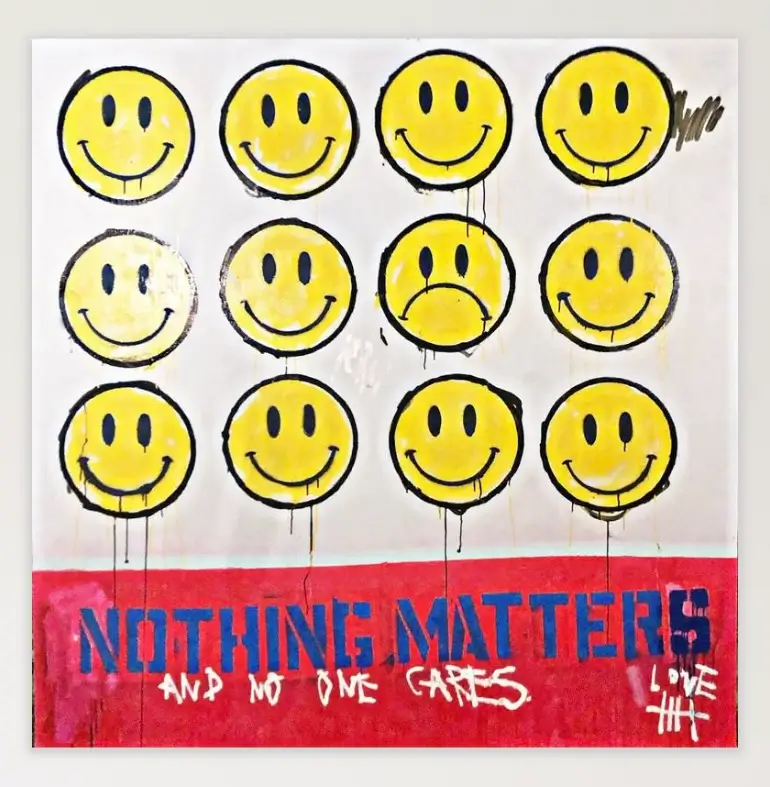
There is an immediate readability to Nick’s Joke Tattoo Painting, but that clarity doesn’t convert into potential acceptance. Eddie Love constructs an image that feels legible at first glance—bold lines, familiar symbols, direct compositions—yet the meaning resists landing. The “joke” implied in the title never quite arrives. It hovers instead, suspended between recognition and misdirection.
This is where the work begins to operate. Not in what it shows, but in what it withholds. The painting behaves like a punchline told out of sequence—something is off, but not enough to dismiss. The viewer lingers, trying to decode a structure that refuses to stabilize.
idea
The view vocabulary is unmistakably drawn from tattoo culture. Thick outlines, simplified forms, emblematic motifs—each element recalls the logic of flash sheets designed for immediacy and permanence. But here, that language is removed from its original function.
On skin, a tattoo is lived with. It moves, stretches, ages. On canvas, it becomes fixed, detached from the body it was meant to inhabit. Love exploits this displacement. The imagery still carries the memory of skin, but the absence of a body creates a quiet tension.
This shift alters how we read the symbols. Without a wearer, there is no biography to anchor them. The motifs become free-floating—suggestive, but unclaimed. The painting doesn’t narrate; it presents fragments that hint at narrative without committing to one.
show
The material choice reinforces this immediacy. Acrylic allows for fast, decisive application. There is little room for hesitation, and that urgency remains in view upon the surface.
Colors sit flat, often unblended. Lines assert themselves without refinement. The painting doesn’t attempt illusion; it leans into its own constructedness. This aligns with tattoo aesthetics, where clarity outweighs nuance. But Love pushes that clarity into ambiguity—forms are crisp, meanings are not.
The result is a surface that feels both controlled and raw. Each mark is intentional, yet the overall composition resists closure. Acrylic becomes less about finish and more about attitude: direct, unpolished, unwilling to over-explain.
afar
The title suggests humor, but the painting withholds the satisfaction typically associated with it. There is no clear punchline, no shared moment of recognition. Instead, the humor feels private—coded, possibly even inaccessible.
“Nick’s Joke” implies an inside reference. Someone, somewhere, understands it fully. The viewer does not. This creates a subtle form of distance. The painting acknowledges humor while denying participation.
That denial becomes the point. Rather than inviting laughter, the work stages the condition of not getting the joke. It turns humor into a structure of exclusion, where meaning exists but remains just out of reach.
away
Even without depicting it, the body is central. Tattoo imagery cannot fully detach from its origin. Every line suggests placement—an arm, a chest, a shoulder. The composition often feels arranged as if it once belonged somewhere physical.
But that body is missing. The canvas holds only the residue of its possibility. This absence creates a strange intimacy. The viewer senses proximity to something personal, yet cannot access it.
The question of “who” lingers. Who is Nick? Why these symbols? What is the joke? The painting offers no answers, only the structure of those questions. It becomes less about identity and more about the impossibility of fully retrieving it.
gullible
There is a deliberate simplicity in the forms—almost naive in appearance. Lines wobble slightly. Shapes feel direct, unembellished. But this is not a lack of skill; it is a choice.
Love adopts a visual language associated with informality—tattoo flash, doodles, street graphics—and places it within the context of painting. This move destabilizes expectations. The work refuses to perform traditional markers of refinement, instead prioritizing immediacy and clarity.
This constructed naivety becomes a strategy. It lowers the barrier to entry visually, while complicating interpretation conceptually. The viewer recognizes the forms, but cannot fully resolve them.
fracture
The painting rarely resolves into a single unified image. Instead, it operates through accumulation—multiple elements coexisting without a fixed hierarchy. Symbols sit alongside each other, connected loosely rather than structurally.
This fragmentation mirrors the logic of memory or inside jokes—pieces that make sense within a specific context, but appear disjointed outside of it. The viewer is left assembling meaning from these fragments, aware that something is missing.
There is no central narrative, only the suggestion of one. The painting becomes a field of potential connections, none of which are confirmed.
pre
Tattoo imagery carries a history of subcultural significance—markers of identity, affiliation, experience. In recent years, that imagery has moved into broader visual culture, becoming aesthetic rather than strictly personal.
Love’s work reflects this shift. By translating tattoo language onto canvas, he exposes its movement from body to surface, from lived experience to visual commodity. The symbols remain potent, but their context has changed.
This raises quiet questions about ownership and meaning. When a tattoo becomes an image detached from a body, what remains of its significance? The painting does not answer—it simply holds that tension in place.
base
The title frames the work without resolving it. “Nick’s Joke Tattoo Painting” suggests specificity, but delivers ambiguity. It points toward a narrative that never fully appears.
This misalignment is intentional. The title acts as a partial key—enough to open the door, not enough to enter. It reinforces the painting’s central dynamic: access without comprehension.
By naming the work in this way, Love introduces a personal dimension that remains inaccessible. The viewer is aware of it, but cannot participate. The painting becomes a closed loop, visible but not fully legible.
fin
What holds in Nick’s Joke Tattoo Painting is not clarity, but persistence. The work doesn’t resolve; it stays. It operates through delay, through the gap between seeing and as an accept.
Love constructs a surface that feels immediate yet resists completion. The viewer is left in a state of suspended interpretation, returning to the image not to solve it, but to remain with it.
The joke, if it exists, is not delivered. It is sustained.