Niki Hare’s “I Do Believe”

September 13, 2024
2 years ago
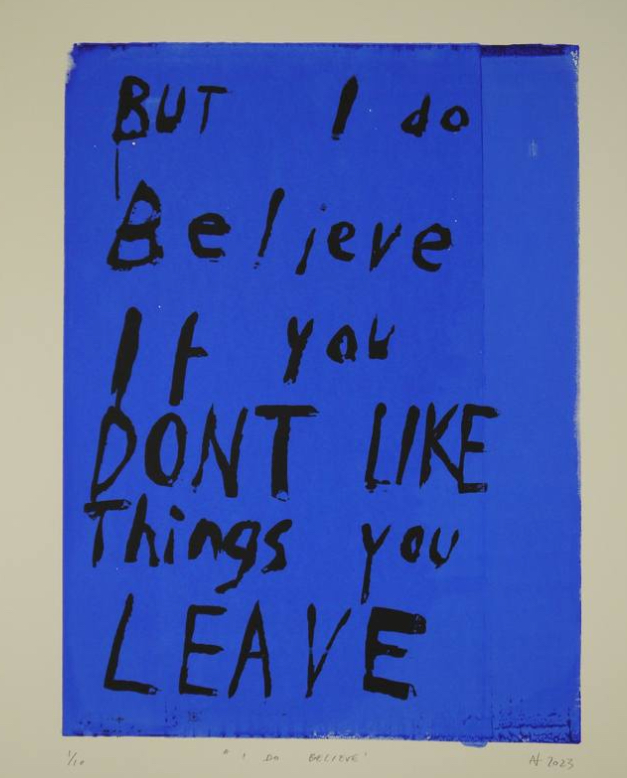
Niki Hare’s “I Do Believe” is a work that encapsulates the layered complexities of human existence, belief systems, and perception. As a self-taught artist based in the UK, Hare’s abstract and non-figurative works delve deeply into the ambiguous and often contradictory nature of thought, emotion, and existence itself. This screenprint on paper, measuring 27.6×19.7 inches, stands as a bold and introspective piece that challenges both the viewer’s eye and mind.
In many ways, “I Do Believe” embodies the essence of Hare’s broader oeuvre, which often explores the fragility and uncertainty of life through layered colors, fragmented text, and non-traditional forms. The absence of clear figurative representation is, in itself, a powerful statement about the limitations of concrete visual language to communicate complex internal states. Through its abstract elements, the artwork opens up an intimate dialogue between artist and viewer, suggesting that belief—both personal and collective—is something transient, mutable, and deeply subjective.
Aesthetic and Formal Analysis
At first glance, “I Do Believe” strikes the viewer with its bold composition and use of vibrant color. The surface is covered in sweeping brushstrokes, layered in a manner that creates both depth and motion, almost as though the painting is in a constant state of flux. The abstract, gestural quality of the brushwork suggests a spontaneity that feels raw and unfiltered. Colors overlap, creating an interplay between light and dark, as though each layer is actively responding to the one beneath it.
In this visual conversation, Hare makes use of text, albeit fragmented and partially obscured. Words are recognizable but incomplete, forcing the viewer to work toward deciphering them, but ultimately preventing full comprehension. This deliberate obscuring of language is central to the piece’s power, echoing the broader theme of elusive truths. The incomplete words and phrases suggest a belief system that is itself incomplete or perpetually in flux. The title, “I Do Believe”, thus becomes a question rather than a statement of certainty, prompting reflection on what we claim to believe, and why.
The composition is a study in controlled chaos. While Hare’s brushstrokes and layered forms might at first appear random, there is a clear sense of balance and intentionality. The tension between the chaotic surface and the underlying structure mirrors the tension between belief and doubt. It is as though the artwork is grappling with itself, trying to make sense of competing emotions and ideas, just as we often do when confronting our personal beliefs.
The piece’s color palette is both vivid and subtle, ranging from cool blues and greys to bursts of warmer tones like reds and yellows. This interplay of warm and cool creates a push-pull dynamic that draws the viewer’s eye across the surface, never allowing it to settle on one particular point. In this way, the work mimics the act of belief: it is not something fixed, but something that evolves, shifts, and changes depending on where we place our focus.
Thematic Interpretation
Thematically, “I Do Believe” taps into some of the most fundamental questions of human existence: What do we believe? How do we form those beliefs? And how do those beliefs evolve over time?
The fragmented text within the artwork points toward the difficulty of articulating belief. It’s as if Hare is suggesting that language itself is inadequate when it comes to describing something as complex as belief, which is inherently personal and often contradictory. By presenting words that are only partially visible or legible, she reinforces the idea that our beliefs are not static truths but are, in fact, mutable and prone to change. We may not always have the words to describe what we believe, or our beliefs may not always align with the reality we perceive.
In a broader sense, *“I Do Believe”* can be read as a commentary on the fragility of belief systems, particularly in contemporary society, where we are bombarded with conflicting information and ideologies. The artwork seems to reflect the fragmented nature of modern existence, where certainty is increasingly hard to come by. In this context, the phrase “I do believe” becomes a kind of mantra, not of absolute truth but of tentative affirmation—a reminder that belief is always a process, a continual act of negotiation between what we know, what we feel, and what we experience.
Personal and Emotional Resonance
While Hare’s work is abstract, there is an undeniably emotional quality to “I Do Believe.” The gestural brushstrokes and layering of colors suggest a sense of urgency, as if the artist is trying to capture a fleeting thought or feeling before it slips away. The incomplete text, too, conveys a sense of frustration or longing—an attempt to communicate something deeply personal, but which ultimately remains just out of reach.
For the viewer, this creates an emotional resonance that is both universal and deeply individual. Each person brings their own beliefs, experiences, and perceptions to the artwork, and as such, each viewer will interpret it in a slightly different way. The open-endedness of the piece invites contemplation and introspection, encouraging the viewer to engage with their own beliefs, doubts, and uncertainties.
Impression
Niki Hare’s “I Do Believe” fits within a broader tradition of abstract and conceptual art that seeks to explore themes of existence, identity, and perception. Artists like Cy Twombly, Mark Rothko, and Jasper Johns come to mind, all of whom used abstraction to probe the boundaries of language, emotion, and belief.
Like Twombly, Hare uses text as a visual element, though in a more fragmented and abstracted form. The interplay between text and image in Hare’s work reflects a similar interest in the limits of language to capture the full spectrum of human experience. Rothko’s use of color to evoke deep emotional states also finds a parallel in Hare’s work, particularly in the way that her layers of color create a sense of depth and complexity.
However, Hare’s work is uniquely her own, characterized by its raw energy, emotional depth, and philosophical introspection. While she draws on the language of abstract expressionism and conceptual art, she brings a distinctly personal voice to her work, one that is deeply concerned with the complexities of human belief and perception.
Niki Hare’s “I Do Believe” is a work that resonates on multiple levels—intellectually, emotionally, and visually. Through its abstract forms, fragmented text, and layered colors, the artwork invites the viewer to engage with their own beliefs and perceptions, while also reflecting on the inherent uncertainty of existence. In this way, the piece stands as a powerful exploration of what it means to believe, to question, and to seek meaning in an increasingly fragmented world.
Ultimately, “I Do Believe” is not just a statement of faith, but a meditation on the process of believing itself—a process that is, like the artwork, always in motion, always evolving, and never fully complete.