Pablo Picasso’s Auto Doodle (1950)

September 14, 2024
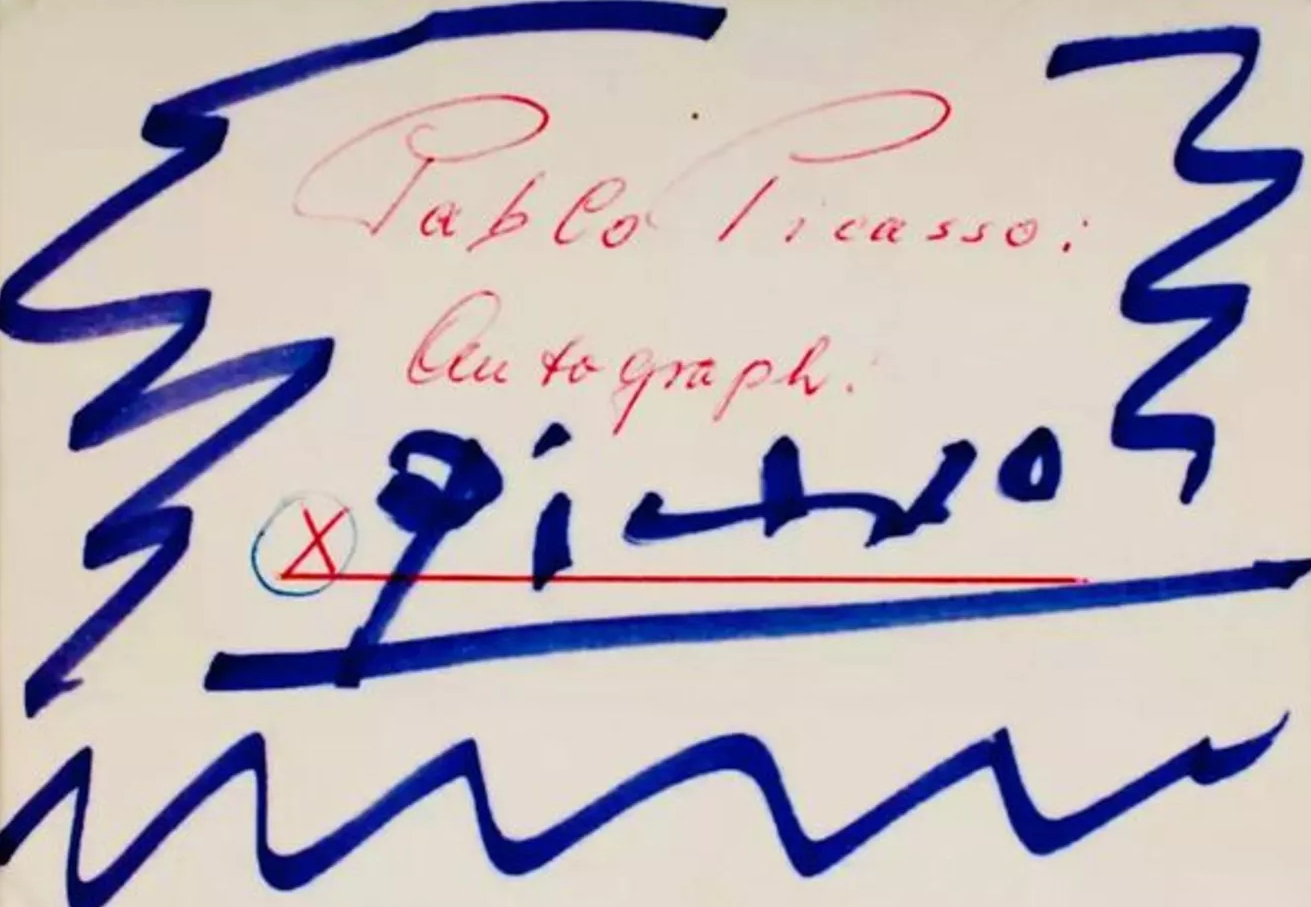
Pablo Picasso, one of the most celebrated and revolutionary artists of the 20th century, was known for his ability to transform and challenge artistic conventions throughout his prolific career. The period following the Second World War marked an intriguing phase in his oeuvre, where he ventured deeper into abstraction, spontaneity, and symbolism. One lesser-known yet deeply significant piece from this period is the 1950 “Auto Doodle,” a work that distills Picasso’s genius into a seemingly playful and simplistic form. On the surface, the “Auto Doodle” might appear to be an informal sketch, but beneath its apparent simplicity lies an exploration of form, spontaneity, and human expression. This critique aims to deconstruct the complexities of this piece and place it within the broader context of Picasso’s work and the art world at large.
Picasso in the Post-War Era
By 1950, Picasso had already established himself as a pioneer of modern art. The creator of Cubism, a movement that forever altered the way form and perspective were perceived in art, Picasso had also delved into Surrealism and Neoclassicism, among other styles. The years following World War II were a time of both reflection and experimentation for the artist. Picasso was not merely an observer of the world around him; he was deeply engaged with the political and social climate, and his art during this period reflected his thoughts on war, peace, and humanity’s place within a fractured world.
The 1950 “Auto Doodle” was created during a time when Picasso had already reached the pinnacle of his fame. His output, however, remained as prolific as ever. Picasso often worked on multiple projects simultaneously, sometimes producing highly finished works, while at other times creating spontaneous sketches and studies that explored new ideas. The “Auto Doodle” falls into the latter category, yet it should not be dismissed as an insignificant or casual endeavor. Picasso’s doodles and sketches were often a testing ground for new concepts, and they provide invaluable insight into his creative process.
Spontaneity and Automatism in “Auto Doodle”
At its core, the “Auto Doodle” reflects a deep engagement with the principles of automatism, a technique that Picasso experimented with throughout his career, particularly in the later stages. Automatism, most commonly associated with the Surrealist movement, involves the process of creating art without conscious control. The artist allows the hand to move freely across the page, guided by the subconscious mind rather than by deliberate planning. This process was meant to reveal hidden emotions, thoughts, or ideas that might not surface through more deliberate methods of creation.
In the case of the “Auto Doodle,” the title itself suggests the automatic, unconscious nature of its creation. It is a drawing made quickly, seemingly without forethought or planning. The rapid, flowing lines, characteristic of Picasso’s later work, indicate a sense of immediacy and spontaneity. Yet, despite the apparent simplicity and lack of structure, there is a palpable energy in the work, a sense that something meaningful is being conveyed through the seemingly chaotic lines.
The “Auto Doodle” exemplifies Picasso’s ability to capture the essence of a subject with a few deft strokes. This economy of line, which became more pronounced in his later years, was a skill that Picasso honed throughout his career. His ability to convey so much with so little is what sets him apart as a master of form and expression. In this doodle, the fluidity and motion of the lines seem to suggest a figure, though the identity and nature of that figure remain deliberately ambiguous. It is through this ambiguity that the viewer is invited to engage with the work on a deeper level, to interpret and project their own meanings onto the abstract form.
The Line as a Vehicle of Expression
One of the most striking aspects of the “Auto Doodle” is the way in which Picasso uses line as a primary vehicle for expression. There is no shading, no attempt at realism, and no use of color—just the purity of the line itself. This approach is reminiscent of Picasso’s earlier experiments with Cubism, where he deconstructed form into its most basic geometric elements. However, in the “Auto Doodle,” the deconstruction goes even further. The lines are no longer concerned with representing objects or figures in a traditional sense; rather, they are an expression of movement and emotion.
In many ways, the “Auto Doodle” can be seen as a precursor to the work of later Abstract Expressionists, such as Jackson Pollock and Franz Kline, who also used spontaneous, gestural lines to convey raw emotion. While Picasso did not identify with the Abstract Expressionist movement, his work during this period shares some of the same concerns, particularly the focus on the physical act of creation as a form of expression.
The line in the “Auto Doodle” is not merely a tool for creating form; it becomes the form itself. The viewer is invited to follow the path of Picasso’s hand as it moves across the page, to experience the act of creation as an ongoing, dynamic process. There is a sense of rhythm in the drawing, as if the lines are tracing a dance across the paper. This emphasis on movement is a hallmark of Picasso’s later work, where he sought to capture the essence of life itself in his art.
The Figure in Abstraction
While the “Auto Doodle” appears highly abstract, there is a suggestion of a figure within the chaotic lines. Picasso was always deeply concerned with the human form, and even in his most abstract works, the figure often remains a central element. In the case of the “Auto Doodle,” the figure is fragmented and obscured, yet there are hints of a face, limbs, or body parts within the swirling lines.
This abstraction of the figure can be seen as part of Picasso’s ongoing exploration of the relationship between form and identity. Throughout his career, Picasso was fascinated by the way in which the human body could be deconstructed and reassembled, both physically and metaphorically. In the “Auto Doodle,” the figure is reduced to its most basic elements, yet it remains present, a ghostly reminder of the human subject that lies at the heart of much of Picasso’s work.
The fragmentation of the figure in the “Auto Doodle” also reflects Picasso’s broader concerns with identity and self-expression. By breaking down the figure into abstract forms, Picasso challenges the viewer’s preconceived notions of what a person should look like, and in doing so, he invites us to reconsider the nature of identity itself. The “Auto Doodle” becomes a meditation on the fluidity of the self, on the ways in which identity can be both constructed and deconstructed through the act of creation.
A Reflection of Picasso’s Broader Themes
Although the “Auto Doodle” might seem like a simple, spontaneous drawing, it is deeply connected to the broader themes that run throughout Picasso’s body of work. One of these themes is the tension between tradition and innovation. Picasso was always deeply aware of the artistic traditions that came before him, yet he constantly sought to challenge and subvert them. The “Auto Doodle” can be seen as a rejection of traditional notions of draftsmanship and composition, a move towards a more liberated, expressive form of art-making.
Another key theme in Picasso’s work is the idea of the artist as a creator of worlds. Throughout his career, Picasso experimented with different styles and techniques, constantly reinventing himself and his art. The “Auto Doodle” is a testament to this restless creativity, a reminder that Picasso was always searching for new ways to express his ideas and emotions. The spontaneous nature of the “Auto Doodle” suggests that Picasso was less concerned with creating a finished product and more interested in the act of creation itself. The drawing becomes a record of this process, a snapshot of the artist’s thoughts and emotions at a particular moment in time.
Impression
While the “Auto Doodle” may not be one of Picasso’s most famous works, it holds a significant place within his broader legacy. This piece highlights his mastery of line and form, his engagement with the subconscious, and his continued exploration of abstraction and the human figure. Moreover, the “Auto Doodle” demonstrates Picasso’s ability to blend spontaneity with technical precision, creating a work that is both playful and profound.
The influence of the “Auto Doodle” can also be seen in the work of subsequent generations of artists. The emphasis on gesture, spontaneity, and abstraction in this piece foreshadows many of the developments that would occur in modern and contemporary art, particularly within movements like Abstract Expressionism and Action Painting.
A Masterpiece in Simplicity
Pablo Picasso’s “Auto Doodle” may appear simple at first glance, but upon closer inspection, it reveals itself as a complex and deeply expressive work of art. The spontaneity of the drawing, combined with its abstracted form, invites the viewer to engage with it on multiple levels, both as an exploration of the subconscious and as a reflection of broader themes in Picasso’s work.
The “Auto Doodle” serves as a reminder of Picasso’s genius and his ability to distill complex ideas into simple, yet powerful forms. It stands as a testament to the artist’s restless creativity, his willingness to experiment, and his enduring influence on the world of art. Whether viewed as a study in abstraction, a reflection on the nature of identity, or simply as a spontaneous moment of artistic expression, the “Auto Doodle” is a masterpiece in its own right.