Paramount’s G.I. Joe Reboot: Max Landis Writing Treatment

March 2, 2026
flow
In today’s franchise economy, development itself has become content. Announcements of “treatments,” “early drafts,” and “deep development” circulate like trailers for films that may never exist. The news that Paramount Pictures is entertaining separate G.I. Joe treatments from Max Landis and Danny McBride belongs squarely to that phenomenon. According to industry reporting, both projects are in deep development and may never see the light of day.
That caveat is not incidental. It is the defining feature of modern studio logic. Intellectual property is no longer simply adapted; it is continuously tested, recalibrated, and ideologically stress-tested long before production begins. Paramount’s exploration of multiple creative directions for G.I. Joe signals less about immediate greenlights and more about a studio searching for tonal equilibrium in a franchise that has historically struggled to define itself.
The real question is not whether either treatment will move forward. It is what their very existence reveals about risk, reputation, and the state of legacy IP in 2026.
g.i. joe
G.I. Joe has always been a shape-shifter. Launched by Hasbro in 1964 as a military action figure aimed at boys, it evolved into the neon-infused, morally binary cartoon saga of the 1980s. “Knowing is half the battle,” the series famously insisted—a line that condensed Cold War-era clarity into a toy commercial’s closing mantra.
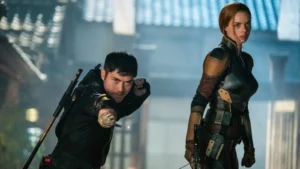
Yet that clarity has proven elusive on film. Paramount’s previous installments—G.I. Joe: The Rise of Cobra (2009) and G.I. Joe: Retaliation (2013)—oscillated between camp extravagance and militarized seriousness. Their box office performance was respectable but not transformative. The 2021 spin-off Snake Eyes attempted a grounded, character-focused pivot but underperformed critically and commercially.
The franchise’s cinematic difficulty stems from a structural contradiction. G.I. Joe is at once a toy-driven fantasy and a quasi-military myth. Its villains are operatic caricatures; its heroes are patriotic archetypes. Translating that aesthetic into a contemporary action landscape—now dominated by self-aware superhero sagas and morally ambiguous espionage thrillers—requires tonal precision the brand has yet to find.
That Paramount is considering multiple treatments suggests the studio understands this instability. The franchise’s next move must reconcile nostalgia with modern sensibilities, spectacle with coherence, irony with sincerity.

max landis
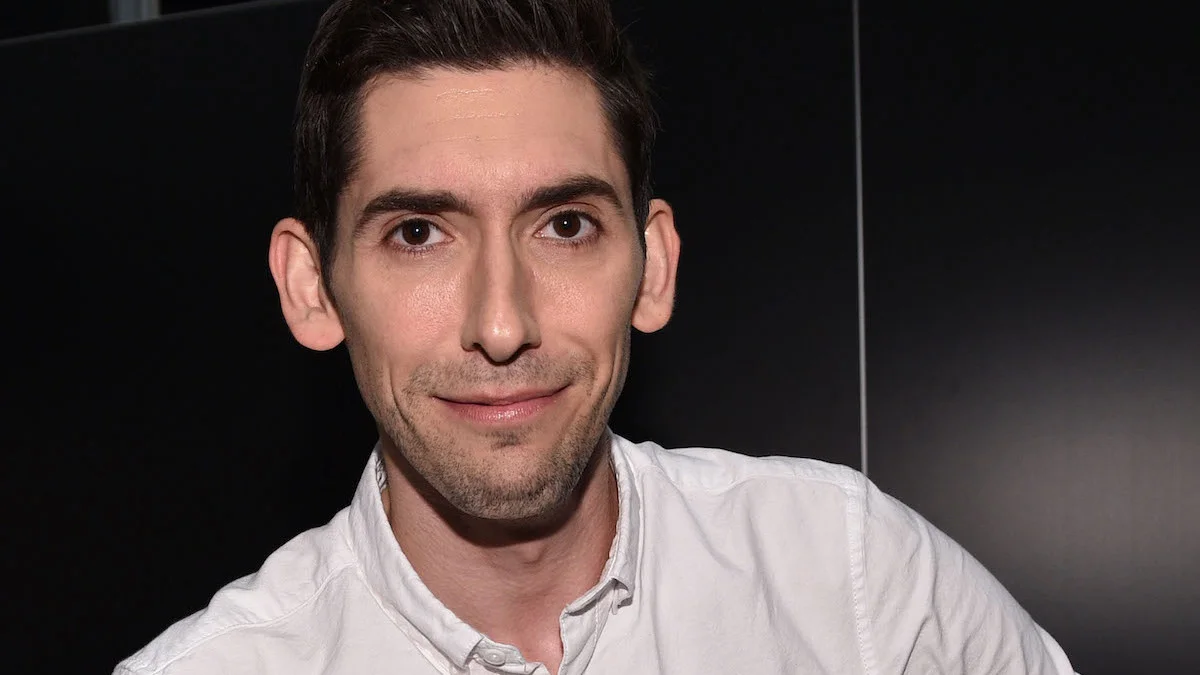
The involvement of Max Landis complicates the equation. Once regarded as a promising genre screenwriter, Landis’s career was upended amid allegations of sexual and emotional abuse during the #MeToo movement. He denied wrongdoing, but the public accusations reshaped his professional trajectory.
In Hollywood, reputation operates as currency. The #MeToo reckoning recalibrated which names could be attached to high-profile projects without reputational risk. A studio commissioning a treatment from Landis is therefore not merely evaluating creative ideas; it is engaging in a delicate calculation about optics, backlash, and potential cultural fallout.
This is not simply about personal controversy. It raises broader questions about authorship and accountability in franchise filmmaking. Does a brand as commercially oriented as G.I. Joe insulate itself from the reputational histories of its creators? Or does a family-adjacent, toy-based property amplify scrutiny?
Hollywood has offered no consistent answer to the art-versus-artist debate. Some creators quietly reemerge; others remain sidelined. The calculus often hinges less on ethical clarity than on perceived profitability and public attention cycles. In Landis’s case, the notion of him developing a mass-market franchise property suggests the industry’s memory is shorter—or at least more negotiable—than public discourse sometimes assumes.
Yet the key phrase remains “treatment.” Commissioning a treatment is a low-commitment maneuver. It allows a studio to evaluate voice and direction without attaching itself irrevocably to the writer. In this sense, Paramount’s reported engagement may reflect strategic ambiguity rather than endorsement.
mcbride
If Landis represents one possible direction, Danny McBride embodies another. Known for his abrasive comedic personas and sharp genre deconstruction, McBride has built a creative brand around irreverence. His work often oscillates between satire and sincerity, skewering machismo while reveling in its absurdity.
A McBride G.I. Joe could theoretically lean into the property’s inherent camp. The Cobra organization, with its theatrical villainy and baroque uniforms, already borders on parody. McBride’s sensibility might foreground that absurdity, reframing the franchise as knowingly exaggerated rather than inadvertently so.
But such a tonal pivot carries its own risk. Studios often seek to broaden audience appeal by injecting humor into legacy properties, yet excessive self-awareness can erode stakes. The Marvel formula normalized quippy deconstruction; audiences now expect a delicate balance between irony and emotional investment.
If McBride’s treatment exists as a counterpoint to Landis’s, Paramount may be staging an internal tonal referendum: earnest military spectacle versus satirical reframing. The fact that both ideas are reportedly in deep development suggests the studio itself remains undecided about what G.I. Joe should be.
stir
The phrase “deep development” has become a staple of industry reporting. It implies progress without commitment. In reality, studios commission multiple treatments for high-profile IP precisely to avoid premature decisions.
Development functions as research and development in corporate terms. Writers are hired to explore thematic angles, character arcs, and structural overhauls. Executives evaluate which version aligns with budget projections, merchandising potential, and global market appeal. Many treatments are shelved; few advance to production.
Public awareness of this process creates a paradox. Announcements generate anticipation while simultaneously acknowledging uncertainty. The result is a culture of perpetual pre-release discourse. Franchises exist in headlines long before they exist on screen.
For G.I. Joe, this extended gestation may reflect caution. The action genre is crowded; audience appetite for military-adjacent spectacle has fluctuated. Paramount cannot afford another underperforming reboot. Development becomes a hedge against miscalculation.
fwd
Paramount’s strategic posture must also be understood within the broader franchise economy. Studios now depend heavily on recognizable IP to mitigate financial risk. Original properties struggle to secure theatrical budgets; legacy brands offer built-in awareness.
Yet familiarity alone does not guarantee success. The challenge is differentiation within saturation. G.I. Joe competes not only with superhero juggernauts but with streaming content that delivers serialized action narratives at lower cost.
In this context, attaching provocative or distinctive voices may be an attempt to reinvigorate the brand. Controversial or comedic creatives generate headlines. Headlines generate cultural oxygen. But oxygen can also ignite backlash.
The inclusion of a writer associated with #MeToo-era allegations invites scrutiny beyond box office metrics. It tests the elasticity of audience forgiveness and the industry’s evolving standards of accountability. Whether or not Landis’s treatment advances, the mere reporting of his involvement forces Paramount into a reputational balancing act.
show
Beyond industrial strategy lies a deeper thematic question: What does G.I. Joe mean in 2026? The original brand emerged from mid-20th-century patriotism and Cold War binaries. Its 1980s reinvention thrived on simplified heroism and flamboyant villainy.
Contemporary audiences inhabit a more fragmented geopolitical landscape. Military narratives are scrutinized; patriotism is politically contested. A modern G.I. Joe must navigate these sensitivities without alienating global markets.
One potential direction is deconstruction—interrogating the myth rather than reaffirming it. Another is stylized escapism—leaning fully into fantasy and detaching from real-world analogues. Each path requires tonal clarity.
The commissioning of separate treatments may reflect Paramount’s attempt to determine which ideological register resonates. Earnest revival? Satirical commentary? Hybrid reinvention? The franchise’s survival may depend on how convincingly it answers these questions.
eco
Studios increasingly treat development as portfolio diversification. Multiple treatments diversify creative risk. If one approach falters, another may gain traction. This approach mirrors venture capital logic: invest in several possibilities; advance the most promising.
However, the public nature of such exploration complicates perception. When reports emphasize that projects “may never see the light of day,” they underscore Hollywood’s inherent volatility. The audience becomes aware not only of what is produced but of what is perpetually unrealized.
This transparency demystifies the process but also exposes the fragility of franchise continuity. For G.I. Joe, a property long associated with consistency of branding, the admission of uncertainty signals an inflection point.
style
Nostalgia has fueled countless reboots, yet its potency is finite. Successful revivals reinterpret rather than replicate. The challenge for Paramount is to identify what remains culturally resonant about G.I. Joe beyond brand recognition.
Is it camaraderie? Stylized villainy? Modular hero archetypes? Without a clear thematic core, treatments risk becoming aesthetic exercises rather than narrative reinventions.
Landis and McBride, despite vastly different public personas, share a common attribute: distinct voice. Paramount’s exploration of their treatments may indicate recognition that voice—more than spectacle—is the missing ingredient in prior adaptations.
fin
The reported treatments illustrate the experimental phase of franchise stewardship. Paramount appears willing to entertain divergent visions while committing to none. This is brewing without boiling—development as temperature control.
Whether either treatment advances is secondary. The process itself reveals a studio grappling with the aftershocks of #MeToo-era accountability, the demands of global franchise economics, and the challenge of reviving a brand whose identity has always been mutable.
In the end, “may never see the light of day” is not an afterthought. It is the governing principle of contemporary Hollywood development. Ideas circulate; reputations fluctuate; franchises linger in suspended animation.
G.I. Joe has survived reinventions before. Whether it can survive perpetual indecision remains the open question.

No comments yet.