Pointillist Square: Nik Kok’s Unique Blend of Precision and Creativity

December 10, 2024
1 year ago
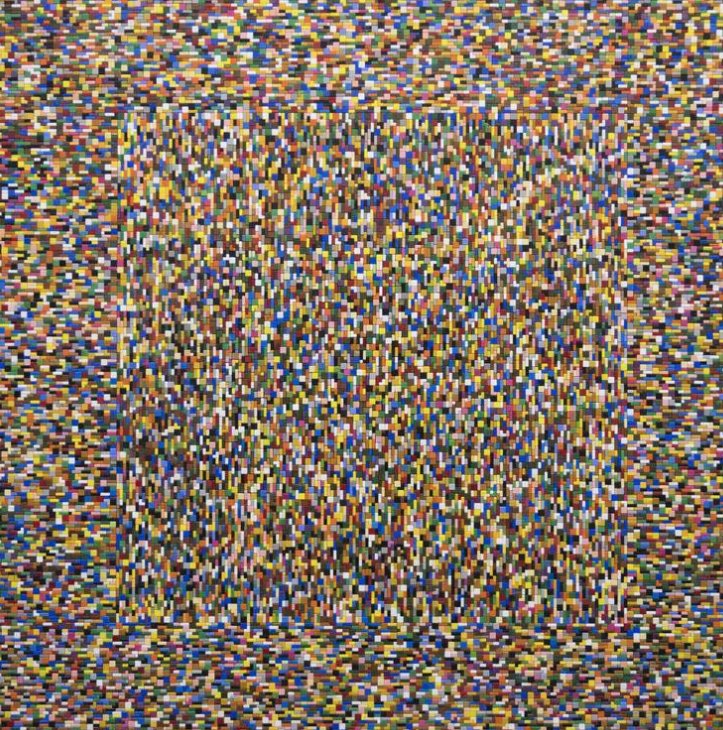
Nik Kok, a Dutch artist celebrated for his innovative approach to material and form, has captivated art enthusiasts with his piece Pointillist Square. This intricate work of art exemplifies Kok’s talent for merging traditional techniques with modern aesthetics, reimagining pointillism in a uniquely tactile and geometric form.
Pointillist Square isn’t just an artwork—it’s a conversation starter that explores the interplay between precision, randomness, and materiality, using Ministeck, a mosaic-like medium rarely associated with fine art.
A Pandemic Creation: The Birth of Pointillist Square
Nik Kok created Pointillist Square during the pandemic, a period when many artists turned to introspection and experimentation. The constraints of lockdown prompted Kok to explore materials readily available to him, leading to his discovery of Ministeck—a nostalgic mosaic toy popular in Europe. Known for its bright colors and modular shapes, Ministeck pieces are typically used to create pixelated images, often with rigid instructions.
However, Kok saw untapped potential in this medium. Over months of meticulous labor, he sourced over 23,000 Ministeck pieces from second-hand stores, online platforms, and collectors. These tiny, interchangeable tiles became the foundation of Pointillist Square, which measures 39.4 x 39.4 inches—a deliberate nod to the geometric form that anchors much of his work.
Rather than follow the typical pre-designed templates associated with Ministeck, Kok approached the project with an abstract, freeform method. He focused on both color and the orientation of individual pieces, allowing randomness and order to coexist within the composition. The result is a stunning mosaic that echoes the principles of pointillism, where tiny individual elements come together to form a cohesive, dynamic whole.
The Technique: Where Pointillism Meets Geometry
Pointillism, a technique pioneered by Georges Seurat and Paul Signac, involves the meticulous application of small, distinct dots of color that, when viewed from a distance, blend to create an image. Nik Kok’s Pointillist Square embraces this concept while introducing a tactile, three-dimensional twist.
Each Ministeck tile serves as a “dot,” but unlike paint, these tiles are physical objects with defined edges and textures. Kok oriented the tiles deliberately, manipulating their angles to create a subtle interplay of light and shadow. This orientation gives Pointillist Square a kinetic quality—it seems to shift and shimmer as viewers change their perspective.
The colors, while chosen randomly in theory, follow an instinctive rhythm that adds depth and harmony to the piece. This balance between randomness and structure speaks to Kok’s fascination with systems and patterns, a recurring theme in his work.
The Square: A Perfect Canvas
Why a square? For Nik Kok, the square is more than just a shape—it’s a philosophical choice. The square represents stability, equality, and simplicity. It’s a form devoid of hierarchy, with all sides and angles in perfect balance. By using the square as his canvas, Kok creates a sense of order even when the individual elements—randomly selected tiles—might suggest chaos.
The square also serves as a reference to modernist traditions in art, recalling the works of Kazimir Malevich and Piet Mondrian, who used geometry as a means to explore universal truths. In Pointillist Square, Kok continues this dialogue, demonstrating how the simplest forms can hold infinite complexity.
Themes of Sustainability and Repurposing
Another compelling aspect of Pointillist Square is its commentary on sustainability. By sourcing second-hand Ministeck pieces, Kok repurposes a material often considered outdated or disposable. This practice aligns with a broader trend in contemporary art, where sustainability and reuse are increasingly central themes.
Kok’s choice to work with recycled materials adds layers of meaning to the piece. Each Ministeck tile carries a history—perhaps it was once part of a child’s game or a forgotten DIY project. By integrating these pieces into his artwork, Kok breathes new life into them, transforming them from discarded objects into components of a vibrant, cohesive whole.
A Visual and Philosophical Journey
Viewing Pointillist Square is an experience that evolves over time. From a distance, the artwork appears unified, its colors blending seamlessly like a painting. Up close, however, the individual Ministeck tiles come into focus, revealing the intricacy of Kok’s process.
This duality mirrors the philosophical underpinnings of pointillism itself: the idea that the whole is greater than the sum of its parts. Kok’s work invites viewers to reflect on this concept, not only within the context of art but in life as well. How do seemingly insignificant elements—whether dots of color, small decisions, or fleeting moments—contribute to a larger narrative?
Reception and Legacy
Since its creation, Pointillist Square has garnered significant attention in the art world, particularly among collectors and critics who appreciate its innovative use of materials. It’s available for purchase through Saatchi Art, further cementing Kok’s reputation as an artist who blends accessibility with high-concept execution.
The piece also resonates with audiences because it bridges the gap between nostalgia and modernity. Many viewers are familiar with Ministeck from childhood, and seeing it repurposed into fine art evokes a sense of wonder and rediscovery.
Expanding the Vision: Seven Pointillist Squares
Kok’s exploration of this technique didn’t stop with Pointillist Square. In subsequent works, such as Seven Pointillist Squares, he expanded on the concept, creating a series of mosaics that delve deeper into themes of color, geometry, and materiality. Each square builds on the ideas introduced in the original piece, showcasing Kok’s ability to continually innovate within a defined framework.
This series also underscores the versatility of Kok’s approach, proving that even within the constraints of a single shape and medium, endless possibilities exist.
Final Note
Nik Kok’s Pointillist Square is more than just an artwork—it’s a testament to the power of creativity, adaptability, and vision. By transforming everyday materials into a meticulously crafted mosaic, Kok challenges viewers to see the extraordinary in the ordinary.
Through its vibrant colors, precise geometry, and thoughtful execution, Pointillist Square invites us to explore the intersection of randomness and order, tradition and innovation, past and present. It’s a piece that demands attention, not just for its aesthetic appeal but for the ideas it embodies—ideas that continue to resonate long after the viewer steps away.
For anyone interested in contemporary art, sustainability, or simply the beauty of transformation, Pointillist Square stands as a compelling example of how art can inspire and provoke, even in the most unexpected ways.