Review: Satellites II: Prada Mode as Atmosphere, Not Event

April 4, 2026
1 hour ago
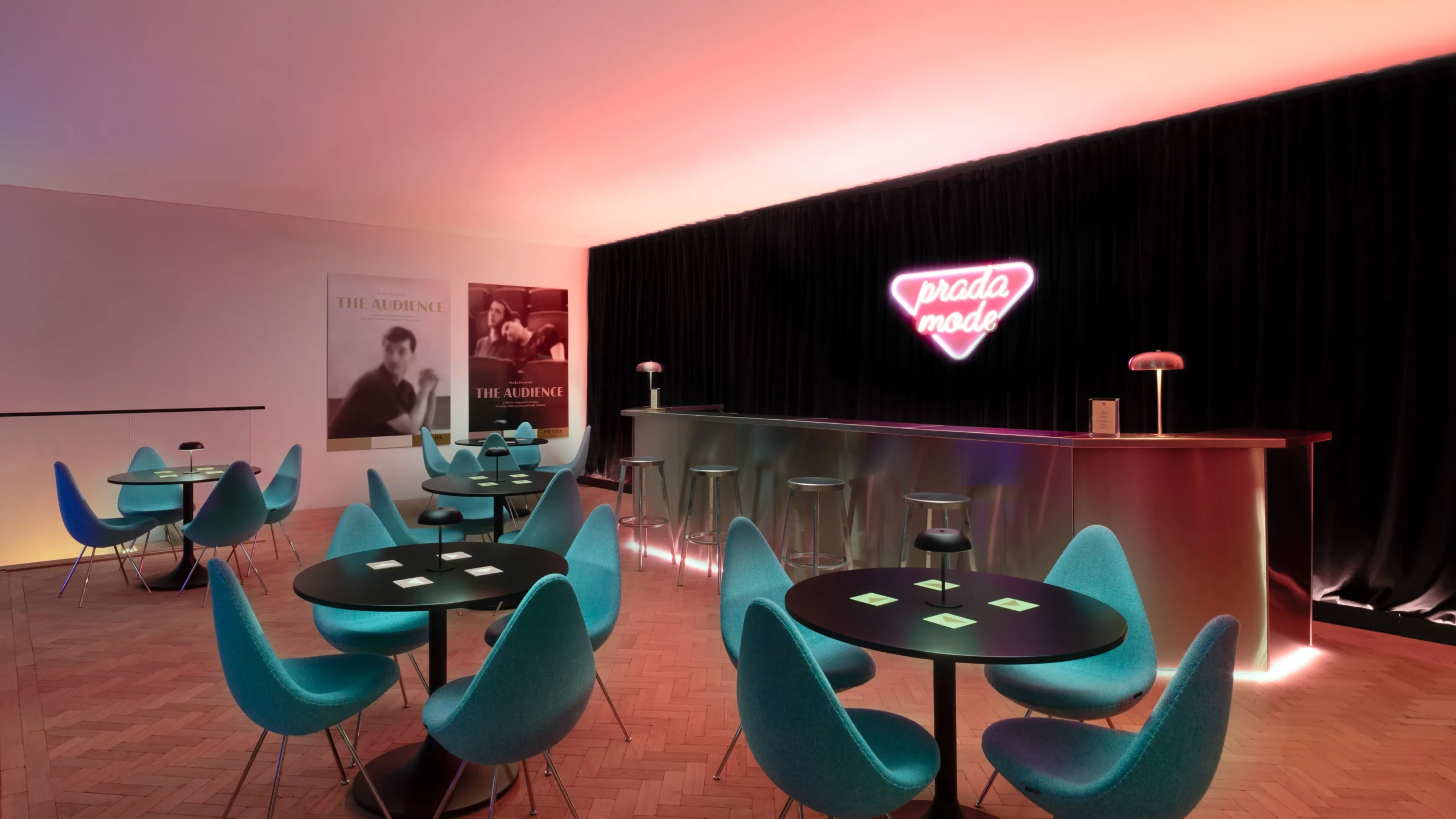
From June 3 to 7, 2026, Prada returns to New York with Satellites II, the fourteenth chapter of its ongoing Prada Mode series. Set within the storied interiors of Hotel Chelsea, the project unfolds less like a conventional cultural activation and more like an inhabited idea—one that treats space, narrative, and perception as interchangeable materials.
Timed to coincide with the Tribeca Festival, Satellites II positions itself between disciplines: cinema and gaming, architecture and performance, memory and simulation. The collection brings together two figures whose work has consistently reshaped narrative language—Nicolas Winding Refn and Hideo Kojima—under Prada’s evolving cultural platform.
The result is not an exhibition in the traditional sense. It is an environment that resists resolution.
stir
Prada Mode has never behaved like a static program. Since its inception, it has moved city to city—Miami, Hong Kong, Shanghai, Moscow—each time reconfiguring itself in response to local context and invited coexisting. Rather than producing consistency, Prada has leaned into variation, allowing each iteration to operate as a discrete cultural experiment.
Satellites II extends this logic, but with sharper focus. The title suggests orbit—objects suspended in relation to something unseen, moving in patterns that imply structure without revealing it. If previous Prada Mode editions explored art as event, this one leans toward art as system.
There is an implicit refusal here: no singular narrative, no definitive entry point. Instead, a network of fragments—rooms, projections, soundscapes, interactive sequences—each acting as a node within a larger constellation.
archive
To situate this project within the Hotel Chelsea is to engage with one of New York’s most mythologized spaces. The building has long functioned as a kind of cultural reservoir—home, temporarily or otherwise, to figures ranging from Bob Dylan to Patti Smith.
But Satellites II does not treat the Chelsea as backdrop. It treats it as perhaps as involver.
The hotel’s architecture—its corridors, its worn surfaces, its layered histories—becomes part of the work’s internal logic. Memory here is not preserved; it is reactivated. Rooms are not simply occupied; they are rewritten.
cin
Refn’s involvement introduces a particular sensibility: cinema stripped of narrative obligation, reduced to mood, texture, and duration. Known for films such as Drive and The Neon Demon, his work often prioritizes visual intensity over linear storytelling.
In Satellites II, that approach is amplified. Rather than directing a film, Refn contributes to an environment where cinematic lang is spatialized. Light becomes architecture. Sound becomes orientation. Time becomes elastic.
There is no beginning or end—only presence.
Refn’s aesthetic—neon saturation, suspended violence, emotional ambiguity—translates into rooms that feel less like scenes and more like states of mind. The viewer is not watching; they are inside.
flow
If Refn dissolves narrative into atmosphere, Kojima rebuilds it as structure.
Best known for the Metal Gear Solid franchise and later Death Stranding, Kojima has long treated games not as entertainment but as narrative ecosystems—spaces where story emerges through interaction rather than exposition.
Within Satellites II, his contribution likely manifests as systems rather than scenes: interactive sequences, branching pathways, environments that respond to presence. Where Refn’s rooms may disorient, Kojima’s may invite participation—though not necessarily clarity.
The connection between the two is not about blending styles. It is about tension.
Cinema, traditionally passive, meets gaming, inherently active. The viewer becomes a participant, but without the reassurance of control.
straddle
What Prada does here is not simply commission. It mediates.
Under the direction of Miuccia Prada and Raf Simons, the brand has increasingly positioned itself as a cultural interlocutor—less interested in product placement than in shaping discourse.
Prada Mode becomes the mechanism through which this happens. It is not a marketing platform in the conventional sense; it is a framework for experimentation, one that borrows from art institutions, film festivals, and private salons without fully belonging to any of them.
Satellites II reinforces this position. By aligning with the Tribeca Festival, Prada situates itself within a broader cultural calendar, but its offering resists the festival’s logic of premieres and screenings. Instead, it creates a parallel experience—one that operates alongside, rather than within, the cinematic mainstream.
idea
The title Satellites II suggests continuation, but also fragmentation.
A satellite exists in relation—to a planet, to a signal, to an unseen center. It transmits, receives, reflects. It is both independent and dependent.
Applied to this project, the metaphor becomes structural. Each room, each installation, each collaboration acts as a satellite—autonomous yet connected. There is no central narrative, only a network of references.
This reflects a broader cultural condition: the shift from linear storytelling to distributed meaning. In an era defined by feeds, fragments, and parallel realities, coherence is no longer given. It is constructed.
Or not.
show
One of the more significant aspects of Prada Mode—and particularly Satellites II—is its rejection of the object as the primary unit of value.
There are no collections to purchase here, no products to anchor the experience. Instead, value is generated through immersion, through presence, through the accumulation of impressions.
This aligns with a larger movement within luxury, where experience increasingly supersedes ownership. Prada does not abandon product; it reframes it. The brand becomes less about what is worn and more about where—and how—it exists.
In this sense, Satellites II is not separate from Prada’s fashion work. It is an extension of it, operating in a different medium.
frame
The event’s duration—five days, limited access—introduces another layer: temporality.
Unlike a museum exhibition, which persists, or a film, which can be replayed, Prada Mode exists within a fixed window. To experience it is to be present at a specific time and place.
This creates a form of scarcity that is not tied to product but to experience. It also reinforces the project’s conceptual framework: satellites appear, transmit, disappear.
What remains is not the installation itself, but its residue—documentation, memory, interpretation.
loc
Hosting Satellites II in New York, specifically during the Tribeca Festival, is not incidental.
New York operates as both stage and subject—a city defined by density, by overlap, by constant reinvention. It is, in many ways, a satellite system in itself: neighborhoods, cultures, industries orbiting one another, intersecting, diverging.
The Hotel Chelsea, situated within this urban fabric, becomes a microcosm of that condition. Its history of transient residents, of overlapping narratives, mirrors the project’s own structure.
Prada does not impose meaning onto the city. It amplifies what is already there.
move
The pairing of Refn and Kojima is, on the surface, unexpected. One works primarily in film, the other in games. One emphasizes mood, the other system.
But both share a commitment to expanding the boundaries of their respective mediums. Both treat narrative not as a fixed sequence but as a malleable construct.
Prada’s role is to create the conditions under which these approaches can intersect—not to resolve their differences, but to stage them.
The result is not synthesis, but dialogue.
vibe
Satellites II points toward a broader shift in how cultural experiences are structured.
It is not quite an exhibition, not quite a performance, not quite a game. It occupies a hybrid space—one that reflects the increasing convergence of disciplines in contemporary culture.
This hybridity is not accidental. It is a response to a world in which boundaries between mediums are increasingly porous. Film borrows from games. Fashion borrows from art. Art borrows from technology.
Prada Mode becomes a site where these exchanges can occur, not as novelty, but as necessity.
fin
There is a temptation to seek clarity—to ask what Satellites II ultimately means, what it is trying to say.
But the project resists that impulse.
Instead, it offers something else: a set of conditions. Spaces to move through, systems to engage with, atmospheres to inhabit. Meaning, if it emerges, does so through experience, not explanation.
In this sense, Satellites II is less about communication than about perception. It does not tell a story. It creates the possibility of one.
And then leaves it unfinished.