review: Fnnch’s Honey Bear and the Stall of Attention

April 3, 2026
2 hours ago
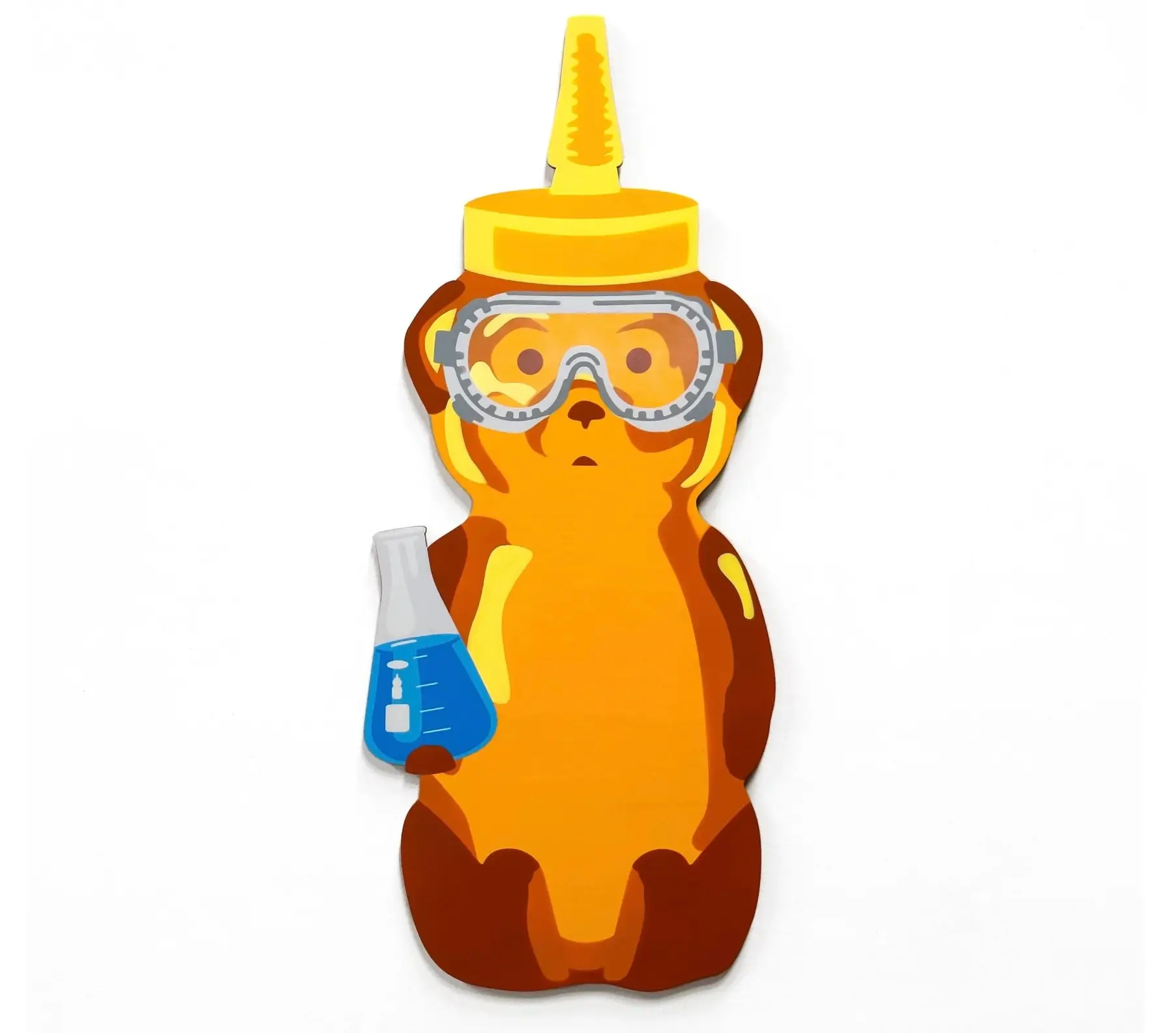
There is something disarming about the bear before anything else registers.
Not the goggles. Not the flask. Not even the improbable premise of a honey bottle reimagined as a sentient figure. It is the stillness. The posture is upright but not assertive, centered but not dominant. A pause lives inside it. The kind of pause that doesn’t announce itself, only accumulates.
This is where fnnch begins—not with spectacle, but with recognition.
Because the form is already known.
A grocery store memory. A plastic bottle squeezed into pancakes. A childhood object that never needed explanation. Fnnch doesn’t invent the bear; he retrieves it. What he alters is its condition.
And here, the condition is inquiry.
assignment
The honey bear is one of those rare design artifacts that has transcended its function. It exists somewhere between packaging and character, between commodity and companion. It was never meant to be read as a figure, but it always has been.
Fnnch leans into that ambiguity.
By preserving the silhouette almost exactly—rounded ears, bulbous torso, simplified limbs—he resists over-design. There is no embellishment that would detach it from its origin. Instead, the transformation occurs through addition, not alteration.
Safety goggles. A lab flask. A squeeze-cap crown.
Minimal interventions, but decisive ones.
The bear is no longer passive.
It is observing. Testing. Holding.
subjective
The goggles matter more than they first appear.
They are oversized, slightly opaque, positioned not as decoration but as a barrier. The eyes behind them are simplified, almost neutral, yet their framing changes the emotional register of the piece.
Without the goggles, the bear would read as exposed. With them, it becomes protected—but also separated.
There is a distance introduced between the viewer and the subject.
The goggles imply risk. They imply environment. They suggest that whatever is happening here requires precaution.
But nothing in the image is volatile.
No explosion. No chaos. No visible reaction.
Only a blue liquid held in a glass flask.
the mixture
Color is doing more work than narrative.
The bear exists in a gradient of ambers and oranges—tones that evoke viscosity, warmth, sweetness. Honey, yes, but also something slower. Something preserved.
Then there is the blue.
Artificial, almost clinical in contrast. It doesn’t belong to the bear’s world, which is precisely why it matters.
The flask becomes the focal disruption.
It introduces a second system into the composition: science against sweetness, analysis against instinct, precision against familiarity.
The bear is holding something that is not itself.
And not entirely understood.
idea
Fnnch’s Honey Bear has always existed within a quiet tension: it is both product and protagonist.
A container designed to be emptied.
A body meant to be consumed.
But here, that logic is reversed.
The bear is no longer the source of the substance—it is the observer of it.
The blue liquid is not honey. It is something else entirely. Something measured. Something perhaps synthetic.
This inversion reframes the bear’s identity.
It is no longer what it contains.
It is what it studies.
imply
There is no action in the piece, only implication.
No bubbling reaction. No visible change in the liquid. No gesture suggesting movement.
The bear simply holds the flask.
And looks.
This is what gives the work its peculiar weight. It is not about discovery, but about the moment before it. The suspension between question and answer.
In most representations of science, the emphasis is on breakthrough—on the visible transformation of matter.
Here, the emphasis is on attention.
The act of looking becomes the act of doing.
theory
There is a subtle redefinition of labor happening in this image.
The goggles and flask suggest work—intellectual, experimental, procedural. But the bear’s posture does not communicate strain. There is no urgency, no pressure.
This is not labor as productivity.
It is labor as curiosity.
A softer form of engagement, one that resists the metrics of output and instead centers the process itself.
The bear is not trying to produce something.
It is trying to understand something.
frame
Fnnch’s work often operates within the visual language of innocence—rounded forms, simplified expressions, accessible color palettes.
But innocence here is not naivety.
It is openness.
The bear does not approach the flask with skepticism or fear. It approaches it with presence. With a kind of neutral readiness that is increasingly rare in visual culture, which often favors irony or critique.
There is no visible judgment in the bear’s face.
Only attention.
tempo
There is humor in the image, but it is restrained.
A honey bear wearing lab goggles is, on paper, absurd. But the execution resists exaggeration. The proportions remain grounded. The expression remains calm.
The humor exists not in the depiction, but in the premise.
And because it is not pushed, it lingers differently.
It becomes less about laughter and more about recognition of contrast.
install
Though the image reads as flat and graphic, there is an implied materiality to Fnnch’s work that often extends into sculpture and installation.
The honey bear, in its original form, is a squeezable plastic container. It is designed for pressure, for release, for use.
In Fnnch’s rendering, that material logic is suspended.
The bear becomes fixed. Solid. Untouchable.
This shift from object to image introduces a new kind of permanence.
The disposable becomes durable.
The consumed becomes observed.
lang
What defines this piece is not what has been added, but what has been left untouched.
Fnnch resists the urge to overcomplicate.
The bear is not anatomically detailed. The environment is absent. The narrative is not spelled out.
This restraint creates space.
For interpretation. For projection. For the viewer to enter the work without being directed too explicitly.
image
There is a subtle reversal in the dynamic between viewer and subject.
We look at the bear.
But the bear is also looking.
Not at us, necessarily, but at something within its own world.
This introduces a layered gaze.
We are observing an observer.
Which complicates the act of viewing.
stasis
There is no indication of time passing in the image.
No before, no after.
Only the present moment of holding and looking.
This temporal suspension aligns with the material metaphor of honey itself—slow, viscous, resistant to rapid change.
The bear exists in that same slowed state.
show
Contemporary visual culture often leans heavily on irony—on the gap between what is shown and what is meant.
Fnnch’s Honey Bear operates differently.
There is no clear punchline.
No overt critique.
Instead, the work offers a scenario.
A gentle displacement of context that invites consideration without demanding it.
fwd
In a way, the piece is about attention itself.
About what it means to look closely.
To hold something unfamiliar without immediately categorizing it.
The bear models a kind of attentiveness that is increasingly rare.
Unhurried. Undistracted. Present.
narra
Despite its anthropomorphic qualities, the bear is not embedded in a story.
There is no background, no setting, no sequence of events.
This absence allows the figure to remain open.
It can be a scientist, a child, a metaphor, a self.
It can shift depending on who is looking.
fin
What remains, after everything is considered, is the image of the bear holding the flask.
Not shaking it. Not analyzing it with instruments.
Just holding it.
Looking.
There is a kind of humility in that gesture.
An acknowledgment that not everything needs to be resolved immediately.
That understanding can begin with attention.
That even something designed to be emptied can become something that observes.
And that sometimes, the most compelling transformation is not in what changes—
but in what begins to look back.