Review: KAWS — Resting Place Companion (Black), 2013

March 28, 2026
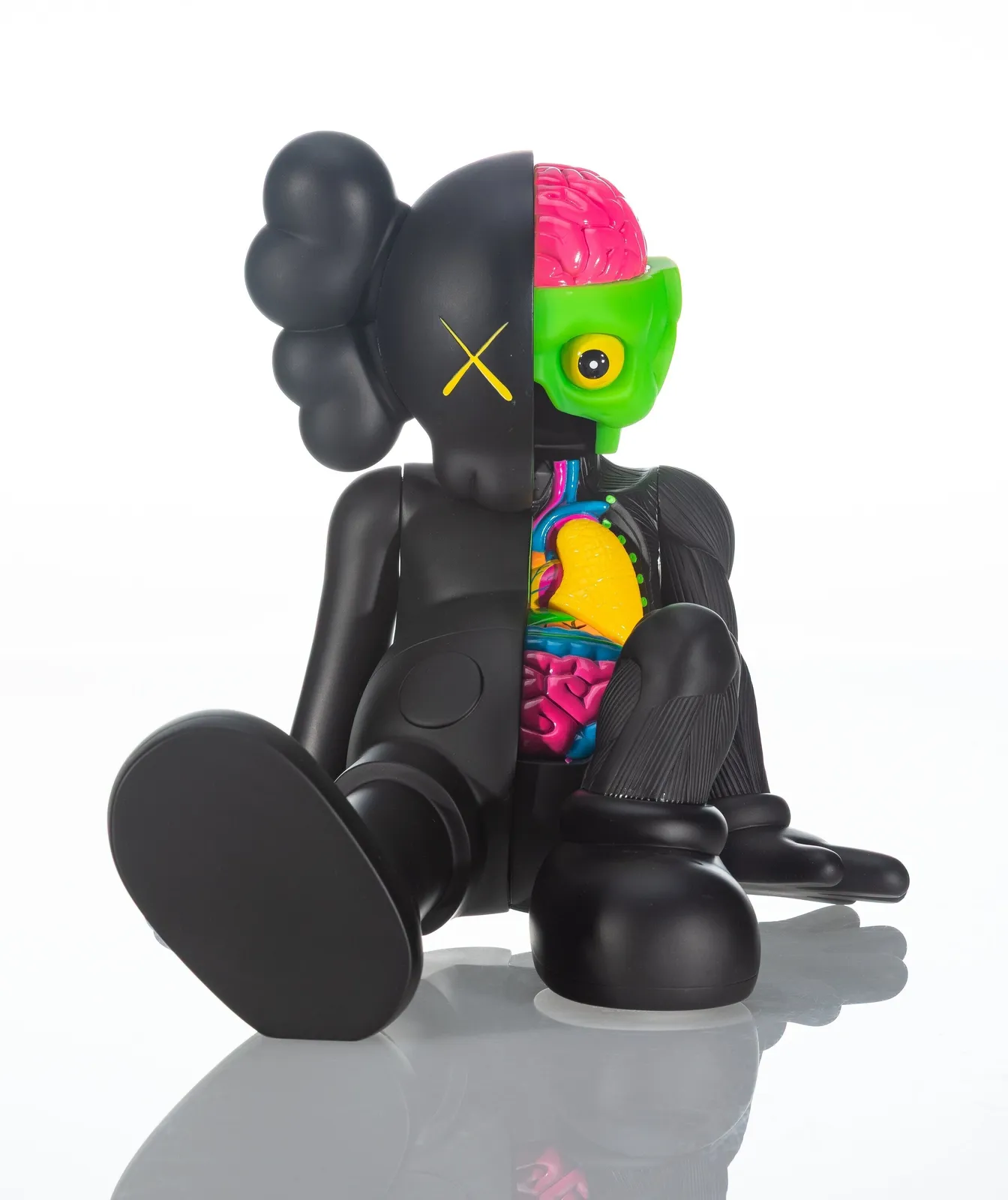
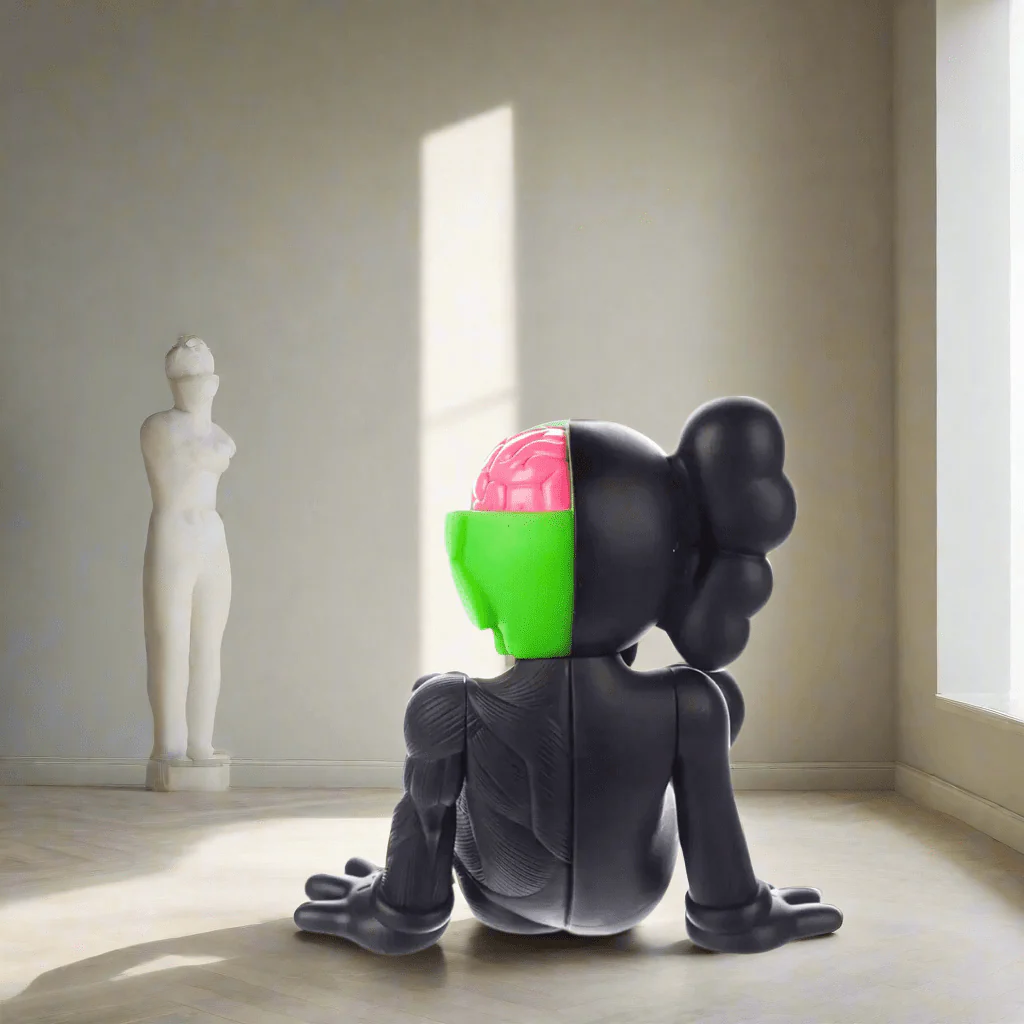
There’s no drama in the way the figure lies down. No theatrics, no exaggerated collapse. Resting Place Companion (Black) (2013) by KAWS begins with a quieter proposition: what does it mean for a character built from pop language to disengage completely? The Companion, long positioned upright—standing, covering its face, slumping forward—now turns sideways, withdrawing from the vertical world that once framed it.
The gesture is simple. The implications are not.
Horizontal Shift
The most immediate change is orientation. The Companion is no longer presented as a figure occupying space in relation to us—eye level, body facing outward—but as a body removed from that exchange. Lying on its side, it redirects attention away from interaction and toward condition. This is not a figure that addresses the viewer. It doesn’t meet your gaze, even symbolically. It opts out.
That shift matters because KAWS’ work has always depended on recognition. The Companion borrows from the visual grammar of Mickey Mouse—the rounded ears, the simplified limbs, the cartoon glove—yet replaces familiarity with distance through the “XX” eyes. In upright versions, that tension between known form and withheld emotion creates friction. Here, the friction dissolves into something quieter. The figure is no longer negotiating with the viewer. It is simply elsewhere.
The Body as Closed Form
The pose is controlled, not collapsed. Arms are folded inward, legs slightly bent, the torso curved just enough to suggest containment. It reads as a self-contained structure, almost architectural in its logic. Nothing extends outward. There’s no reaching, no signaling.
That inwardness is key. The Companion has often been interpreted as a stand-in for emotional states—fatigue, anxiety, detachment—but in this configuration, it resists narrative. There’s no clear before or after. The figure is not in transition. It is already there, already settled into its position.
The absence of facial expression reinforces that closure. The “XX” eyes, a defining motif in KAWS’ work, function less like a mask here and more like a full stop. They don’t conceal emotion; they negate the need to search for it. The figure is not asking to be read.
Title Without Resolution
“Resting Place” is a phrase that carries weight without specificity. It can describe a temporary pause, a place to recover, or something more permanent—a site of finality. KAWS leaves the term open, refusing to anchor the sculpture to a single interpretation.
This ambiguity is deliberate. The Companion is not depicted in motion toward rest, nor emerging from it. It exists within rest as a condition. Whether that condition is restorative or terminal is left unresolved.
That lack of resolution aligns with the broader trajectory of KAWS’ practice. His work rarely offers clear emotional cues. Instead, it creates frameworks where viewers project their own states onto familiar forms. The Companion becomes less a character and more a surface for interpretation.
Material Presence
The black finish sharpens that effect. It absorbs light, flattening detail and emphasizing silhouette. Without color variation, the eye focuses on form—the curve of the back, the angle of the limbs, the compactness of the pose.
There’s a physical weight to it. Even when produced in vinyl, the matte black surface gives the sculpture a density that feels closer to cast material than to collectible object. It resists gloss, resists spectacle. The figure doesn’t announce itself; it holds space quietly.
At the same time, the smoothness of the surface maintains a connection to KAWS’ roots in design and product culture. The Companion has always existed between sculpture and object, between gallery and retail. Resting Place Companioncontinues that duality, but shifts the emphasis toward contemplation rather than display.
Context Within the Companion Series
By 2013, the Companion had already undergone multiple iterations—standing figures, seated versions, works where the character covers its face or slumps forward. Each variation explores a different relationship between the body and emotion, between exposure and withdrawal.
_ Resting Place Companion_ marks a turning point in that sequence. It removes the figure from active gestures and places it into a state of complete disengagement. There is no covering of the face, no attempt to hide. The withdrawal is total, not reactive.
This evolution mirrors a broader shift in KAWS’ work during that period, where the emphasis moved from immediate visual impact toward more subdued, introspective forms. The Companion becomes less animated, more reflective—less about gesture, more about condition.
Between Object and Figure
Part of what gives the work its tension is the way it sits between being a character and being a form. The Companion is recognizable, even iconic, yet in this position it begins to lose some of that identity. It reads almost as an abstracted body, a shape defined by curves and volumes rather than by narrative.
That ambiguity allows the sculpture to operate in multiple contexts. In a gallery, it can be read within the lineage of contemporary figurative sculpture—alongside works that explore the body as a site of psychological inquiry. In a domestic setting, it functions differently, becoming an object that introduces a quiet, reflective presence into space.
The scale also plays a role. Larger versions emphasize the physicality of the form, turning the figure into something you move around, something that occupies your environment. Smaller editions bring it closer, more intimate, almost like a personal artifact.
Cultural Positioning
KAWS occupies a unique position between fine art and popular culture. His work draws from commercial imagery, street art, and graphic design, yet is firmly embedded within contemporary art discourse. The Companion, as a recurring figure, embodies that intersection.
_ Resting Place Companion_ complicates it further. By removing the figure from active engagement, it strips away some of the immediacy associated with pop-derived imagery. What remains is something quieter, less about recognition and more about presence.
This shift reflects a broader cultural moment where overstimulation—visual, digital, emotional—has led to a renewed interest in stillness. The sculpture doesn’t respond to that moment directly, but it resonates with it. It offers a form that neither competes for attention nor withdraws entirely. It simply exists.
A Figure That Doesn’t Ask
What ultimately defines Resting Place Companion (Black) is its refusal to demand interpretation. It doesn’t guide the viewer toward a specific reading. It doesn’t provide emotional cues beyond its posture. It doesn’t resolve the ambiguity embedded in its title.
Instead, it creates a space—both literal and conceptual—where the viewer can pause. The figure’s stillness becomes a kind of mirror, reflecting whatever state the viewer brings to it.
There is no conclusion built into the work. No narrative arc to follow. Just a body, lying down, held in a moment that could be rest, retreat, or something else entirely.
And in that refusal to define itself, the Companion becomes something more than a character. It becomes a condition—one that sits quietly, persistently, in the space between movement and stillness.