Revisiting Mia Sara’s Legacy and the Lasting Glow of “Ferris Bueller’s Day Off”

June 16, 2025
10 months ago
It’s been nearly four decades since audiences first followed a charming, cunning teenager named Ferris Bueller as he defied school, authority, and time itself for one unforgettable day in Chicago. But beyond Matthew Broderick’s magnetic performance and John Hughes’ whip-smart screenplay, there was a quieter elegance balancing the comedic chaos—a presence both romantic and perceptive. That presence was Mia Sara as Sloane Peterson, Ferris’ girlfriend and emotional anchor. While Ferris stole the spotlight, it was Sara’s performance that lent the film its equilibrium—her calm gaze, gentle voice, and quiet introspection offering contrast to the film’s irreverent bravado.
And then there was the parade.
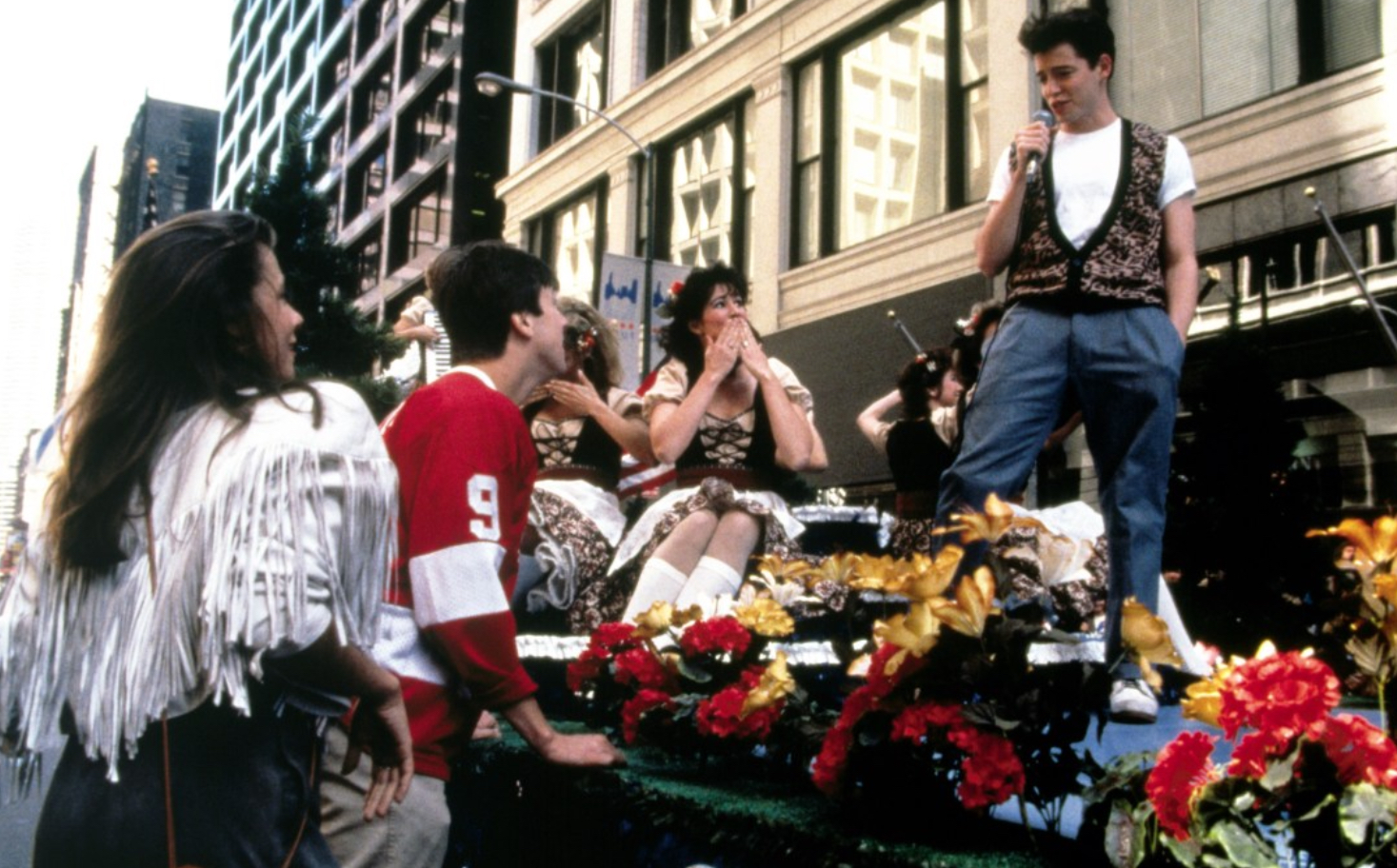
Among the film’s many memorable moments—the joyride in the 1961 Ferrari, the art museum interlude, the daring escapes from the school principal—it is the Von Steuben Day Parade sequence that has perhaps become Ferris Bueller’s Day Off’s most iconic scene. A jubilant, borderline anarchic celebration of music, dance, and mid-city freedom, it symbolizes the film’s central thesis: life moves pretty fast—so why not jump on the float?
For Mia Sara, filming that sequence was an experience of pure, kinetic energy. “We would do the dance and then we’d get in a van and they’d drive us blocks away,” she recalled in a People interview. “And the camera would go, and then we’d do the dance again and wait for Matthew to pass. It was just this crazy ‘let’s catch it as many times as we can.’ So that was a great moment.”
A Moment in Time, A Feeling Forever
What Mia Sara describes is not just a filming technique—it’s a snapshot of cinema in motion, of capturing lightning in a bottle. The parade scene, shot over multiple days using real crowds and practical setups, was less about polished choreography and more about vibe. The camera chased energy. The dancers, extras, and stars didn’t just perform—they lived the moment. And for a young actor like Sara, relatively new to the film industry, it was an immersion into the wonder and unpredictability of filmmaking at its most improvisational.
When Broderick’s Ferris breaks into “Twist and Shout,” the crowd—construction workers, downtown office staff, dancers, tourists—erupts into coordinated yet chaotic celebration. Sara, in character as Sloane, watches from the sidelines, occasionally swept up in the fun but also serving as the grounded observer. She smiles, sways, and laughs, embodying the film’s seamless blend of youthful abandon and reflective sincerity.
What makes Sara’s memory so resonant is its simplicity. She doesn’t talk about fame, technique, or script. She talks about movement, van rides, and the surreal repetition of dancing down Chicago’s avenues while chasing a camera and following Ferris’ path. It’s a perfect metaphor for youth—the constant pursuit of something joyful and elusive, the thrill of repetition before it becomes routine, and the unique way a scene becomes memory.
Sloane Peterson: The Calm Within the Storm
In cinematic history, there’s no shortage of teen girlfriends written as background noise. But Sloane Peterson stands apart. She’s neither a manic pixie dream girl nor a damsel in distress. She’s confident without being arrogant, supportive without being submissive, and graceful without being aloof. She is the one who sees Ferris clearly, even as the city becomes their playground.
Sara’s performance was subtle. She didn’t shout or steal scenes. Instead, she carried herself with poise and maturity, anchoring the film with a sense of quiet truth. She let Ferris be the spectacle, but through her expressions and presence, Sloane grounded that spectacle in something emotional and real. Her line, “What are we going to do?” uttered while sitting in the hot tub with Ferris, isn’t just a logistical question—it’s a reflection of the uncertainty of youth, the fear of growing up, and the end of an era they don’t want to let go.
It’s that fragility, laced within the exuberance, that gives Ferris Bueller’s Day Off its lasting emotional core. Sara understood that. Even in scenes where she had little dialogue, her eyes told the story—watching Ferris with admiration, worry, and love.
Rewatching Through Mia Sara’s Eyes
To revisit Ferris Bueller’s Day Off today is to see a film that functions both as a satire and a time capsule. The fashion, the slang, the architecture of 1980s Chicago—all are preserved in Hughes’ vision. But more than that, the film has become a ritual of rediscovery. It’s passed down, generation to generation, as both a rebellion fantasy and a heartfelt goodbye to youth.
And in the middle of it all, Mia Sara remains luminous. Her performance ages better with time because it was never cloying or exaggerated. She embodied the girl next door with a backbone, the dream without distortion. Her chemistry with Broderick was soft and natural, filled with small gestures—hand-holding, glances, shared laughter. It’s these elements that make the romance feel lived-in and believable.
The fact that she can recall the parade sequence with such fondness, nearly 40 years later, suggests that her connection to the film was not purely professional. It was personal. And it shows.
Mia Sara After Ferris
Though she went on to appear in films like Legend and Timecop, and TV roles in series like Chicago Hope and Birds of Prey, Sara gradually stepped away from acting in the 2000s. Today, she is a poet, a mother, and a figure often remembered with a kind of reverent affection by those who grew up watching her. Unlike many of her contemporaries, she never chased the Hollywood spotlight. Her absence has made her legacy even more mythic.
In the rare interviews she’s given, Sara has always spoken with grace about her early years in film. There is no bitterness, no disillusionment—just gratitude, reflection, and an evident artistic soul that now finds expression through writing rather than screen.
Why the Parade Still Matters
The Von Steuben Day parade, as imagined in Ferris Bueller’s Day Off, is more than a cinematic flourish. It’s the film’s turning point—where Ferris fully commits to joy, and the city itself responds. It’s spectacle, sure. But it’s also a signal to the audience: this is not just a comedy. This is a celebration of what it means to be alive, especially in those brief years before life gets more complicated.
Sara, in remembering the chaos of that shoot—the constant movement, the waiting, the van rides—reveals something more profound than just nostalgia. She taps into the essence of why that film still works. Because like youth itself, it was improvised. There was a plan, of course, but also space for chaos, for surprise, for laughter.
And that’s what John Hughes did best. He created blueprints for emotion—then let the performers fill in the color. Mia Sara brought a soft, warm tone that continues to resonate.
The Final Frame
“Let’s catch it as many times as we can,” she said. And perhaps, that’s what all of Ferris Bueller’s Day Off really was—a frantic, beautiful attempt to capture a moment before it disappeared. Before graduation. Before adulthood. Before consequence.
Mia Sara, with her quiet dignity and reflective charm, didn’t just catch the moment—she held it steady so the rest of us could dance around it. That’s her legacy in the film. She didn’t need to twist or shout. She just needed to be there.
And nearly forty years later, she still is.