RICE NINE TEN Knitting Basketball Shirt (Light Blue)

June 4, 2025
10 months ago
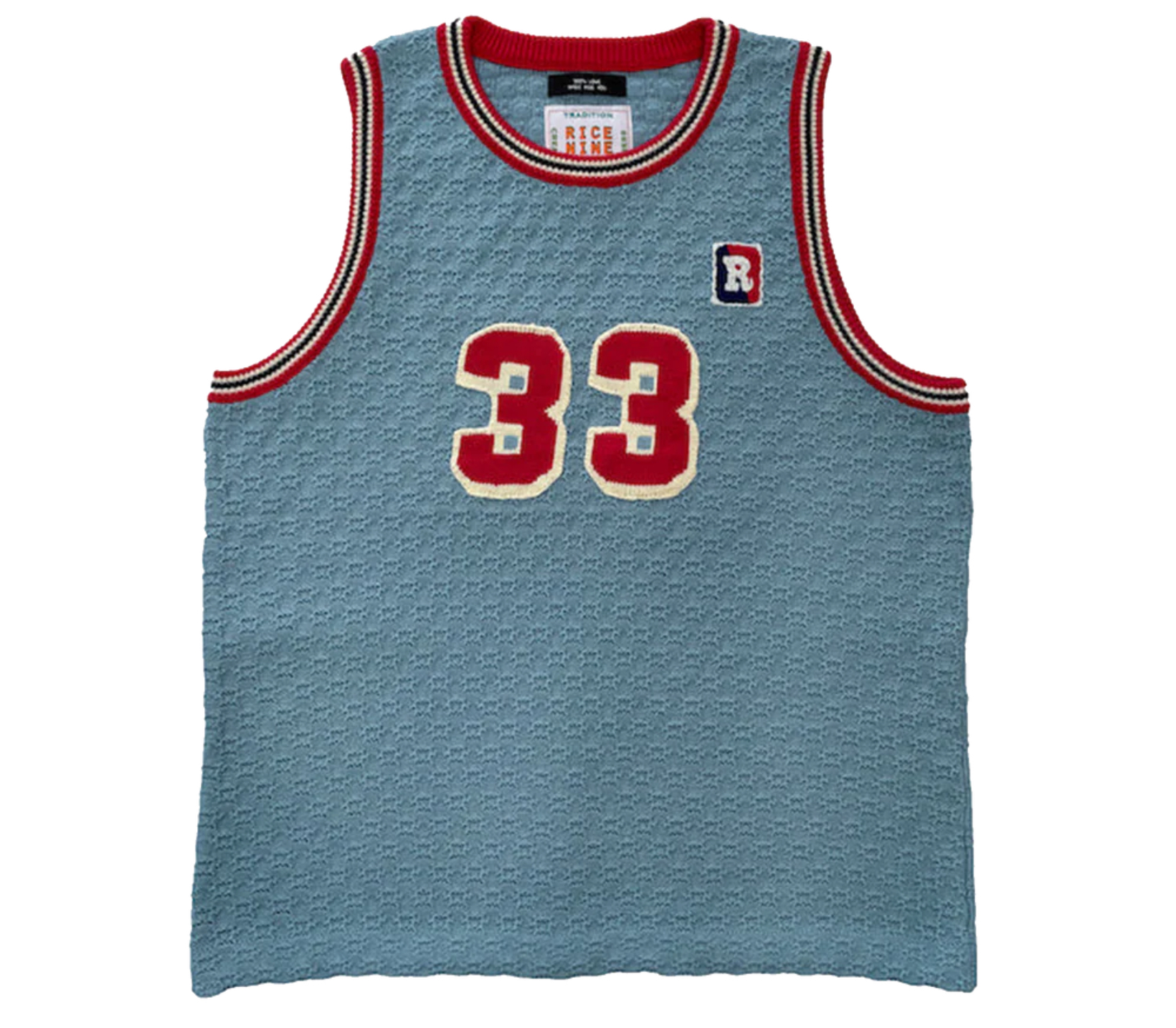
In the ever-evolving dialogue between athletic utility and avant-garde tailoring, the RICE NINE TEN Knitting Basketball Shirt (Light Blue) emerges as a quiet disruptor. Part jersey, part textile sculpture, it dismantles the conventional silhouette of American sportswear and rebuilds it through a framework deeply rooted in Japanese sensibility and handcrafted aesthetics. Designed by Shohei Kimura, founder of RICE NINE TEN, the garment blends emotional subjectivity with cultural narrative, demonstrating that nostalgia and technical innovation can coexist not only harmoniously—but provocatively.
RICE NINE TEN: An Ethos of Contradiction
Brand Philosophy: The Meaning of “IKI”
Founded in 2017, RICE NINE TEN’s name is a coded homage to the Japanese kanji 粋 (“IKI”), a concept associated with refined stylishness and rebellious elegance. The characters for “rice” (米), “nine” (九), and “ten” (十) visually construct the ideogram for “IKI”, revealing a semantic layering that mirrors the brand’s approach to garment-making: one that values hidden meaning, layered identity, and cultural tension.
At the heart of Kimura’s philosophy is a commitment to intuition over trend, where pieces emerge less from seasonal demands and more from emotional impulse and memory. This emotionality is expressed not through overt storytelling, but through fabric, silhouette, and restraint.
The Designer: Shohei Kimura
Kimura’s journey is rooted in subcultural cosmopolitanism. Having spent time in New York crafting his early label POURTON DE MOI and working under the radar with Pleasure Principle, he returned to Tokyo with a sharpened focus: reasserting the role of the hand in an increasingly automated fashion system. RICE NINE TEN became his platform to test boundaries, where seemingly ordinary garments—button-downs, sportswear, knitwear—are pushed into emotional and artisanal territories.
Dissecting the Design: Form, Fabric, Function
Silhouette: Anti-Performance Aesthetics
The Knitting Basketball Shirt disrupts performancewear logic by removing its original function—breathability, moisture-wicking, speed—and replacing it with contemplative tactility. The fit nods to the loose, oversized drape of 1990s NBA jerseys, but every decision is a subversion:
- Sleeveless form – signaling sport, yet entirely static and woolen.
- Minimal neckline – softly ribbed, avoiding the aggressive V-necks of traditional jerseys.
- Absence of Logos – a rejection of brand hierarchies and commodification.
Materials and Construction
The material blend—54% nylon, 16% acrylic, 10% wool, 20% polyester—is carefully calibrated. Nylon provides structural integrity, acrylic ensures lightness, wool introduces warmth and softness, and polyester brings durability. But more than composition, it’s how the fabric is manipulated that tells the story:
- Knitted on home machines, not industrial looms, each shirt is inflected with individual variance.
- Hand embroidery replaces machine-pressed graphics. Each numeral stitched into the fabric surface echoes labor, time, and a meditative patience.
- Color palette – The light blue tone evokes the optimism of schoolyard sport, contrasted by ribbed trims that hint at retro team kits.
These are not just formal gestures; they represent a commitment to slowness, imperfection, and emotion in fashion.
Cultural Crosscurrents: Sportswear Through a Kabukimono Lens
Kabukimono: The Historical Nonconformists
RICE NINE TEN openly invokes the kabukimono—flamboyant outcasts of Edo-period Japan who rejected social norms through radical dress. This legacy surfaces not in overt costume but in disruption of code: making a basketball jersey out of wool, choosing embroidery over print, inserting luxury into something born of the street.
Sportswear as Memory Device
The jersey as an object is steeped in nostalgia—from playgrounds to high school gymnasiums to streetwear’s global takeover in the ’90s. What Kimura does is freeze that motion, translating kinetic energy into soft stillness. The act of knitting itself—loop over loop, slowly built—mirrors memory-making.
There’s also a sense of gender neutrality in the shirt. Free of tailored chest darts or exaggerated shoulders, the garment becomes a canvas. Anyone can wear it. Everyone leaves their trace.
Styling Considerations: Knitted Fluidity in Urban Uniforms
Despite its conceptual density, the Knitting Basketball Shirt is wearable, adaptive, and deeply integrative into different wardrobes.
Everyday Layering
- Over crisp white shirting with wide-leg pants, it reads as downtown intellectual.
- With raw denim and low-top trainers, it becomes a homage to Tokyo’s post-heritage workwear scene.
- Beneath a trench or kimono-style coat, the sleeveless form peeks out, subtly defiant.
Runway-Ready Statements
- For fashion-forward silhouettes, pair it with asymmetrical pleated skirts, drop-crotch trousers, or hand-dyed indigo garments.
- Accessorize with chunky jewelry, tabi boots, or avant-garde eyewear for a coherent editorial look.
- Market Rarity, Pricing, and Cultural Capital
Retail Landscape
Retailing at ¥49,500 JPY (~$350 USD), the price reflects both technical artistry and cultural intention. It’s not a mass-market product—availability is limited to boutique stockists and selective web outlets.
Position in Japanese Fashion Ecosystem
Unlike major Japanese players like COMME des GARÇONS or sacai, RICE NINE TEN resists scale. It thrives in domestic micro-markets and fashion collector circles, where value is measured not just by resale price, but by design language.
Kimura’s pieces are less performative, more intimate, often embraced by musicians, stylists, and underground cultural figures who favor story over spectacle.
Impression: A Quiet Revolution in Yarn
The RICE NINE TEN Knitting Basketball Shirt (Light Blue) is not a loud garment. But in its restraint lies its subversion. It resists industrial speed, rejects overt branding, and gently disturbs the borders between athletic, artisanal, and archival.
Shohei Kimura’s creation reminds us that fashion can be a tactile memory, a cultural provocation, and a spiritual object—all at once. For wearers attuned to texture, history, and subtle rebellion, this shirt is not merely clothing. It’s a woven philosophy.