Robert Pattinson in Paris: Dior Composure Frames The Drama with Zendaya

March 31, 2026
2 hours ago
a moment
There are appearances that declare themselves, and there are those that seem to arrive almost incidentally—unforced, unannounced, yet quietly exacting. Robert Pattinson’s recent step out in Paris belongs to the latter. The image does not strain toward spectacle. Instead, it settles into a kind of composure that feels earned rather than constructed, as though the moment understands its own weight and chooses not to emphasize it.
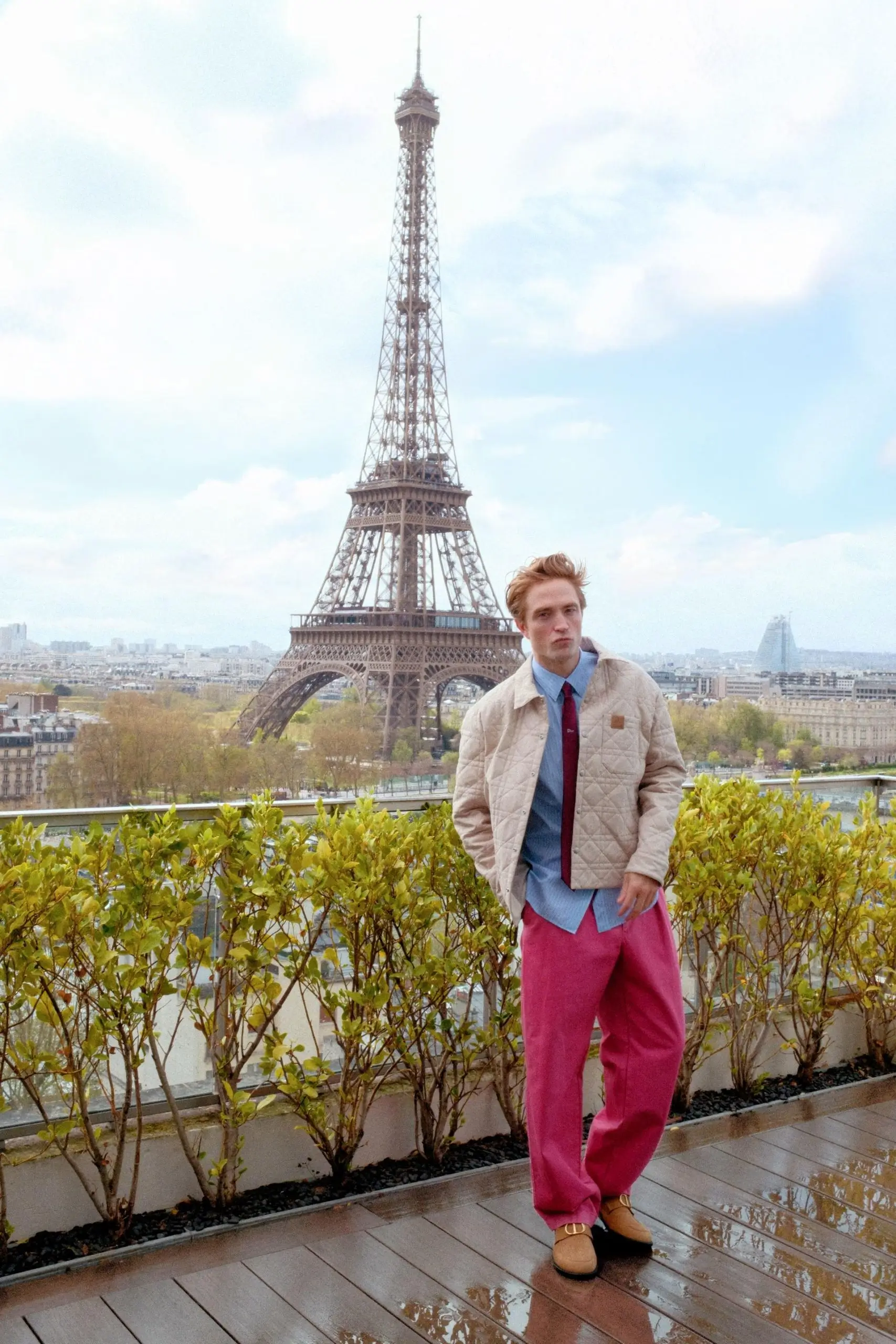
Behind him, the Eiffel Tower rises with its familiar lattice—an architecture of repetition, discipline, and historical permanence. In front of it, Pattinson stands in a look by Dior that mirrors this sensibility: structured, deliberate, and quietly resolved. The scene is not dramatic, but it is exact. And in that exactness, it begins to suggest something more.
This is not simply a press appearance. It is a prelude.
stir
The Dior look—beige cannage fabric jacket, blue striped shirt, red silk tie, pink chinos, brown loafers—might, on paper, read as expressive. Yet on the body, it resolves into something more restrained. The palette does not compete; it converses. The pink is softened by proportion, the red contained by placement, the beige grounding the composition with a familiar calm.
What becomes evident is that the outfit is not designed to impress in isolation. It is designed to hold itself together. There is an internal coherence to it, a sense that each element understands its role within a larger system. Nothing is exaggerated; nothing is withheld. The look exists in balance.
And balance, here, is not aesthetic alone. It is thematic.
film
At the time of this appearance, Pattinson is engaged in press surrounding The Drama, a forthcoming film alongside Zendaya. Directed by Kristoffer Borgli, the project arrives under the careful stewardship of A24—a studio whose work often resists easy classification.
The premise, at first, appears familiar. A couple stands on the threshold of marriage, their lives seemingly aligned toward a shared future. The days leading up to the wedding are expected to affirm this alignment, to solidify what has already been decided.
But the film does not move in affirmation. It moves in disruption.
What begins as certainty is gradually unsettled. Not through spectacle, but through revelation. The tension does not come from external circumstance, but from within—an unspooling of understanding that alters how each character perceives the other. The wedding, rather than a culmination, becomes a point of exposure.
The structure remains. The meaning shifts.
flow
Seen in this light, Pattinson’s appearance in Paris begins to resonate differently. The Dior look, with its measured construction, reflects a world in which things are held in place. Lines are defined. Proportions are maintained. There is a sense that everything has been considered.
And yet, the film he is promoting suggests the opposite trajectory. A movement away from certainty. A loosening of definitions. A recognition that what appears stable may not remain so.
The tension between these two conditions—structure and unraveling—does not resolve itself. Instead, it is held in suspension. The image of Pattinson, composed against the Eiffel Tower, becomes a quiet articulation of this suspension. He stands within order, while speaking toward instability.
away
To consider Paris merely as a setting would be to diminish its role. The city functions here as a kind of cultural framework, one that carries with it a long history of refinement, discipline, and aesthetic continuity. The Eiffel Tower, in particular, is not only a landmark but a symbol of engineered precision—a structure that reveals its own logic through repetition.
This logic finds an echo in Dior’s design language. The cannage motif, with its geometric patterning, suggests a similar commitment to order. It is decorative, but it is also structural. It imposes a rhythm upon the surface, a sense of continuity that extends beyond the individual garment.
Together, Paris and Dior establish a visual environment defined by coherence. Within this environment, Pattinson’s presence does not disrupt. It aligns.
Which is precisely why the film’s premise—its quiet destabilization—feels all the more pronounced by contrast.
show
There is a tendency, in moments of view, to perform emphasis. To amplify gesture, to assert presence. Pattinson’s approach here is notably different. His posture is relaxed, his expression contained. There is no overt attempt to dominate the frame.
This restraint does not read as absence. It reads as control.
In many ways, this mirrors the kind of performances that have come to define his recent work. Characters that do not declare themselves immediately, but reveal their complexities over time. Individuals whose internal states are not fully legible at first glance.
In The Drama, this approach is likely to find a particularly fitting context. A story concerned with the gradual erosion of certainty requires performances that can sustain ambiguity. That can hold tension without resolving it too quickly.
Pattinson’s presence in Paris suggests an understanding of this requirement. The performance has already begun, even if only in gesture.
people
Opposite Pattinson in The Drama is Zendaya, an artist whose own trajectory has been defined by a careful negotiation between visibility and depth. Her work often occupies a space between clarity and complexity, offering performances that are both immediate and layered.
The pairing of these two actors is not incidental. It suggests a dynamic in which neither presence overwhelms the other. Instead, each becomes a counterpoint, a reflective surface through which the other can be understood.
In a narrative centered on a relationship under strain, this balance becomes essential. The film does not require a dominant perspective. It requires an exchange—one in which meaning is generated through interaction rather than assertion.
This, too, finds an echo in the Paris image. The look is not singular; it is relational. Each element gains significance through its proximity to the others.
subtle
What distinguishes The Drama from more conventional relationship narratives is its refusal to externalize conflict in obvious ways. The disruption is not marked by grand events, but by shifts in perception. Moments of recognition that alter the trajectory of understanding.
This kind of disruption is difficult to depict, and even more difficult to sustain. It requires a careful calibration of tone, an ability to suggest rather than declare.
The Dior look, in its own way, operates similarly. It does not rely on a single statement piece or an overt gesture. Its impact is cumulative, built through the interaction of elements that, individually, might seem understated.
The connection is not literal, but it is resonant. Both the film and the look engage with the idea that meaning can emerge through subtle shifts, rather than dramatic declarations.
sig
In the end, what remains most striking about this moment is its refusal to resolve into a single narrative. It does not present a clear message or a definitive interpretation. Instead, it offers a set of conditions—a composition of elements that suggest multiple readings.
Pattinson in Dior, in Paris, promoting a film about a relationship on the verge of unraveling. Each component carries its own significance. Together, they form a kind of quiet equation, one that balances structure against uncertainty, composure against tension.
The image does not explain itself. It does not need to.
fin
There is something quietly humbling in this restraint. In the recognition that not every moment needs to declare its importance in order to possess it. That meaning can reside in alignment, in the careful calibration of elements that, together, create a sense of coherence.
Pattinson’s appearance in Paris does not seek to redefine him, nor does it attempt to encapsulate the entirety of The Drama. Instead, it offers a glimpse—a moment in which the external and the internal briefly align, before inevitably diverging again.
And perhaps that is what makes it compelling. Not its ability to assert, but its willingness to suggest. Not its certainty, but its openness to interpretation.
In a landscape often defined by immediacy and emphasis, this kind of quiet precision feels not only rare, but necessary.