RSRV Champion Sweatshirt: Motorsport DNA

January 22, 2026
In an err when luxury houses borrow freely from athletic wear and sports brands flirt with couture techniques, the most interesting garments often emerge in the overlap—where function, subculture, and graphic identity converge. The RSRV Champion Sweatshirt sits squarely in that intersection. Produced under Alpinestars’ experimental RSRV line, the piece translates decades of motorsport protection and ergonomic research into a pared-back, city-ready silhouette that reads less like merch and more like a study in technical restraint.
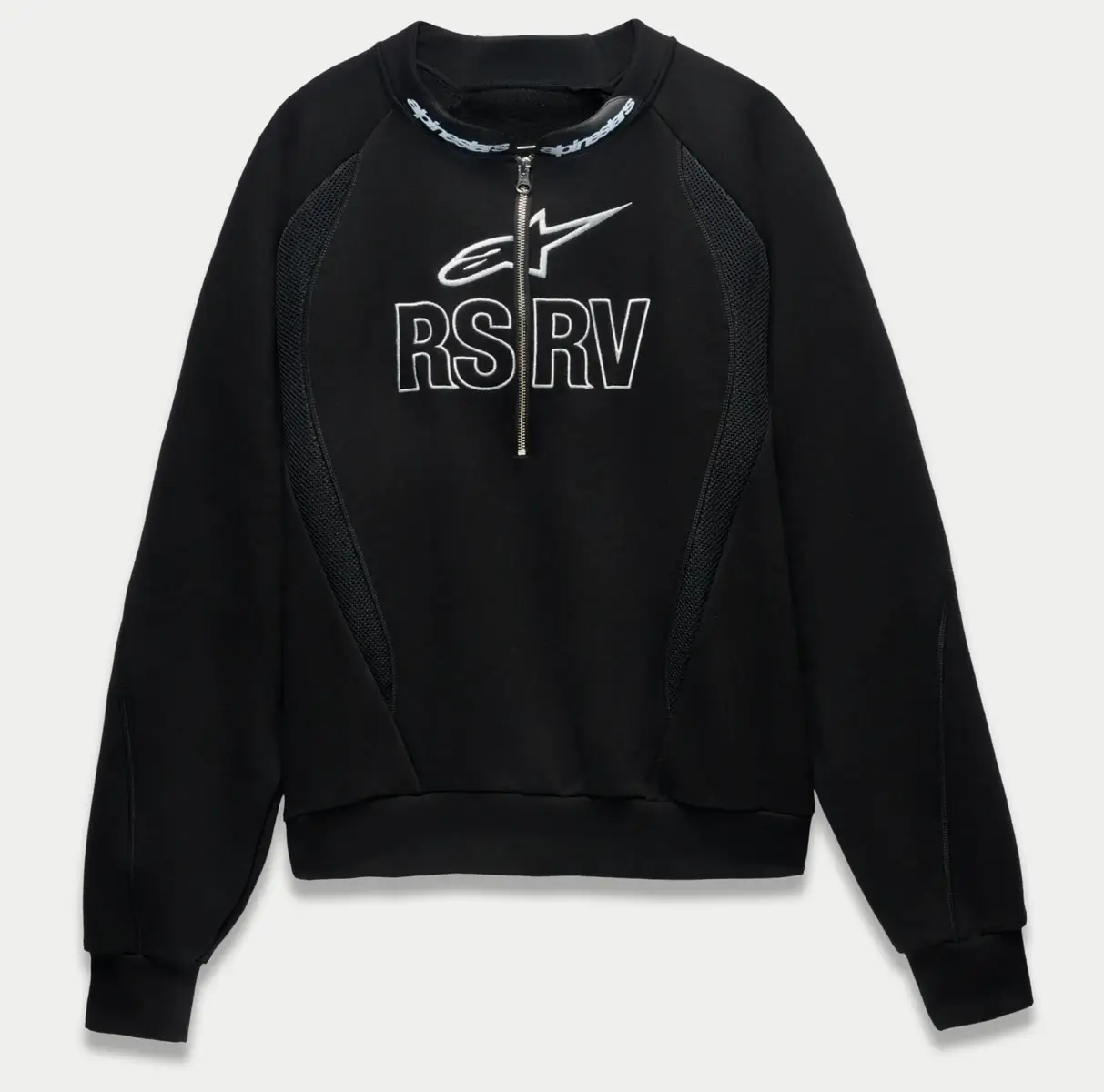
At first glance, it appears deceptively simple: a black crewneck with a short front zip, sculpted seams, and bold white “RSRV” branding across the chest. Look closer, however, and the s weatshirt reveals itself as a modular hybrid—part riding layer, part street staple, part conceptual uniform—engineered with the same attention to movement and reinforcement that defines Alpinestars’ racing gear.
stir
Alpinestars is best known for its role in professional motorsport and motorcycle racing, supplying riders with suits, boots, gloves, and protective systems built for extreme conditions. Over the last decade, however, the brand has increasingly explored how that technical expertise might translate into lifestyle apparel.
RSRV—short for reserve—functions as its research arm, a space where silhouettes can be re-imagined without the strict regulatory constraints of racing homologation. Within this context, the Champion Sweatshirt reads like a prototype released into the wild: stripped of overt armor but retaining the anatomical logic, paneling, and durability that underpin riding garments.
Rather than leaning into overt futurism, the design communicates through structure. Every seam placement and fabric transition suggests motion mapping, as if the sweatshirt were drafted on a body mid-corner at speed.
sil
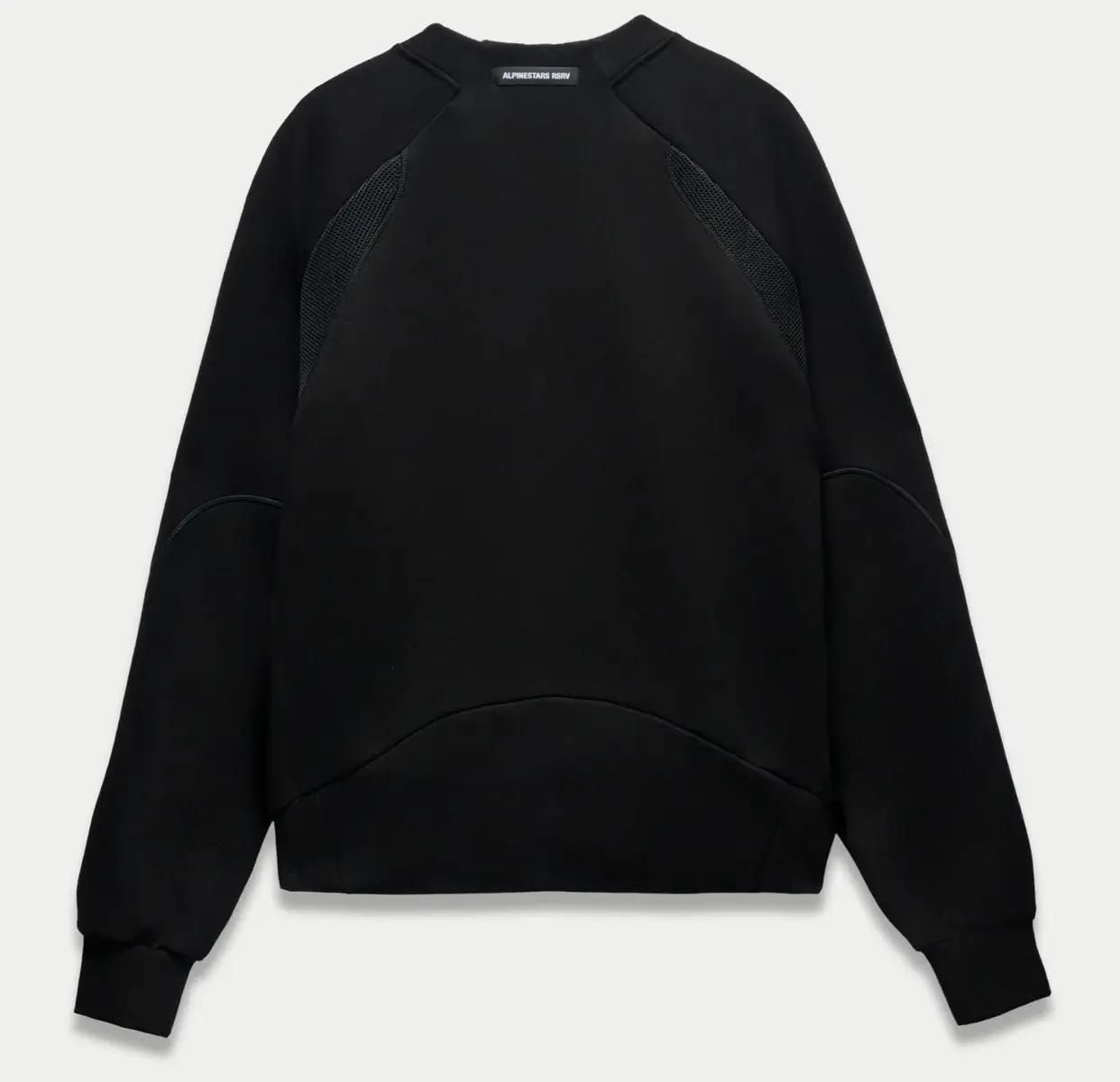
The sweatshirt’s cut deviates subtly from standard athletic fleece. Instead of flat raglan sleeves and uninterrupted front panels, the RSRV Champion introduces contoured mesh inserts that run along the torso and under the arms, visually carving the garment into aerodynamic zones. These perforated sections provide ventilation while also echoing the look of racing undersuits and protective liners.
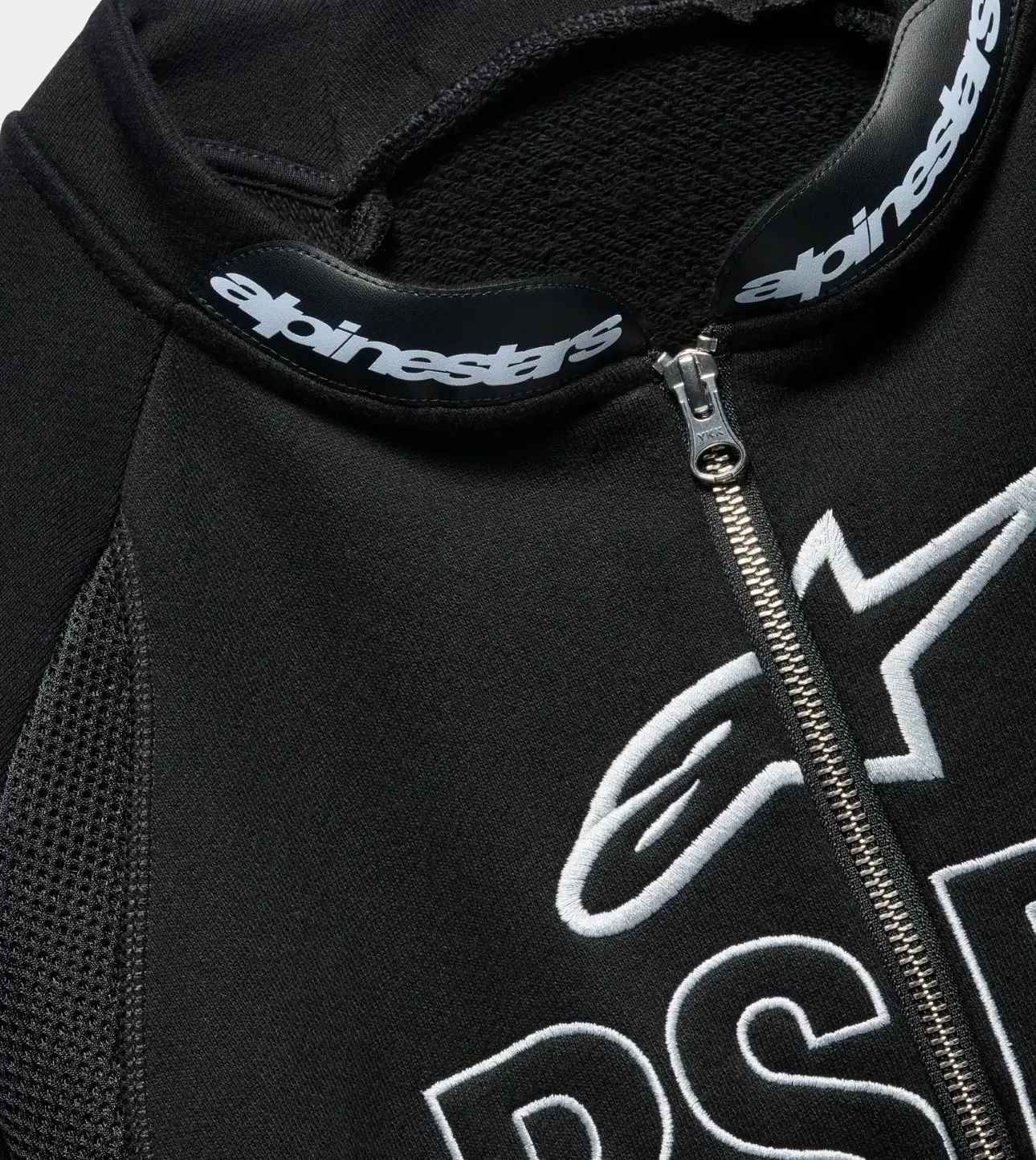
The half-zip at the collar is another motorsport-coded detail. Positioned centrally and finished with a polished metal pull, it allows the neckline to open for airflow or close into a snug, almost balaclava-adjacent shape. Around the collar interior, the Alpinestars wordmark repeats in a continuous loop, transforming what is normally a hidden label into a subtle graphic band.
From the rear, the sweatshirt becomes even more minimal. The back panel is free of loud logos, broken only by the same sculptural seam lines and mesh zones found on the front. A small “ALPINESTARS RSRV” label sits at the nape, reinforcing the sense that this is a system garment—part of a wider modular wardrobe rather than a standalone graphic piece.
flow
RSRV’s approach to branding is markedly restrained compared to typical motorsport apparel. Instead of sponsor-style clutter, the Champion Sweatshirt relies on a single focal point: the bold RSRV lettering across the chest, accompanied by Alpinestars’ star emblem rendered in crisp white embroidery.
The typography is blocky and industrial, reminiscent of pit-lane stenciling or equipment crates, yet its placement feels deliberately fashion-forward—balanced, centered, and scaled for everyday wear rather than spectacle. It is branding as punctuation, not proclamation.
This restraint allows the garment to sit comfortably in multiple wardrobes. Styled with cargo trousers and technical sneakers, it leans utilitarian. Paired with tailored wool pants or layered under a coat, it becomes a subtle nod to performance culture without tipping into costume.
tact
While the sweatshirt reads as black-on-black minimalism in photographs, texture plays a significant role in person. The main body appears constructed from a dense, smooth fleece—substantial enough to hold its shape—contrasted with the open-hole mesh panels that introduce both airflow and visual depth.
These material shifts mirror the layering strategies of racing gear, where abrasion-resistant zones sit alongside breathable sections. Even without protective padding, the sweatshirt carries that logic into daily life, suggesting durability at stress points and flexibility where the body bends.
The ribbed cuffs and hem anchor the silhouette, preventing it from ballooning outward and reinforcing the idea that this is a garment meant to move with the wearer rather than drape loosely.
show
What makes the RSRV Champion Sweatshirt compelling is not just its construction but the way it reframes motorsport aesthetics for a non-riding audience. Instead of leather panels, carbon fiber textures, or reflective piping, the piece relies on pattern engineering—the invisible architecture of sportswear design—to communicate its origins.
The curved seams tracing the torso resemble the articulation lines on race suits. The mesh panels evoke ventilation channels. The collar branding recalls the interior labels of helmets or balaclavas. None of these details are overtly aggressive, yet together they create a garment that feels purpose-built rather than decorative.
In the broader streetwear ecosystem, this positions RSRV closer to technical fashion labels than to logo-driven collaborations. The sweatshirt feels aligned with the growing appetite for functional minimalism—clothing that signals expertise and system design rather than hype.
idea
Performance-inspired fashion has evolved dramatically over the past decade. What began as obvious athletic references—track pants, windbreakers, running shoes—has shifted toward subtler integrations of outdoor and motorsport technology into everyday silhouettes.
The RSRV Champion Sweatshirt exemplifies this progression. It does not look like riding gear adapted for the street; it looks like streetwear designed by people who build riding gear. That distinction matters. Instead of borrowing aesthetics, the garment borrows methodologies: ergonomic mapping, ventilation logic, reinforcement through construction rather than add-ons.
This approach resonates in a moment when consumers are increasingly interested in how clothes are made, not just how they photograph. The sweatshirt invites scrutiny. It rewards closer inspection. It feels like a piece you could wear daily without exhausting its visual language.
style
Because of its monochrome palette and disciplined branding, the Champion Sweatshirt functions as a versatile anchor piece. In a technical wardrobe, it layers naturally with shell jackets, modular vests, and cargo trousers. In a more minimal setup, it pairs cleanly with denim, tailored slacks, or leather footwear, offering just enough edge to disrupt otherwise classic lines.
Culturally, it speaks to a convergence of worlds: motorsport fans drawn to Alpinestars’ heritage, fashion audiences attuned to technical silhouettes, and streetwear consumers who value scarcity and research-driven sublines. RSRV operates in that liminal zone where equipment becomes apparel and apparel hints at equipment.
fin
The RSRV Champion Sweatshirt is not built to shout. Its appeal lies in precision—how lines follow the body, how mesh breaks up mass, how branding is deployed with discipline rather than excess. It is a study in translation, converting the logic of racing protection into a garment suited for everyday movement.
In doing so, Alpinestars’ RSRV line underscores a larger shift in contemporary fashion: away from surface-level sport references and toward deeper integrations of performance engineering. The Champion Sweatshirt feels less like a seasonal graphic piece and more like a uniform for a future where technical literacy is as important as aesthetic fluency.
For anyone tracking the evolution of performance-driven streetwear, it stands as a quiet but confident signal—proof that the most compelling design innovations often come not from decoration, but from how clothes are built to work with the body itself.