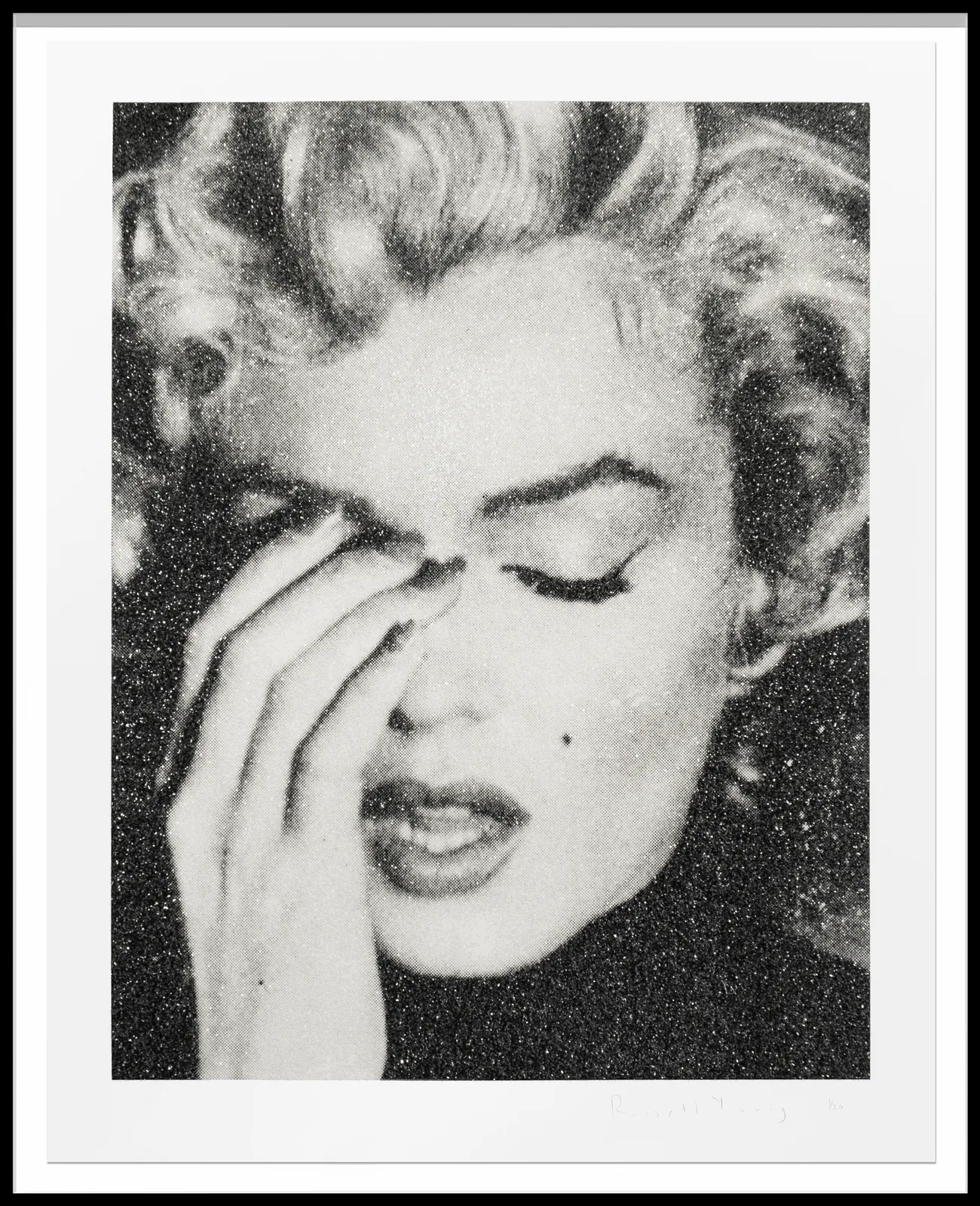
Familiarity usually softens an image. Repetition turns it ambient, strips it of friction, makes it easy to live with. Marilyn Crying by Russell Young refuses that trajectory. It compresses one of the most circulated faces in modern culture—Marilyn Monroe—into something tense, almost electrically unstable.
What registers first is recognition. What lingers is interference.
Young does not attempt recovery. He works in saturation—where the image has already been seen too much, handled too often, flattened into symbol. Instead of peeling back layers to find authenticity, he amplifies the conditions that made authenticity impossible in the first place.
The portrait doesn’t open. It resists.
idea
Acrylic and hand-pulled oil-based ink screenprint establish the structural base, but the decisive shift happens at the surface. Diamond dust interrupts the image, refracting light into micro-fractures that refuse visual stability.
The effect is not indulgent. It is corrective.
From a distance, the face appears resolved—high-contrast, sharply legible, almost cinematic in its compression of silhouette and highlight. Step closer and coherence begins to slip. The skin breaks into particulate shimmer. The tears—central, unavoidable—refuse to settle into sentiment. They catch light, distort it, redirect it.
This is not gloss. It is abrasion disguised as glamour.
Young has used diamond dust for years, but here it operates with precision. It destabilizes the expectation that beauty should hold. It introduces movement into what should be fixed. The image never fully lands.
flow
The scale mirrors the human body without mimicking it, creating a spatial tension: the viewer is neither dwarfed nor entirely in control.
That balance matters.
Too small, and the image would collapse into objecthood—collectible, manageable. Too large, and it risks spectacle. Here, the dimensions sustain confrontation. The viewer remains implicated, held in a loop between distance and proximity.
The surface pulls you in. The instability pushes you back.
stir
Emotion in mass culture is often simplified into legibility—joy, sadness, desire, loss. Marilyn Crying resists that simplification. The tear is not a narrative device. It does not point backward to a specific moment, nor forward to resolution.
It functions structurally.
The tear interrupts the face’s symmetry. It disrupts the expectation of control that Monroe’s image historically performs. But more than that, it exposes the mechanics of looking. The viewer is trained to read tears as intimacy, as access to interiority. Young denies that access.
The tear is visible. Its meaning is not.
This distinction matters. It transforms the work from emotional portrait to visual system under stress.
style
Young’s use of silkscreen places him in direct dialogue with Andy Warhol, whose serial images of Monroe helped define the relationship between celebrity and reproduction. But where Warhol embraced repetition as both method and critique, Young intensifies the singular image until it behaves like repetition.
The effect is subtle but significant.
Instead of presenting multiple versions, Young creates one image that feels multiplied—layered with prior encounters, cultural memory, inherited recognition. The viewer does not see this Marilyn in isolation. Every previous Marilyn collapses into it.
The image is crowded.
This density shifts the work away from homage. It becomes a site where cultural accumulation is made visible, where the weight of prior images presses against the present one.
pressure
Monroe’s image has long been associated with glamour—radiant, controlled, endlessly reproducible. Young reframes glamour as something closer to pressure.
High contrast flattens the face into zones of light and shadow, eliminating gradients that would otherwise soften the image. The result is stark, almost confrontational. Beauty is still present, but it is held in tension, compressed into a narrower visual bandwidth.
Diamond dust intensifies this compression. It catches light aggressively, refusing subtlety. The surface glitters, but the effect is not ease—it is insistence.
Glamour becomes effortful. Maintained. Fragile.
The work suggests that what has been historically read as effortless allure is, in fact, the result of sustained pressure—cultural, industrial, psychological.
theory
Young’s broader practice often engages with figures whose public images have eclipsed their private lives—icons shaped as much by mythology as by reality. His portraits do not attempt to reconstruct biography. They operate adjacent to it.
In Marilyn Crying, this approach is refined.
The work does not illustrate Monroe’s life—its well-documented arcs of success, scrutiny, and premature death. Instead, it engages with the persistence of her image. What does it mean for a face to continue circulating long after the person is gone? What happens when that circulation becomes self-sustaining?
Young’s answer is not narrative. It is material.
The image holds. The person recedes.
rare
As a limited edition, signed and numbered, stamped “Marilyn 100” and authorized by the Estate of Marilyn Monroe and Authentic Brands Group, the work participates in a familiar art-market logic: scarcity within reproducibility.
This tension is not incidental. It mirrors the work’s internal dynamics.
Silkscreen, by nature, is a reproducible medium. It carries the logic of multiplication. The limited edition constrains that multiplication, reintroducing exclusivity. Diamond dust further individualizes each print—no two surfaces refract light in exactly the same way.
The result is a controlled contradiction: an image born from repetition, stabilized through limitation, and subtly differentiated through material variance.
Ownership becomes part of the work’s meaning.
place
Shipping from Brooklyn, with the option for local pickup, situates the work within a contemporary network of circulation—gallery, collector, private space. The absence of a fixed frame in the listing introduces another layer of variability. Presentation is not fully determined. It remains open, contingent.
This matters for how the work lives.
Framed differently, lit differently, placed in different environments, the diamond dust will behave differently. The image is not static. It responds. It shifts with context.
The work is completed not at the point of production, but in its ongoing interaction with space, light, and viewer.
configured
Young’s engagement with Monroe sits alongside his portraits of other cultural figures—Elizabeth Taylor, Kurt Cobain—each treated not as individual subjects but as nodes within a larger system of cultural projection.
What distinguishes Marilyn Crying within this lineage is its clarity of focus.
The image is stripped to essentials. No extraneous detail, no narrative scaffolding. Just face, tear, surface. The reduction intensifies the work’s impact. It leaves less room for distraction, more space for tension.
The icon is not expanded. It is compressed.
fin
Some works conclude when you leave them. Others persist as afterimage—carried forward, reactivated in different contexts. Marilyn Crying belongs to the latter.
Not because it reveals something hidden, but because it destabilizes something assumed.
The face remains recognizable. The tear remains visible. But neither settles into meaning. The image continues to operate—quietly, insistently—beyond the moment of viewing.
That persistence is the work’s final gesture.
Not closure. Continuation.