Ryan Gosling Enters the Daniels Cinematic Framework for (2027)

March 27, 2026
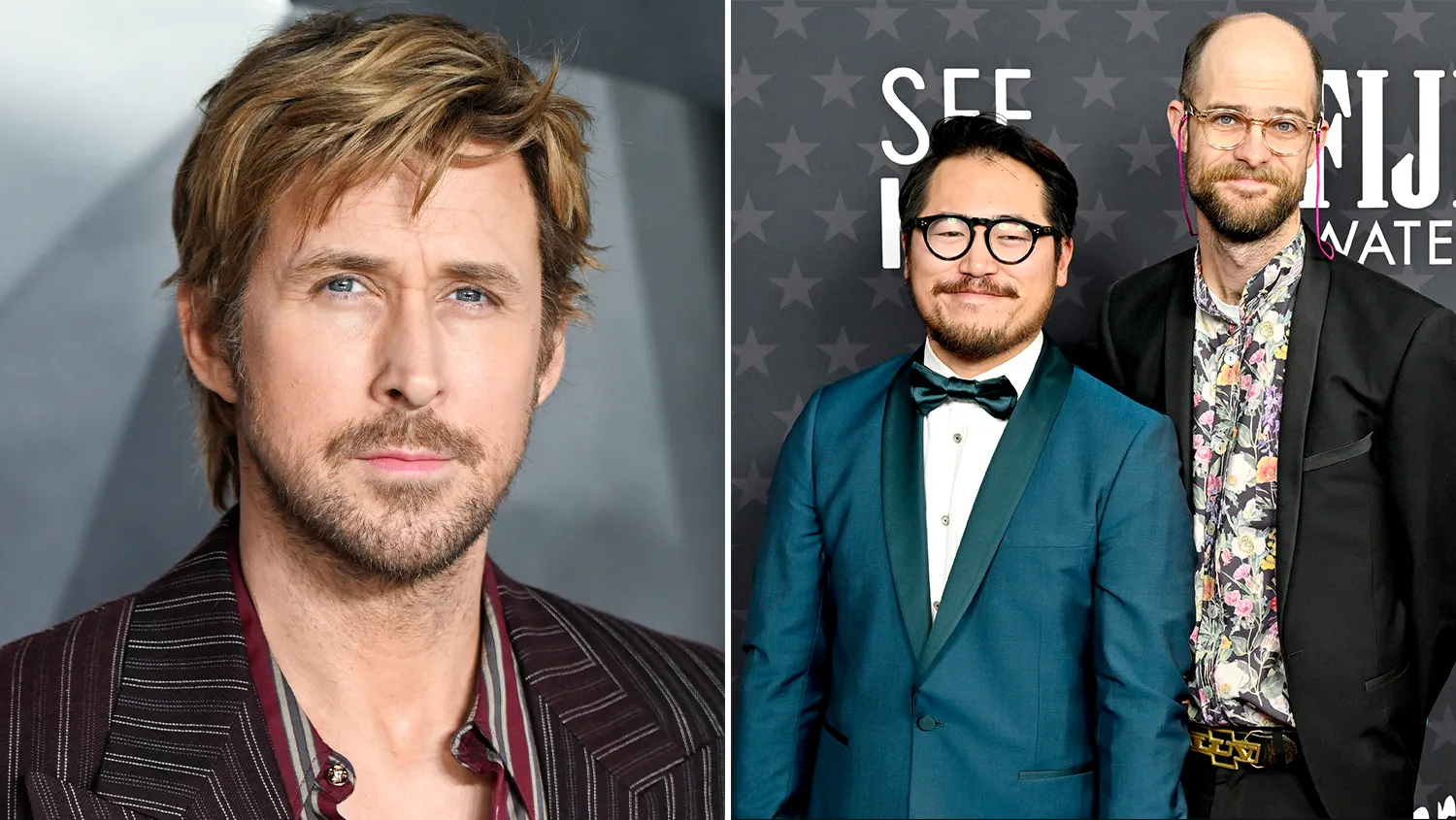
The announcement arrives without a title, without a synopsis, and with just enough detail to signal intent. Ryan Gosling will lead a new feature from Daniel Kwan and Daniel Scheinert—the directing pair known collectively as Daniels—with a theatrical release set for November 19, 2027. On paper, it reads like a straightforward alignment of A-list actor and Oscar-winning filmmakers. In practice, it suggests something more deliberate: Gosling continuing to build a body of work shaped not just by roles, but by the dynamics of collab itself.
There is a difference between choosing scripts and choosing systems. What Gosling appears to be doing now is the latter.
stir
Gosling’s career has never followed a predictable arc, but it has always been methodical. From early performances rooted in interiority to more stylized, culturally amplified roles in the 2020s, his evolution has been less about reinvention and more about recalibration. Each phase introduces a subtle shift in how he engages with authorship.
Working with Daniels extends that trajectory.
Their breakout film, Everything Everywhere All at Once, didn’t just succeed commercially and critically—it redefined how contemporary audiences engage with narrative density. It collapsed genre boundaries, moved fluidly between absurdist comedy and existential drama, and demanded a level of emotional elasticity rarely seen in mainstream cinema. That elasticity is precisely where Gosling operates most effectively.
But more importantly, Daniels represent a particular kind of authorship: one that is inherently plural.
Unlike traditional director-led productions, where a singular vision governs tone and structure, Daniels’ work is built on internal dialogue. Ideas are tested, refracted, and expanded through collaboration before they ever reach the screen. The result is not compromise—it is amplification. Two perspectives, sharpened against each other, producing something neither could arrive at alone.
For an actor like Gosling, this creates a different kind of space. Less hierarchical. More volatile. Potentially more rewarding.
idea
What defines Daniels is not simply their visual maximalism, but their ability to organize excess into coherence.
In Everything Everywhere All at Once, multiverse logic becomes a structural device for emotional storytelling. The film’s rapid tonal shifts—moving from slapstick to tragedy within seconds—are not arbitrary. They are calibrated to reflect the fragmentation of identity, memory, and connection in a hyper-mediated world.
This approach requires performers who can navigate contradiction without flattening it.
Gosling’s strength has always been his control. Even in roles that lean toward spectacle, there is a measured quality to his performances—a sense that every gesture is intentional, even when the character appears untethered. That control becomes especially potent when placed inside a system that thrives on unpredictability.
The Daniels method does not erase that control; it pressures it.
And under pressure, Gosling tends to become more precise, not less.
shift
This collide also reflects a broader pattern in Gosling’s recent choices: an increasing alignment with filmmakers who operate as duos or within tightly integrated creative partnerships.
Directing duos function differently from solo auteurs. Decision-making is distributed, but not diluted. There is a built-in system of critique, a constant negotiation that refines ideas before they solidify. For actors, this can create a more dynamic feedback loop—one that encourages risk while maintaining structural clarity.
Gosling’s interest in this model suggests a shift in how he defines creative trust.
Rather than relying on singular authority, he appears drawn to environments where authorship is shared, where the process itself becomes part of the final form. It’s a subtle but meaningful distinction. The work is no longer just about the performance; it’s about the ecosystem in which that performance is developed.
intent
The November 19, 2027 release date is not incidental. Positioned at the edge of awards season, it signals confidence in both the material and its reception. It also reinforces a commitment to theatrical storytelling at a time when distribution strategies remain in flux.
Daniels’ previous success demonstrated that audiences are willing to engage with complex, unconventional narratives on a large scale. Gosling’s involvement adds another layer of accessibility without necessarily simplifying the material. His presence tends to anchor even the most experimental projects, providing a point of entry for broader audiences.
This balance—between accessibility and ambition—will likely define the project’s positioning.
It is not expected to be minimal. Nor is it likely to be purely spectacle-driven. If anything, the Daniels-Gosling alignment suggests a film that operates in tension: between intimacy and scale, coherence and fragmentation, control and release.
show
What kind of role Gosling will take on remains undisclosed, but certain assumptions can be made based on the Daniels’ established language.
Their characters are rarely singular. They exist across variations—multiple versions, alternate selves, emotional states that overlap rather than resolve. Identity is fluid, often unstable. Narrative progression is less about linear development and more about accumulation.
For an actor, this requires a different kind of calibration.
Instead of building a character along a single arc, the performance must hold multiple possibilities simultaneously. It must remain coherent even as it fractures. Gosling’s ability to internalize complexity without externalizing it too explicitly makes him particularly suited to this challenge.
He does not over-explain. He allows ambiguity to remain intact.
Within a Daniels framework, that restraint becomes a counterweight to visual and tonal excess. It grounds the film without constraining it.
straddle
The collaboration also occupies an interesting position within the broader industry landscape.
Daniels are no longer outsiders, but they have not fully assimilated into traditional studio systems either. Their work maintains an experimental edge, even as it reaches wider audiences. Gosling, meanwhile, operates comfortably within both independent and mainstream contexts, moving between them without friction.
Together, they create a hybrid model.
A film that carries the markers of prestige—high-profile talent, awards-season timing, theatrical release—while retaining the unpredictability of experimental cinema. This hybridization reflects a broader shift in audience expectations, where distinction between “art” and “entertainment” is increasingly porous.
The success of Everything Everywhere All at Once was not an anomaly. It was an indicator.
role
One of the more compelling aspects of this pairing is the potential tension between Gosling’s restraint and Daniels’ maximalism.
Maximalist cinema often risks overwhelming its own emotional core. When everything is heightened, differentiation becomes difficult. Daniels have managed to avoid this through careful structuring, but the presence of an actor known for precision and minimalism introduces an additional layer of control.
Gosling does not compete with spectacle. He absorbs it.
This dynamic could allow the film to expand without losing focus, to explore extremes without collapsing into excess. It creates a center of gravity—an anchor point around which the film’s more chaotic elements can orbit.
what
At this stage, the absence of detail is part of the narrative.
No title. No plot. No supporting cast. This lack of information does not signal uncertainty; it suggests a controlled rollout. In an industry saturated with pre-release content, withholding specifics can function as a strategic choice—allowing anticipation to build without overdetermining audience expectations.
It also aligns with Daniels’ approach to storytelling, where discovery is central to the experience.
Revealing too much too early would undermine that.
sum
By the time the film reaches theaters on November 19, 2027, it will carry multiple layers of expectation. Not just because of the names involved, but because of what those names represent within the current cinematic moment.
For Ryan Gosling, it marks a continued refinement of his collaborative strategy—an investment in systems that prioritize dialogue over singular vision. For Daniel Kwan and Daniel Scheinert, it is an opportunity to expand their language with a performer capable of navigating its complexities without dilution.
What emerges from that convergence is still unknown.
But the conditions are precise.
And in contemporary cinema, precision—especially within chaos—is often where the most interesting work begins.