Shepard Fairey, 2009 — Be The Change: The Image and Its Moment

March 20, 2026
influ
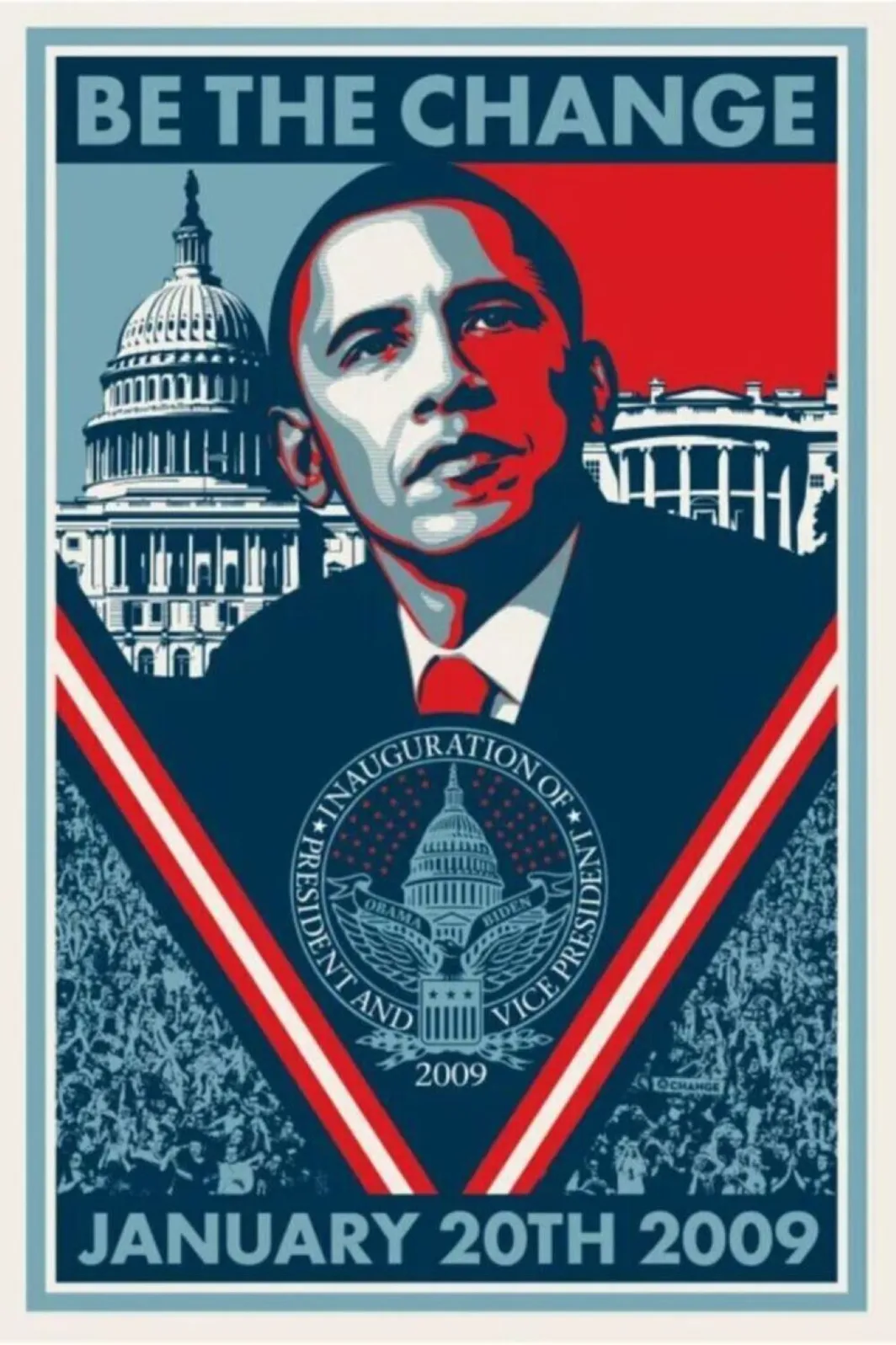
In the stratified ecosystem of contemporary art, where the distance between mass image and museum artifact has collapsed into something almost indistinguishable, Shepard Fairey’s Be The Change (2009) occupies a uniquely calibrated position. It is at once accessible and rare, political yet aestheticized, rooted in street culture while fully absorbed into the institutional canon. This particular work—rendered as a screenprint on paper in a limited edition of 1000—represents not merely a collectible object but a crystallization of a moment when graphic design, activism, and mass media converged with unprecedented force.
Measuring 24 × 35 4/5 inches (61 × 91 cm), the print asserts its presence physically as much as ideologically. The scale is deliberate: large enough to command wall space, yet intimate enough to retain the immediacy of a poster—its original, intended format. Unlike a canvas, which often implies singularity, the screenprint format embraces repetition. Yet, paradoxically, through hand-signing and numbering, each piece regains a sense of individuality within its multiplicity.
The condition—excellent, unframed, accompanied by a certificate of authenticity issued by a gallery—reinforces its status as both artwork and artifact. It is not merely preserved; it is archived, authenticated, and contextualized within the systems that now govern contemporary art valuation. The absence of a frame is telling. It allows the work to exist closer to its origins: raw, immediate, and adaptable to its environment.
fairey
Born in 1970 in the United States, Fairey emerged in the early 1990s through the now-mythologized “Andre the Giant Has a Posse” campaign. What began as a play experiment in sticker culture quickly transformed into a semiotic intervention, questioning authority, authorship, and the mechanisms of visual persuasion.
The Andre campaign’s brilliance lay in its ambiguity. It did not tell viewers what to think; it compelled them to question why they were thinking at all. This strategy—subtle, subversive, and deeply informed by the aesthetics of propaganda—would become Fairey’s signature language.
By 2008, this language reached its apotheosis with the HOPE poster created for Barack Obama’s presidential campaign. That image, with its triadic color scheme of red, beige, and blue, and its stylized portraiture, transcended its political context to become one of the most recognizable artworks of the 21st century. It was not merely a campaign poster; it was a cultural artifact, a symbol of aspiration, and a case study in the power of graphic design to shape collective consciousness.
Be The Change, produced the following year in 2009, operates as both a continuation and a distillation of that moment. It extends the view grammar established by HOPE while shifting the emphasis from a singular political figure to a broader, more participatory call to action.
view
Fairey’s work is often described as propaganda-inspired, but this characterization only scratches the surface. His compositions are meticulously constructed systems of view hierarchy, where every element—color, typography, pattern, and portraiture—functions with precision.
In Be The Change, the color palette adheres to Fairey’s established triad: deep red, muted blue, and cream. These colors are not arbitrary; they evoke both American patriotism and historical propaganda aesthetics, referencing Soviet constructivism, Chinese cultural posters, and mid-century political graphics. The palette is emotionally charged, instantly recognizable, and psychologically effective.
The portrait—central to the composition—is rendered in Fairey’s signature style: high-contrast, simplified, yet deeply expressive. It is not realism in the traditional sense; it is iconography. The subject becomes less an individual and more a symbol, a vessel for collective ideals.
Typography conjures an equally critical role. The phrase “Be The Change” is not merely a caption; it is a directive. Set in bold, declarative type, it functions as both slogan and command. Fairey understands that text, when integrated seamlessly into an image, can amplify its impact exponentially. The words do not explain the image; they activate it.
Surrounding patterns—often floral or ornamental—introduce a layer of complexity that contrasts with the starkness of the central portrait. These elements soften the composition while simultaneously referencing historical decorative motifs, creating a dialogue between past and present.
stir
The notion of a limited edition—particularly one of 1000—introduces a fascinating tension. On one hand, the work is reproducible, rooted in a medium designed for dissemination. On the other, its limitation creates scarcity, elevating it within the art market.
This paradox is central to Fairey’s practice. His work originates in the streets, where replication is not only accepted but essential. Yet, as his career has progressed, these same images have been absorbed into galleries, auctions, and private collections, where scarcity and exclusivity define value.
The hand-signed and numbered nature of Be The Change bridges these two worlds. It acknowledges the work’s reproducibility while reasserting the artist’s presence within each individual piece. The signature becomes a mark of authenticity, a guarantee of origin, and, ultimately, a driver of market value.
Fairey’s auction record—reaching over $600,000 at Sotheby’s in 2020—underscores this transformation. What began as ephemeral street interventions now commands six-figure sums, collected by institutions such as the San Francisco Museum of Modern Art and the Art Institute of Chicago. The trajectory is not merely upward; it is emblematic of a broader cultural shift in how we define and value art.
flow
Representation by leading galleries, including Baldwin (with locations in London, Miami, and Dubai), situates Fairey firmly within the global art market. These spaces function as both commercial platforms and cultural validators, shaping the narratives around contemporary artists.
Exhibitions such as The Future is Unwritten (Opera Gallery, 2023) and earlier shows at Pace Prints and Jacob Lewis Gallery demonstrate the sustained institutional interest in Fairey’s work. These exhibitions do more than display art; they contextualize it, situating individual pieces within broader thematic and historical frameworks.
For collectors, this institutional backing is critical. It provides not only validation but also a narrative—an understanding of the work’s significance within the larger arc of contemporary art. Ownership, in this context, becomes participation in a cultural dialogue.
show
At its core, Be The Change is a political artwork. Yet, its politics are mediated through aesthetics, making it both accessible and enduring. Fairey does not present complex policy arguments; he distills ideas into images that resonate on an emotional level.
The phrase itself—“Be The Change”—is rooted in a broader philosophical tradition, often attributed to Mahatma Gandhi. By incorporating this message into a visually compelling format, Fairey transforms a familiar maxim into a contemporary call to action.
This approach raises important questions about the role of art in political discourse. Can an image inspire action? Can aesthetics influence ideology? Fairey’s work suggests that the answer is yes—but with nuance. The power of his images lies not in their specificity but in their openness, allowing viewers to project their own meanings and motivations.
rare
From a collector’s perspective, the details matter. The excellent condition of the print ensures its longevity, preserving both its visual impact and its market value. The inclusion of a certificate of authenticity adds a layer of security, confirming its provenance and legitimacy.
The absence of a frame, while seemingly minor, offers flexibility. It allows the collector to determine how the work is presented, integrating it into a personal or curated environment. In this sense, the artwork becomes not just an object but a component of a larger aesthetic narrative.
street
The journey of street art—from urban surfaces to gallery walls—is one of the most significant developments in contemporary art. Shepard Fairey stands at the center of this transformation, bridging the gap between underground culture and mainstream recognition.
Be The Change embodies this evolution. It retains the immediacy and accessibility of street art while embracing the permanence and prestige of gallery presentation. It is both transient and enduring, ephemeral in origin yet archival in execution.
idea
More than a decade after its creation, Be The Change remains strikingly relevant. Its message—simple yet profound—continues to resonate in a world defined by rapid change and constant upheaval. The work does not belong to a single moment; it transcends time, adapting to new contexts and interpretations.
This enduring relevance is perhaps Fairey’s greatest achievement. By creating images that operate on multiple levels—visual, emotional, and conceptual—he ensures that his work remains engaged with the present while rooted in a rich historical tradition.
clue
In the final analysis, Shepard Fairey’s Be The Change is more than a screenprint. It is a proposition—an invitation to engage, to reflect, and to act. It occupies a space between art and activism, between individuality and collectivity, between the street and the institution.
For the collector, it offers both aesthetic pleasure and cultural significance. For the viewer, it provides a moment of recognition—a reminder of the power of images to shape our understanding of the world.
And for the broader discourse of contemporary art, it stands as a testament to the evolving relationship between image, message, and medium. In an age saturated with visuals, Be The Change cuts through the noise, asserting its presence with clarity, conviction, and undeniable style.