Shepard Fairey’s Parkland Voices (2020): A Low-Numbered Echo of Resistance and Renewal

April 23, 2025
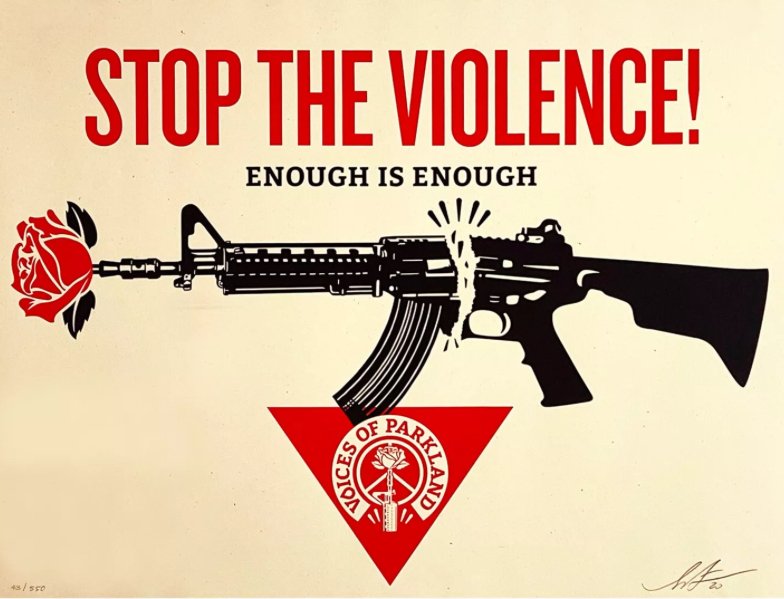
In the wake of national tragedy, some artists respond with silence, others with fury. Shepard Fairey—artist, activist, and architect of the Obey Giant mythos—has built a legacy from speaking through image. With Parkland Voices (2020), Fairey offers not just a screen print but a memorial manifesto, imbued with the youthful defiance of a generation born into lockdown drills and mass shootings. Executed as a screen print on cream Speckletone fine art paper, this edition serves as both artifact and action—a snapshot of post-trauma protest and an enduring call to civic engagement.
This in-depth editorial explores the artistic techniques, cultural relevance, and emotional weight of Parkland Voices—with special attention to its low-numbered printings, which elevate its value not just as a collectible, but as an intimate witness to grief and collective strength.
CONTEXT: THE PARKLAND SHOOTING AND A YOUTH MOVEMENT IGNITED
On February 14, 2018, seventeen people were killed at Marjory Stoneman Douglas High School in Parkland, Florida. It was one of the deadliest school shootings in U.S. history. But the tragedy sparked something different—an articulate, media-savvy, furious movement led by survivors like Emma González, David Hogg, and Jaclyn Corin. Within weeks, they organized March for Our Lives, one of the largest youth-led protests since the Vietnam War.
Fairey’s Parkland Voices, released in 2020, is an aesthetic record of this emotional and political upheaval. It doesn’t exploit the trauma; it amplifies the resolve. True to form, the image is bold, confrontational, and redemptive, drawing from Fairey’s decades-long vocabulary of punk, propaganda, and power.
A CLOSER LOOK: ARTISTIC ELEMENTS OF
PARKLAND VOICES
Fairey’s medium is screen printing, and here he uses it masterfully. Parkland Voices is rendered on cream Speckletone fine art paper, a textured stock that evokes zines, flyers, and underground print traditions. Its tactile quality contrasts sharply with the precision of the graphic composition, forcing the viewer to reconcile handcrafted immediacy with calculated design.
Key visual elements include:
- A central portrait of a young protester, eyes upward, jaw set—neither tragic nor angry, but resolute.
- A megaphone, stylized and symbolic, from which floral motifs and rays of light emanate—suggesting not violence, but amplification, transformation.
- Bold text, often a hallmark of Fairey’s style, with phrases like “Protect Our Future” or “Enough”, depending on the variant.
- Red, black, and gold palette, invoking vintage political posters, Soviet agitprop, and 1960s protest art.
The print is symmetrical but not sterile. The edges bleed with texture. There’s a sense of urgency even in its balance. It’s propaganda for peace—a weapon of optimism.
THE LOW-NUMBERED PRINT: COLLECTIBILITY AND CULTURAL CHARGING
In the realm of printmaking, a low-numbered edition—particularly a piece marked 1/100 or 2/100—carries provenance and prestige. Collectors prize these early pulls for their direct link to the artist’s hand and initial intent. In screen printing, the first few impressions often contain crisper lines, more even ink application, and fewer variations, making them aesthetically and financially significant.
In the case of Parkland Voices, a low-numbered version is more than just a desirable object—it’s a relic of immediacy, printed when the memory of the movement was still raw, when youth leaders were still defining their public voice. Owning one is like possessing a snapshot of American protest history, closer to the fire, nearer to the pulse.
SHEPARD FAIREY’S EVOLVING LANGUAGE: FROM HOPE TO ACTION
Fairey is best known for his “Hope” poster during Barack Obama’s 2008 campaign, a graphic that became emblematic of idealism, unity, and grassroots optimism. But by 2020, his work had shifted—Hope was no longer enough. The post-2016 landscape demanded something more aggressive, more grounded in the reality of protest and policy.
Parkland Voices reflects this shift. It trades aspiration for action, replacing abstract change with real faces, real names, and real grief. It’s a work of anger and grace, focused not on politicians but on the people affected by their failures.
Whereas Fairey’s earlier pieces often played with irony or subversion, Parkland Voices is sincere to the bone. It doesn’t wink at the viewer. It looks them straight in the eye and dares them to stay silent.
SCREEN PRINTING AS A POLITICAL MEDIUM
Fairey’s choice of medium is deliberate. Screen printing, historically tied to mass production and underground culture, suits his populist leanings. Think of Warhol’s celebrity silkscreens or Barbara Kruger’s photomontages. Fairey operates in that lineage, but with a distinctly agitational purpose.
In Parkland Voices, each layer of ink is a layer of meaning:
- The red is rage and alarm.
- The black is mourning and determination.
- The gold is idealism—the belief that something good can still emerge from wreckage.
The Speckletone paper is not just aesthetic—it’s activist. It recalls political flyers wheat-pasted onto telephone poles and alley walls. It’s printmaking for the people, and Parkland Voices is not meant to sit quietly in a gallery—it’s meant to confront, to discomfort, to speak.
FROM PARKLAND TO PRINT: YOUTH, MEDIA, AND THE POLITICS OF REPRESENTATION
There’s a profound weight in Fairey’s choice to center young faces. In an age where teenagers are often dismissed as apathetic or distracted, Parkland Voices insists otherwise. It renders their leadership, their grief, and their demands in permanent ink.
In doing so, the print becomes a counter-narrative. It disrupts media portrayals of youth as victims or rebels without cause. Instead, it presents them as architects of change, visually elevated to iconography on par with civil rights leaders or cultural revolutionaries.
This is Fairey’s radical empathy: not speaking for the youth of Parkland, but making their voices louder, more lasting.
THE ART MARKET AND MORAL CURRENCY
Fairey’s prints have always oscillated between art and activism, but Parkland Voices puts that tension into sharp focus. In 2020, partial proceeds from sales were donated to gun reform organizations and community initiatives, blurring the line between commerce and cause. This was art that didn’t just comment on injustice—it funded its opposition.
As of 2025, the market for Fairey’s politically charged works—especially low-numbered editions—has soared. Collectors, galleries, and museums alike understand that owning such a piece isn’t just about value; it’s about cultural responsibility. To display Parkland Voices is to make a statement, to remember, and to resist forgetting.
Flow
Five years after its creation, Parkland Voices resonates more deeply than ever. In an era still marked by political fragmentation and rising violence, Fairey’s print reminds us that voices—especially young ones—carry weight. That design can be protest. That memory can be a medium.
A low-numbered copy of Parkland Voices isn’t just a collector’s gem—it’s a reminder of the urgency of remembrance. It’s a still image that moves the spirit. And in Fairey’s world, that’s the highest function art can serve.
No comments yet.