Review: Škoda DuoBell Reconfigures the Signal in a Headphone-Heavy City

April 12, 2026
3 hours ago
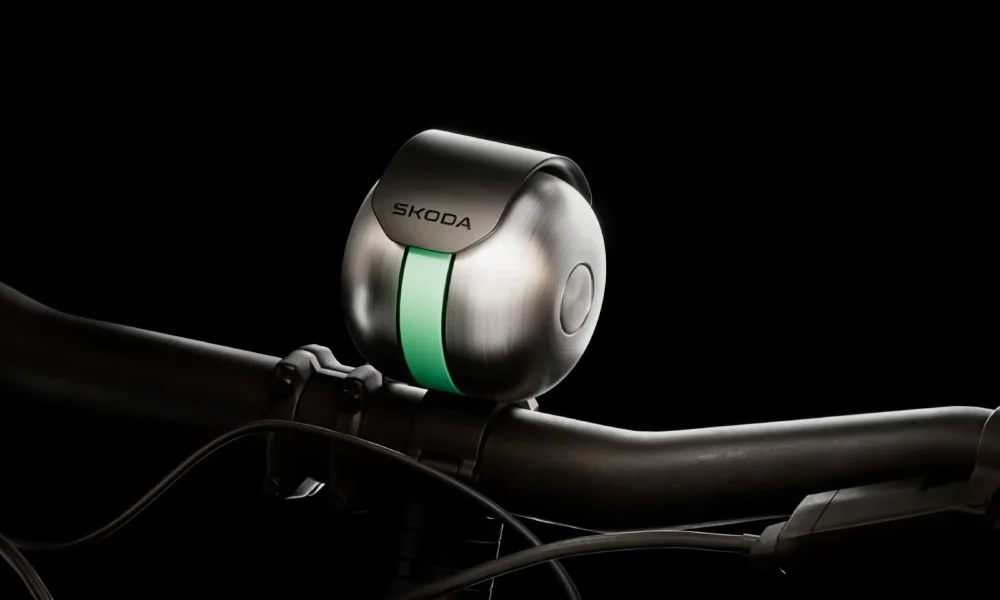
There’s a quiet tension running through modern cities—one that hums beneath the choreography of bikes, scooters, pedestrians, and cars. It isn’t just traffic; it’s perception. As noise-cancelling headphones become a default layer of urban life, the sonic cues that once governed movement—horns, bells, voices—are increasingly muted. Into this friction steps Škoda Auto with DuoBell, a deceptively simple object engineered to solve a distinctly contemporary problem: how do you make yourself heard when the world is actively tuning you out?

challenge
Noise-cancelling technology has evolved from a luxury to an everyday utility. Either commuting, walking, or cycling, people curate their soundscapes, filtering out the unpredictable in favor of controlled audio environments. While this creates personal comfort, it introduces a layer of risk in shared public spaces. Cyclists, in particular, rely on bells as a non-aggressive way to signal presence—less intrusive than a shout, more immediate than a visual cue.
But traditional bells operate within a narrow acoustic band, easily suppressed by active noise cancellation algorithms designed to eliminate repetitive, high-frequency disturbances. In short, the very technology meant to create calm inadvertently erases critical safety signals.
stir
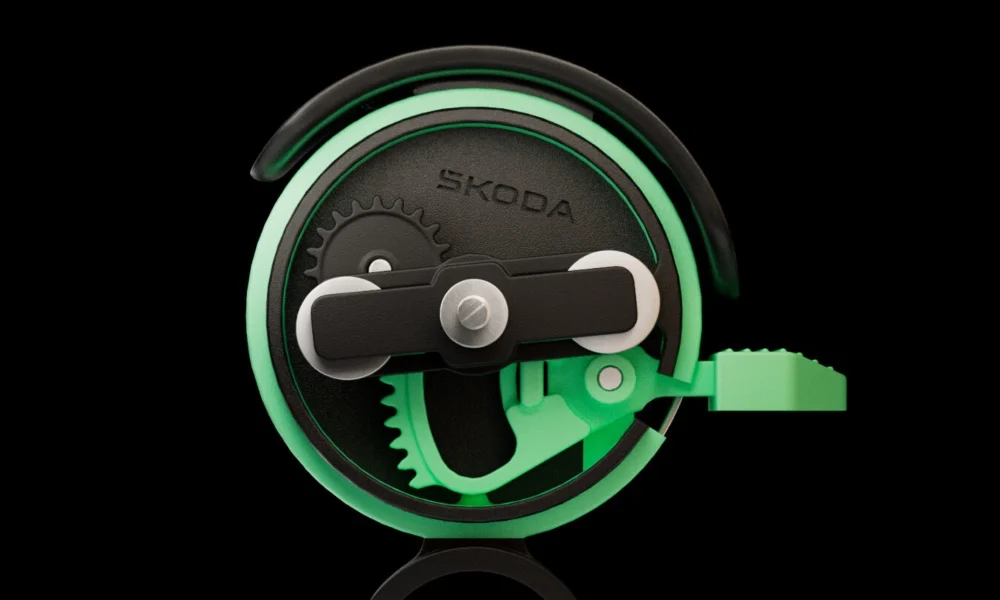
DuoBell’s innovation lies not in volume, but in complexity. Rather than emitting a single, predictable chime, the device produces two distinct tones simultaneously—each occupying different frequency ranges. This dual-layered sound is intentionally harder for noise-cancelling systems to fully suppress. Where one frequency might be filtered out, the other slips through, ensuring at least partial audibility.
The principle is subtle but effective. Active noise cancellation works by identifying and counteracting consistent sound patterns. DuoBell disrupts that consistency. Its paired tones create a shifting acoustic signature—less like a static bell, more like a dynamic signal that resists easy categorization by algorithms.
In practice, this means a pedestrian wearing premium headphones—whether from Sony or Apple—is more likely to register the presence of a cyclist using DuoBell than with a conventional bell. It’s not about piercing through with brute force; it’s about outmaneuvering the filter.
flow
DuoBell aligns with the restrained, functional aesthetic often associated with Škoda Auto’s broader design language. It avoids the overly playful or ornamental cues typical of lifestyle cycling accessories. Instead, it leans into a minimal, almost industrial clarity—compact, unobtrusive, and quietly purposeful.
This matters. Urban cyclists increasingly curate their setups with the same intentionality seen in fashion or tech. A bell is no longer just a safety tool; it’s part of a visual system. DuoBell’s design acknowledges this, integrating seamlessly into handlebars without disrupting the overall silhouette.
The tactile experience is equally considered. The actuation feels deliberate, producing a crisp response that reinforces the product’s precision. It’s a small detail, but one that aligns with the broader shift toward refined, user-centered micro-interactions in everyday objects.
safeguard
DuoBell reflects a larger trend: the reframing of safety as a design challenge rather than a regulatory obligation. Instead of simply meeting standards, products like this anticipate behavioral shifts—headphones, distracted walking, multimodal transport—and adapt accordingly.
This approach mirrors innovations across mobility sectors. From adaptive lighting systems in cars to haptic feedback in wearables, the goal is the same: communicate effectively within increasingly complex environments. DuoBell extends that philosophy into the micro-mobility space, where interactions are faster, closer, and often less predictable.
deposition
Headphones—especially noise-cancelling models—don’t just block sound; they create a personal bubble. Within that bubble, external cues are deprioritized, sometimes entirely ignored.
This isn’t inherently negative. It reflects a desire for control in overstimulating environments. But it also challenges the implicit social contract of shared spaces, where awareness of others is key to fluid movement.
DuoBell doesn’t attempt to break that bubble aggressively. It doesn’t blast through with jarring volume. Instead, it negotiates—finding a way to be noticed without being disruptive. It’s a design solution that respects both the cyclist’s need to signal and the pedestrian’s desire for auditory autonomy.
idea
While DuoBell is, on the surface, a niche product, it signals something larger about where mobility design is heading. As cities become denser and technologies more personalized, the interfaces between people—sound, light, touch—must evolve.
Škoda Auto’s involvement is particularly notable. Traditionally associated with automobiles, the brand’s exploration of cycling accessories suggests a broader engagement with urban mobility ecosystems. It’s less about vehicles in isolation and more about how different modes coexist.
This aligns with a growing industry perspective: that the future of transportation isn’t defined by a single solution, but by the seamless integration of many. Cars, bikes, pedestrians, and public transit all share the same spatial and sensory landscape. Products like DuoBell operate at the intersections of these systems, addressing friction points that might otherwise go unnoticed.
think
There’s a tendency to equate innovation with complexity—advanced materials, digital interfaces, connected systems. DuoBell challenges that assumption. Its core idea is almost disarmingly simple: change the sound so it can’t be ignored.
Yet within that simplicity lies a nuanced understanding of both technology and behavior. It recognizes how noise-cancelling works, how people move, and how small interventions can have outsized impression.
In a way, DuoBell is less about the bell itself and more about a mindset. It’s a reminder that even the most familiar objects can be reimagined when viewed through the lens of contemporary life. The city has changed. The way we listen has changed. And sometimes, the smartest response isn’t to shout louder—but to speak differently.
sum
DuoBell doesn’t promise to solve every challenge of urban mobility. But it does something arguably more important: it reframes a problem that many have accepted as inevitable. In doing so, it opens the door to a new category of design thinking—one that operates not at the level of grand systems, but in the small, precise adjustments that make shared spaces safer and more intuitive for everyone.
In the layered noise—and silence—of the modern city, that kind of thinking resonates.