frame
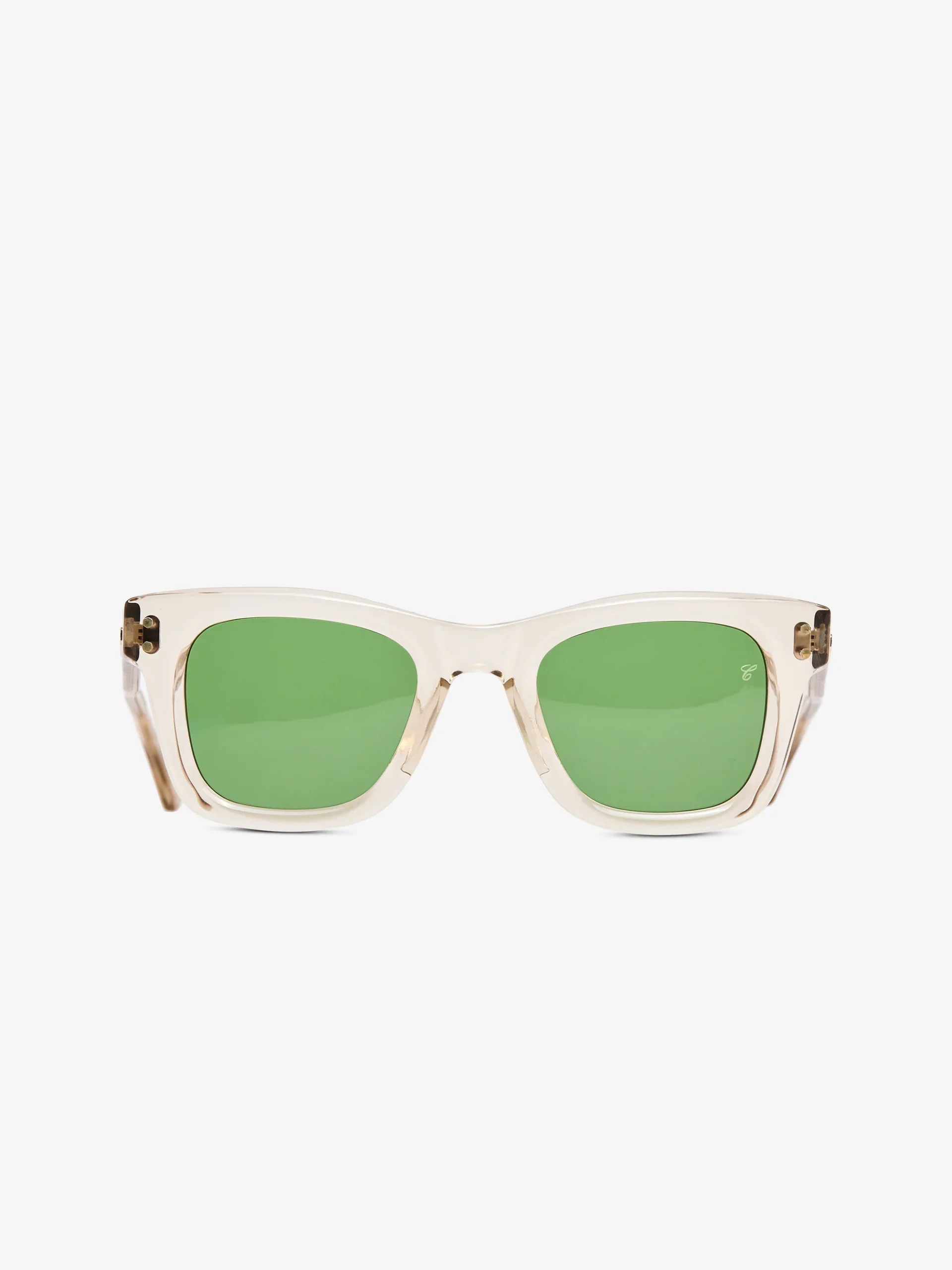
The FITZ x Casinola “EDDIE” isn’t trying to compete with the noise of contemporary eyewear. It removes itself from it. What you’re looking at is a frame that understands proportion before presence—something that sits on the face without insisting on being the center of attention, yet inevitably becoming it.
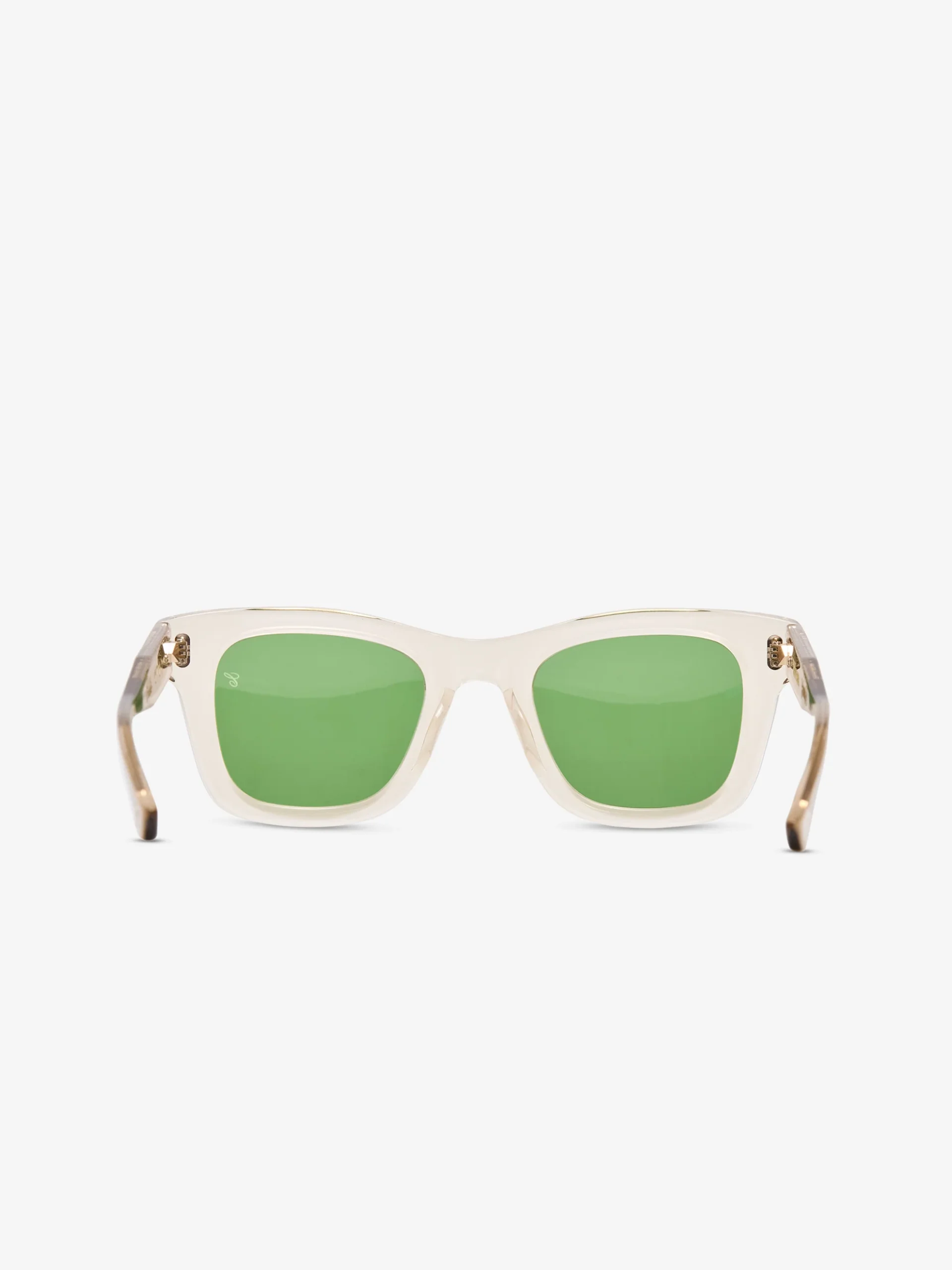
The first read is clarity. A translucent, almost mineral-toned acetate that feels closer to glass than plastic. It doesn’t mask structure; it reveals it. Hinges, core wires, subtle reinforcements—everything becomes part of the composition. Nothing is hidden, but nothing is exaggerated either.
Then the interruption: green lenses. Not dark, not aggressive, but tuned. A softened, almost herbal green that shifts depending on light—cooler in shade, warmer under direct sun. It reframes the neutrality of the frame with just enough tension.
This is where “EDDIE” finds its balance. Between exposure and control.
stir
The silhouette leans into a square geometry, but not the heavy, blocky kind that dominates retro revivals. Instead, it’s softened at the edges—rounded corners, a gentle slope along the brow line, a bridge that doesn’t over-assert itself.
It’s a shape that feels familiar without being referential. Somewhere between classic American optical frames and contemporary European restraint. The kind of form that doesn’t date quickly because it never fully belongs to a single moment.
What’s important here is proportion. The lens height is generous enough to feel current, but not oversized. The width sits comfortably across the face, avoiding both narrow sharpness and exaggerated spread. It’s calibrated.
Casinola’s design language is evident in that calibration. FITZ’s influence appears in the refinement—the way edges feel slightly more deliberate, slightly more graphic than purely functional eyewear.
form
Transparent acetate has become a recurring motif in eyewear, but often as a stylistic gesture. Here, it feels structural.
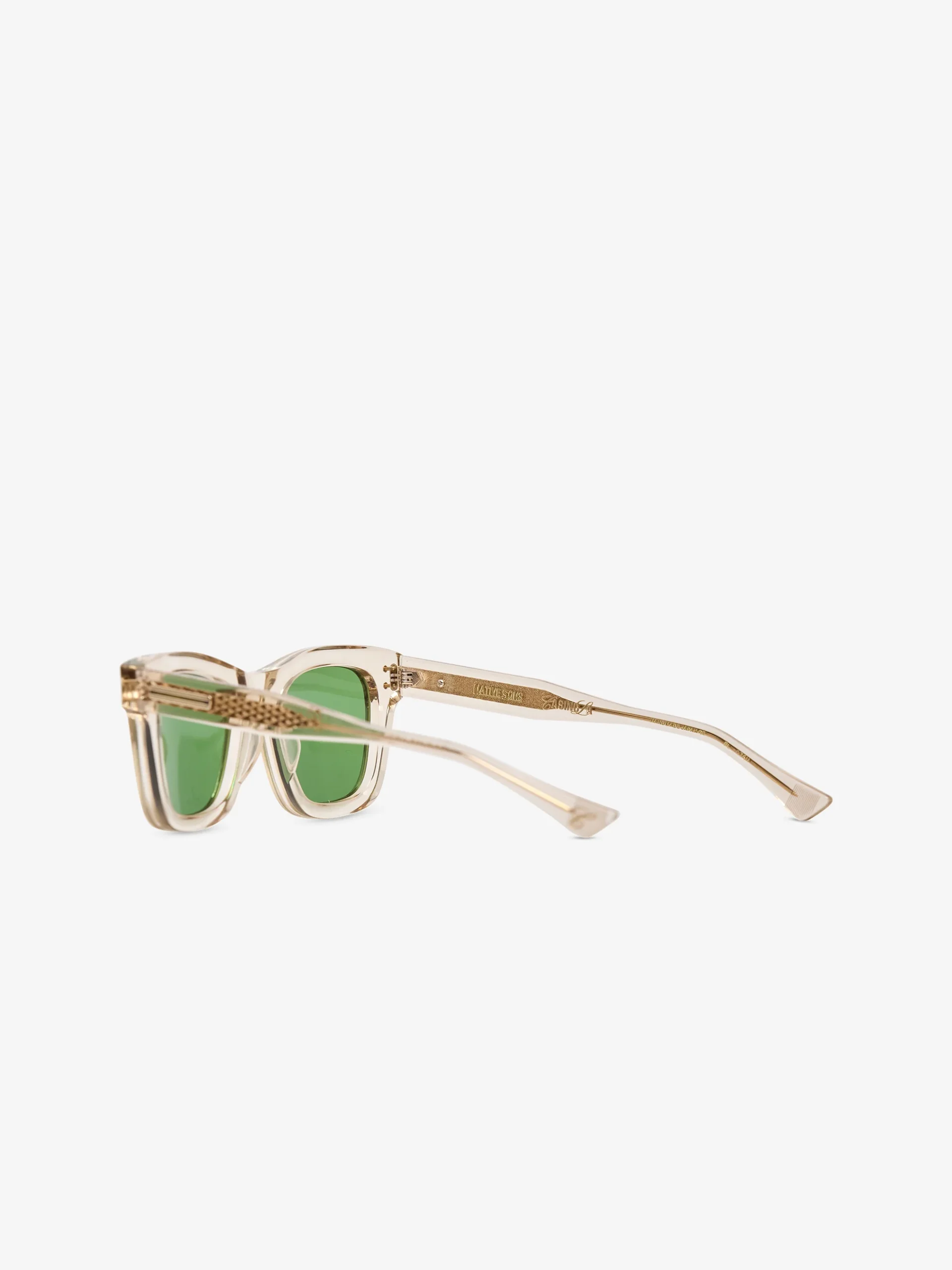
The clarity of the frame allows the internal architecture to participate visually. You see the metal core running through the temples, the hinge mechanics, the subtle tonal shifts within the material itself. It’s less about showing off and more about acknowledging how the object is made.
There’s also a tonal warmth to the acetate—leaning slightly champagne rather than stark clear. That decision matters. It softens the interaction with skin tone, making the frame feel integrated rather than sitting on top of the face.
The lenses, in contrast, carry saturation. The green isn’t mirrored or overly glossy. It’s matte in its effect—absorbing light rather than reflecting it. That gives the sunglasses a more grounded presence.
show
One of the most compelling elements in “EDDIE” is the hinge work. Gold-toned hardware, visible through the translucent frame, becomes a quiet focal point.
From the side, the temples reveal engraving—subtle branding, likely co-signed between FITZ and Casinola. It’s not immediately legible at a distance, but up close, it adds another layer of intention.
The hinge itself feels engineered rather than ornamental. Compact, precise, and integrated into the frame without disrupting its flow. This is where craftsmanship shows—not in excess detail, but in how seamlessly everything connects.
Even the temple tips carry a slight tint variation, grounding the frame visually as it moves toward the ear. These micro-decisions accumulate.
wear
On face, the experience shifts. What looks minimal in isolation becomes more dimensional in context.
The transparency of the frame allows facial structure to remain visible, which changes how the sunglasses interact with expression. They don’t obscure; they filter. The green lenses add a layer of separation from the environment, but not detachment.
This is not a shield. It’s an adjustment.
Stylistically, “EDDIE” operates across wardrobes. It works with tailored pieces—linen shirts, soft suiting—but equally with casual structures: washed denim, cotton tees, lightweight outerwear. The neutrality of the frame anchors it, while the lenses provide just enough distinction.
There’s also a seasonality to it. The green lens reads particularly well in spring and summer light, but the frame’s warmth allows it to transition into cooler months without feeling out of place.
flow
Like the earlier footwear collaboration, FITZ x Casinola avoid overt branding. The only visible mark on the lens is a small, almost calligraphic emblem—placed discreetly, not centered.
On the temple, the engraving carries more information, but again, it’s for the wearer, not the observer. This is branding that lives in the margins.
It reflects a broader shift in luxury and contemporary design: away from recognition as spectacle, toward recognition as familiarity. You don’t need to announce what you’re wearing if the object already communicates its intent.
position
“EDDIE” exists in a space that feels increasingly relevant—between fashion and object design. It’s not trying to be archival, nor is it chasing experimental extremes.
Instead, it aligns with a quieter movement: products that prioritize longevity, material honesty, and subtle differentiation.
In a market saturated with oversized logos, aggressive silhouettes, and trend-driven colorways, this collaboration feels almost resistant. Not nostalgic, but grounded. Not minimal for the sake of aesthetics, but for clarity.
It suggests a wearer who is less interested in being seen immediately, and more interested in being understood over time.
why
What makes the FITZ x Casinola “EDDIE” compelling is not a single standout feature, but the accumulation of decisions.
The choice of a translucent frame instead of opaque.
The decision to use green lenses instead of black or brown.
The restraint in branding.
The precision in proportion.
Individually, these are small moves. Together, they create something that feels considered.
There’s a discipline to the design. Nothing feels added for the sake of completion. Nothing feels missing either.
“EDDIE” doesn’t try to redefine eyewear. It refines what already works—and in doing so, becomes harder to ignore.
resolve
In the end, the FITZ x Casinola “EDDIE” is less about innovation and more about resolution.
A frame reduced to what it needs to be.
A color story that doesn’t overreach.
A construction that reveals just enough of itself.
It’s the kind of object that doesn’t announce its arrival—but once worn, becomes difficult to replace.
Not louder. Just clearer.