Samurai Tree 20W by Gabriel Orozco (2007): Geometry as a Living Condition

April 4, 2026
25 minutes ago
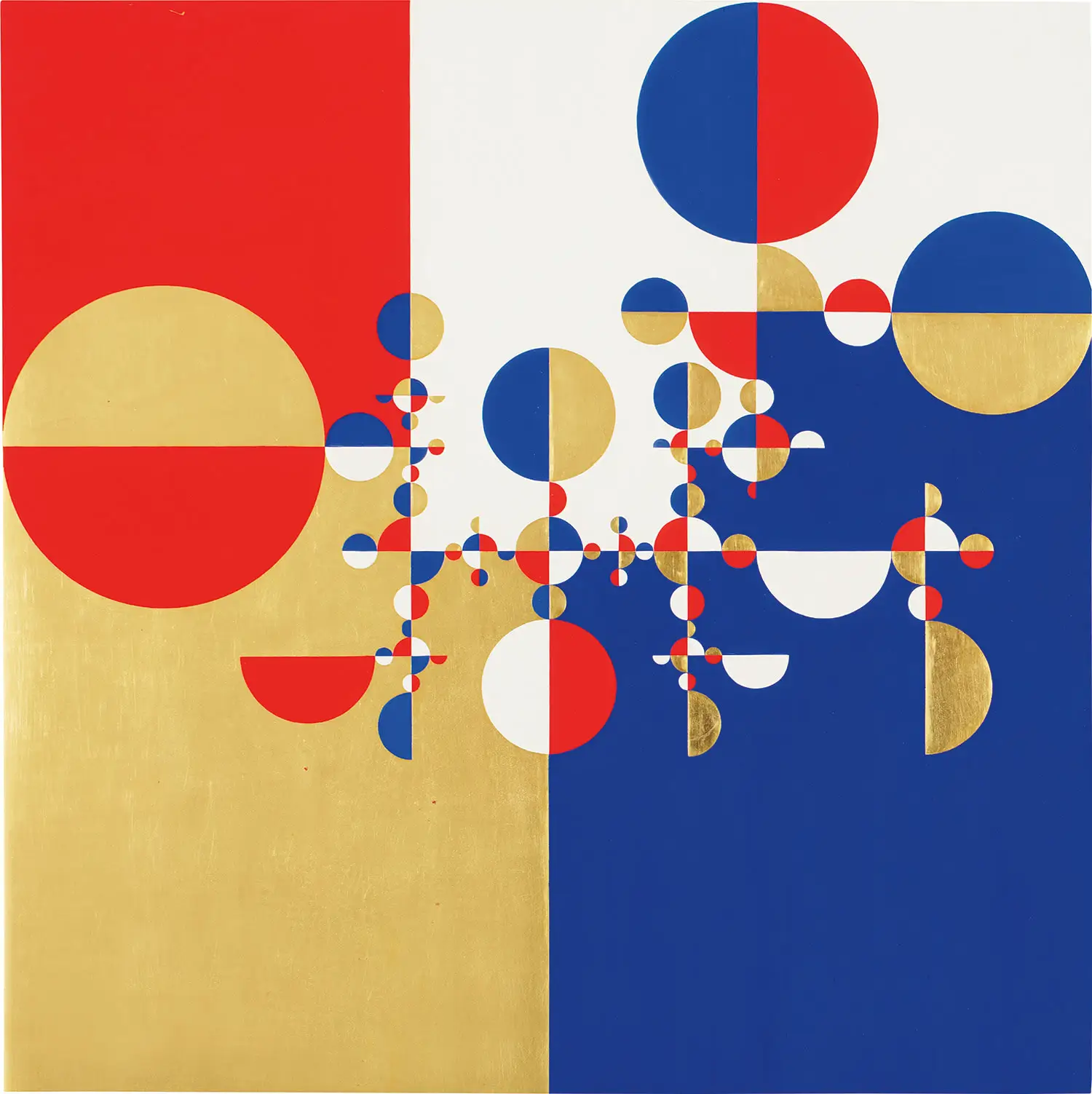
There is no spectacle in Samurai Tree 20W, and that is precisely its force. It does not arrive loudly, nor does it demand immediate submission. Instead, it holds—firmly, quietly—within a system so controlled that its complexity feels almost withheld. A vertical division splits the canvas into red and blue, circles propagate across the surface, gold interrupts with measured luminosity. The image reads quickly, but it does not resolve quickly. It lingers. It reorganizes itself as one looks.
In the broader arc of Gabriel Orozco’s practice, this painting belongs to a lineage of works that resist fixed identity. Orozco has long moved between mediums—photography, sculpture, intervention, painting—not to master them individually, but to dissolve their boundaries. What persists across these shifts is not a style, but a method: an interest in systems that generate form, in structures that remain open, in objects that behave less like conclusions and more like propositions. Samurai Tree 20W distills this approach into a surface that appears finite yet operates as something ongoing.
precursor
The painting begins with a condition rather than a composition. Red on one side, blue on the other—this binary is not symbolic, but structural. It establishes tension, a field of opposition that will be negotiated rather than resolved. From this division, circles emerge. They are not decorative insertions but units of logic, each one divided internally into quadrants of red, blue, white, and gold. These circles repeat, but repetition here is not duplication. It is transformation.
Each iteration is derived from the last—split, mirrored, displaced—forming a chain of decisions that extends across the canvas. There is no central point, no hierarchy. The work expands laterally, guided by rules that are felt rather than fully understood.
idea
This generative logic places the work in proximity to systems-based practices of the late twentieth century, yet it avoids their rigidity. Where the serial structures of Sol LeWitt or Donald Judd emphasize industrial precision and impersonal execution, Orozco introduces a softer instability.
The system is visible, but it is not sealed. It allows for deviation, for subtle asymmetry, for moments where the logic bends rather than breaks. These deviations are not errors; they are conditions of continuation. They prevent the painting from resolving into predictability. They keep it open.
symbol
The circle operates as the fundamental unit of thought within Samurai Tree 20W. It is both complete and divisible—a closed form that contains within it the possibility of fragmentation. In Orozco’s system, circles are halved, quartered, mirrored, and scaled. Each transformation produces new relationships, new tensions.
What emerges is not a pattern in the decorative sense, but a field of interdependence. Each circle belongs to itself, yet also to the system that produced it. The painting becomes a network—one in which no element is entirely autonomous.
show
Color here is not expressive; it is structural. Red does not signal emotion; it anchors position. Blue does not evoke atmosphere; it establishes counterweight. White interrupts, creating moments of pause. Gold complicates everything.
The use of gold leaf introduces a material dimension that resists full absorption into the painted surface. It reflects light unevenly, shifting as the viewer moves. It is both within the composition and slightly outside it—hovering between image and object.
This instability is crucial. It prevents the painting from becoming purely optical. It insists on presence.
equilibrium
At first glance, the painting appears symmetrical. A vertical axis divides the composition, and forms seem to mirror one another across it. But this symmetry is never exact. Small deviations accumulate—slight shifts in placement, variations in scale, disruptions in sequence.
These interruptions are not incidental. They are what keep the system active. Perfect symmetry would close the work, rendering it static. Orozco instead allows imbalance to persist, creating a tension that never fully resolves.
tension
The canvas operates not as a background but as a field of negotiation. The division between red and blue establishes a boundary, but the circles continually cross it, destabilizing its authority. Gold surfaces catch and release light, altering perception. White creates intervals—moments where the density of form recedes.
The result is a surface that behaves dynamically. It is not something one looks at, but something one moves through. The eye travels, pauses, recalibrates.
flow
There is a mathematical logic underpinning the painting—division, repetition, scaling—but it never becomes mechanical. Orozco allows intuition to intervene. Slight irregularities, subtle shifts, decisions that cannot be fully reduced to rule.
This balance is essential. The painting exists between calculation and improvisation. It is governed, but not constrained. Structured, but not rigid.
touch
The inclusion of gold leaf introduces a historical echo. It recalls traditions of icon painting, of surfaces imbued with value and reverence. Yet here, gold is not symbolic in any fixed sense. It is material—reflective, unstable, resistant.
It anchors the work in a lineage of craft while simultaneously disrupting that lineage. The painting becomes both contemporary and referential, present and historical.
pov
Encountering Samurai Tree 20W requires a recalibration of attention. It does not offer immediate narrative or spectacle. Instead, it unfolds slowly, through sustained looking.
From a distance, the work reads as a unified system. Up close, it fractures into detail—edges, textures, subtle variations. The viewer oscillates between these modes, constructing an understanding that is never complete.
In this way, the act of viewing becomes participatory. The painting is not fixed; it is activated through perception.
practical
Within Orozco’s broader body of work, the Samurai Tree series represents a sustained investigation into how systems generate form. Each painting is not an endpoint, but a variation—a continuation of a process that could extend indefinitely.
“20W” signals this condition. It is one iteration among many, part of a sequence rather than a singular statement. The work resists finality. It remains open.
fin
Every element is accounted for, every variation rooted in a system. And yet, within that discipline, there is expansion. Growth. Movement.
The painting does not resolve; it sustains. It holds order and variation in tension, allowing neither to dominate. It is precise without being closed, structured without being static.
In this, Orozco offers not just an image, but a way of thinking—one in which systems are not endpoints, but conditions of possibility. A geometry that does not fix the world, but allows it to continue.