The Spotify Listening Lounge in London: A Controlled Acoustic Environment

April 6, 2026
1 hour ago


There is a subtle shift happening in how sound is being positioned—not as a background utility, but as an environment in itself. What was once compressed, optimized, and miniaturized for portability is now expanding again, reclaiming depth, texture, and dimensionality. The listening room, long considered a niche obsession of audiophiles, is being reintroduced to a broader audience, not as nostalgia, but as infrastructure.
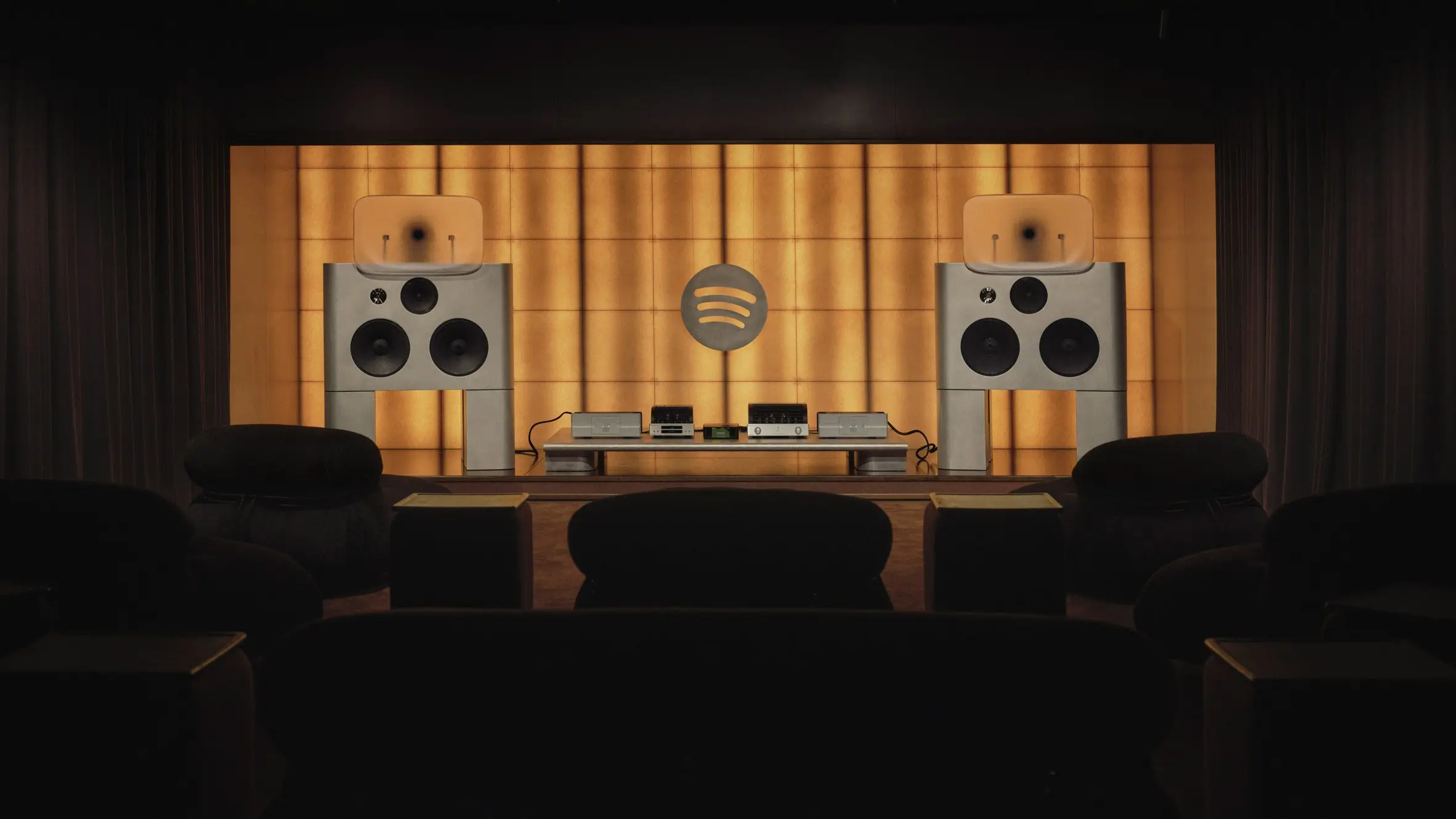
At its London headquarters, Spotify has formalized this shift with the introduction of its Listening Lounge—a purpose-built acoustic chamber designed to host its lossless audio offering in its most resolved state. It is not a showroom in the traditional sense, nor a branding exercise in surface aesthetics. Instead, it operates closer to a controlled environment, where architecture, material, and sound engineering converge into a single objective: to let audio exist without interference.
The room does not ask for attention. It conditions it.
View this post on Instagram
flow
Streaming has historically been about access—more music, faster, anywhere. But ubiquity has come at the cost of fidelity. Compression artifacts, while imperceptible to many, have shaped how music is consumed for over a decade. With the reintroduction of lossless audio tiers, platforms are beginning to recalibrate what “quality” means in a digital context.
Spotify’s Listening Lounge exists within this recalibration. It is not merely a space to hear higher bitrates; it is a space that exposes the consequences of hearing differently.
Lossless audio, in isolation, is a technical specification. Within this room, it becomes experiential. The difference is no longer theoretical—it is spatial, almost architectural. Details that once flattened into the mix begin to separate. Reverb tails stretch longer. Low-end frequencies carry weight without distortion. Silence itself gains structure.
The lounge reframes listening as an act of presence.
stir
Unlike traditional interiors, where sound is often treated as an afterthought, the Listening Lounge is constructed with acoustic behavior as its primary logic. Every surface, every junction, every material selection contributes to how sound travels—or more precisely, how it doesn’t.
The palette leans into density and tactility. Wood paneling, fabric-wrapped absorbers, and diffusive geometries create a layered acoustic field. These are not decorative choices. They are calibrated interventions, designed to manage reflections, control reverberation times, and prevent standing waves.
There is a quiet rigor to the space. Nothing feels arbitrary.
The walls do not simply enclose; they shape. The ceiling does not hover; it modulates. Even the floor participates, absorbing just enough to anchor the sonic image without dulling it.
In this sense, the room behaves less like architecture and more like an instrument—one that is tuned not to produce sound, but to reveal it.
clairvoyant
At the center of the Listening Lounge is a bespoke speaker system, designed specifically for the room’s acoustic profile. This is critical. High-fidelity playback is not about individual components in isolation, but about system coherence—how speakers, amplification, and space interact as a unified whole.
While specific technical details remain closely held, the system prioritizes neutrality. There is no artificial coloration, no exaggerated bass, no engineered “warmth” designed to flatter. Instead, the aim is transparency: to reproduce audio as it exists in the recording, without editorializing.
This approach can be disorienting at first. Many listeners are accustomed to consumer tuning—systems that enhance certain frequencies to create an immediate sense of impact. The Listening Lounge does the opposite. It removes those enhancements, allowing the recording itself to define the experience.
The result is a different kind of engagement. One that is slower, more attentive.
You don’t just hear the music. You hear the decisions behind it.
mode
There is a tendency to think of materials in view terms—texture, color, finish. In the Listening Lounge, materials operate acoustically first, visually second.
Wood, for instance, is not used for warmth in the aesthetic sense, but for its reflective properties in specific frequency ranges. Fabric panels are not soft for comfort, but for their ability to absorb mid and high frequencies. Even the spacing between elements is calculated, introducing micro-variations that scatter sound waves to prevent echo buildup.
This is material as medium.
The room becomes a translation layer, converting electrical signals into physical vibrations, then shaping those vibrations into something coherent and legible. It is an invisible process, but one that defines the entire experience.
There is a discipline to it. A refusal to let design drift into decoration.
imbue
In an era where “immersive” often implies visual overload—LED screens, reactive lighting, spatial theatrics—the Listening Lounge takes a more restrained approach. Immersion here is not about stimulation, but about reduction.
The lighting is subdued. The color palette is controlled. There are no visual distractions competing with the audio. The room does not attempt to impress through spectacle. It withdraws, creating conditions where the listener can focus entirely on sound.
This restraint is deliberate.
By minimizing visual input, the room heightens auditory perception. Subtle details become more pronounced. The spatial positioning of instruments—left, right, center, depth—becomes easier to track. The listener is not overwhelmed; they are recalibrated.
Immersion, in this context, is about clarity.
stay
Spotify’s move into lossless audio is not happening in isolation. Competitors such as Apple Music and Tidal have already positioned high-fidelity streaming as a differentiator. What sets Spotify’s approach apart is the emphasis on environment.
Rather than simply offering a higher-quality stream, Spotify is constructing a narrative around how that stream should be experienced.
The Listening Lounge becomes part of that narrative—a physical manifestation of a digital upgrade.
It suggests that fidelity is not just about data, but about context. That better sound requires better spaces. That listening, at its highest level, is not passive consumption, but active engagement.
This is a subtle but significant shift. It repositions streaming from convenience to craft.
idea
For most users, Spotify exists in the private domain—headphones, earbuds, personal devices. The Listening Lounge expands that experience into a shared, spatial context.
This transition changes how music is perceived.
Headphones create intimacy. They place sound directly inside the listener’s head, collapsing space into a two-dimensional plane. A room, by contrast, externalizes sound. It allows it to occupy physical space, to move, to breathe.
In the Listening Lounge, this spatialization becomes tangible. Instruments are no longer abstract points in a stereo field; they have presence, location, distance. The listener is not inside the music. The music is around the listener.
It is a subtle inversion, but one that fundamentally alters the experience.
suspense
There is a psychological dimension to high-fidelity listening that often goes unacknowledged. When sound is clear, detailed, and spatially coherent, it reduces cognitive load. The brain does not have to work as hard to interpret what it is hearing.
This creates a sense of ease. A kind of mental quiet.
In the Listening Lounge, this effect is amplified. The controlled acoustics eliminate many of the distortions and reflections that typically complicate listening environments. The result is a cleaner signal—not just technically, but perceptually.
Listeners often describe this as “hearing more,” but it is equally about “hearing less”—less noise, less interference, less confusion.
The space does not add information. It removes obstacles.
show
One of the challenges of acoustic design is that its success is largely invisible. Unlike visual design, where outcomes are immediately apparent, acoustic outcomes are felt rather than seen.
This makes the Listening Lounge an interesting case study. It is a space where the most important design decisions are the least visible.
The angle of a panel. The density of a material. The distance between surfaces. These are not elements that draw attention, yet they define the entire experience.
There is a quiet confidence in this approach. A willingness to prioritize performance over display.
It is design that trusts the user to feel the difference, even if they cannot immediately articulate it.
retro
While the Listening Lounge is located within Spotify’s London headquarters, its implications extend beyond a single room. It functions as a prototype—a controlled environment that demonstrates what is possible when audio, architecture, and technology are aligned.
The question, then, is how this model translates.
Will elements of this approach filter into consumer spaces? Into retail environments? Into future products? It is unlikely that most users will replicate a purpose-built acoustic room in their homes. But the principles—material awareness, spatial consideration, system coherence—can scale.
In this sense, the Listening Lounge is less a destination and more a reference point.
A way of setting a new baseline for what listening could be.
move
There is an underlying shift embedded in this project. For years, the trajectory of audio technology has been toward invisibility—smaller devices, wireless systems, seamless integration. The Listening Lounge reverses that trajectory, not by making technology more visible, but by making experience more deliberate.
It asks for time. For attention.
In doing so, it challenges the prevailing model of consumption, where music is often backgrounded, fragmented, and multitasked. The lounge suggests an alternative: that listening can be an activity in itself, not just a companion to other tasks.
This is not a rejection of convenience, but a rebalancing.
A reminder that access and quality do not have to be mutually exclusive.
fin
The Spotify Listening Lounge is not defined by what it contains, but by what it enables. It is a space that reframes sound as something spatial, material, and experiential.
It does not attempt to reinvent listening. It refines it.
By aligning architecture, material, and technology, Spotify has created an environment where lossless audio is not just heard, but understood—where the difference is not explained, but felt.
In a landscape saturated with content, this kind of clarity becomes its own form of luxury.
Not louder. Not brighter. Not more.
Just closer to what was always there.