Triple Sevens All Star Football Hoodie White: A Graphic-Driven Take on Fiction Sportswear

April 7, 2026
1 hour ago
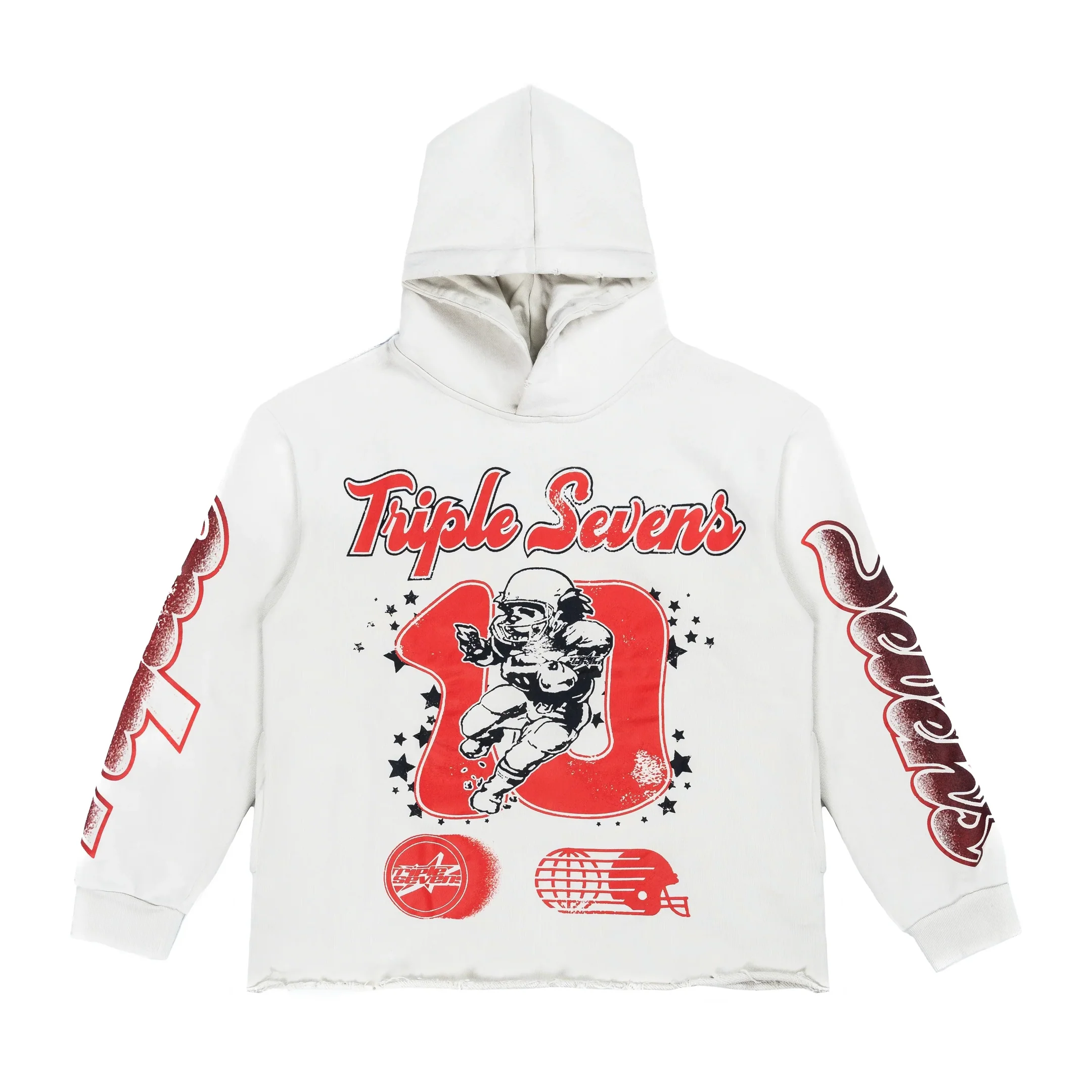

The Triple Sevens All Star Football Hoodie in white reads like something recovered rather than newly made. It carries the visual weight of a team-issued piece—something that should belong to a locker room, a sideline, or a forgotten championship run—yet it exists entirely outside of any real league. That tension is precisely where its appeal sits. It is designed as memory, not documentation.
The bold red “Triple Sevens” script across the chest establishes the illusion immediately. It looks like a team name, rendered in a nostalgic athletic typeface that recalls varsity jackets and mid-90s sports merchandise. Beneath it, the central football player graphic moves through a field of stars, framed by an oversized numeral that feels like a jersey number enlarged into iconography. Nothing here is subtle, but everything is intentional. The hoodie doesn’t reference a specific moment in sports history; it reconstructs the feeling of one.
style
Triple Sevens as a motif operates before it functions as a brand. The number itself carries a layered cultural weight—luck, repetition, amplification. In gambling, it signals jackpot. In fashion, it becomes a shorthand for excess and recognition. In this hoodie, it behaves like a team identity that never needed to exist to be believable.
What makes this effective is the way the branding avoids over-definition. There is no official league, no real roster, no historical archive to verify. Instead, the hoodie leans into ambiguity, allowing the wearer to project their own familiarity onto it. It feels like something you’ve seen before, even if you haven’t. That is the core mechanism of its design.
View this post on Instagram
show
The visual structure of the hoodie is built in layers, each one contributing to the illusion of authenticity. The central player graphic anchors the piece, but it is surrounded by smaller elements that complete the narrative. A helmet icon sits near the hem, echoing the language of team branding systems. A circular emblem adds another layer of insignia, as if referencing a conference or division that exists only within the garment’s internal logic.
The sleeve graphics extend this further. Running text along the arms mirrors the format of practice gear or sideline apparel, where branding becomes repetitive and functional. Here, it is purely aesthetic, but it carries the same visual authority. The slightly distressed texture of the red print softens the impact just enough, suggesting wear, age, and use. It doesn’t look freshly printed. It looks inherited.
flow
Despite its heavy visual identity, the hoodie itself is grounded in familiar streetwear construction. The fabric leans toward a cotton fleece blend, offering weight without rigidity. The fit is relaxed, slightly boxy, allowing the graphics to sit flat and uninterrupted across the body. The hood is structured but not exaggerated, maintaining a balance between form and wearability.
What distinguishes it subtly is the hem. The slightly raw or cropped finish introduces a contemporary edge, pulling the piece away from pure sports replication and back into fashion. It signals that this is not archival reproduction but reinterpretation. The garment is aware of its references, but it is not bound by them.
a return
The Triple Sevens hoodie arrives within a broader shift in fashion where restraint has given way to expression. After a prolonged period of minimal branding and tonal palettes, graphic-heavy pieces have re-emerged with renewed relevance. This is not simply a return to logos; it is a return to narrative through design.
The red-on-white contrast plays directly into this. It is immediate, high-visibility, and unmistakably bold. There is no attempt to blend in. Instead, the hoodie asserts itself as the focal point of any outfit. This aligns with a wider movement in contemporary streetwear, where garments are designed to carry the entire visual identity of a look rather than complement it.
View this post on Instagram
drive
One of the most interesting aspects of the piece is its relationship to sport. It borrows heavily from football iconography—helmets, numbers, player silhouettes—but detaches these elements from any real-world context. This places it within a growing category of fictional sportswear, where brands construct their own leagues, teams, and histories.
This approach allows for a kind of universal nostalgia. By avoiding specificity, the hoodie taps into shared cultural memories of sport without limiting itself to a particular team or era. It becomes accessible across geographies and generations. The imagery is recognizable, but the story remains open.
vibe
Because of its density, the hoodie functions best when allowed space. It does not benefit from competition. Paired with simple denim or neutral trousers, it becomes the defining element of the outfit. The contrast between its bold graphic language and a restrained base creates balance without diminishing its impact.
There is also room to push it further. Styled with wider silhouettes or layered under structured outerwear, the hoodie shifts toward a more fashion-forward interpretation. In these contexts, it reads less as sportswear and more as a graphic artifact, something designed as much for visual presence as for function.
protean
Within the broader Triple Sevens lineup, the white version stands apart for its clarity. Other colorways soften or complicate the palette, introducing earth tones or deeper hues that shift the mood of the piece. The white base, however, offers the most direct expression of the design. It amplifies the red, sharpens the contrast, and makes the graphic language unmistakable.
This clarity also reinforces the illusion of authenticity. It resembles classic team merchandise, where white garments served as the most visible and accessible form of branding. In that sense, the hoodie feels closest to the imagined origin it references.
sum
What ultimately defines the Triple Sevens All Star Football Hoodie is not its construction or even its graphics, but its ability to function as a constructed memory. It presents itself as something familiar, something that should have existed long before it did. It draws from visual archives without replicating them directly, assembling fragments into a cohesive narrative that feels complete.
This is where contemporary streetwear continues to evolve. It is no longer just about logos or collaborations, but about building worlds—however small, however implied. The hoodie does not need a backstory because it creates one through design alone.
In that sense, it succeeds not by referencing history, but by simulating it.