Star Wars: The Redemption of Revenge of the Sith

April 28, 2025
There is a strange, almost gravitational inevitability to the way we reassess art over time. Works once dismissed can emerge, years or even decades later, crowned with a fresh legitimacy, viewed through lenses less clouded by the biases and expectations of the moment. So it is with George Lucas’s Star Wars: Episode III – Revenge of the Sith — a film that, once maligned or merely tolerated, now commands an increasingly fervent segment of defenders who argue, without irony or apology, that it is the finest Star Wars film of them all.
Such a claim, at first blush, may appear unhinged. Surely The Empire Strikes Back holds the undisputed throne? Surely A New Hope retains its mythic primacy? But beneath the memes, the ironic Twitter threads, and the swelling tide of online nostalgia, there lies a real critical reconsideration: Revenge of the Sith, flawed though it may be, is Star Wars at its most operatic, its most tragic, and its most personal.
It is, in many ways, George Lucas’s purest work — unfiltered, undiluted by committee — and time has proven remarkably kind to its strange, mournful brilliance.
A Film Born in Scorn
To appreciate the elevation of Revenge of the Sith, one must first recall the climate into which it was born. By 2005, the prequel trilogy had become something of a cultural punchline. The Phantom Menace was derided for its wooden performances, excessive reliance on CGI, and the much-maligned figure of Jar Jar Binks. Attack of the Clones fared little better, burdened by clunky dialogue and an unconvincing romance between Anakin Skywalker and Padmé Amidala.
Lucas, once the revered creator of a new modern mythology, was increasingly painted as an out-of-touch auteur, lost amid digital excess and unable to recapture the magic of his earlier work. By the time Revenge of the Sith arrived, expectations were low; the prequels, it was assumed, would end not with a bang but a whimper.
And yet.
From its opening sequence — an exhilarating starfighter ballet over the besieged skies of Coruscant — Revenge of the Sith felt different. The film wasted no time immersing the audience in a world on the brink of collapse, a galactic order crumbling under its own hypocrisy and hubris. There was a gravity here, a sense of fatalism that had eluded the previous prequel entries. Something was happening — something real.
The Tragedy of Anakin Skywalker
At the heart of Revenge of the Sith lies its most radical decision: it is a tragedy, in the classical sense. There are no true victories, only compromises. No heroic last stands, only betrayals. Lucas crafted a story where love curdles into obsession, loyalty into treachery, hope into tyranny.
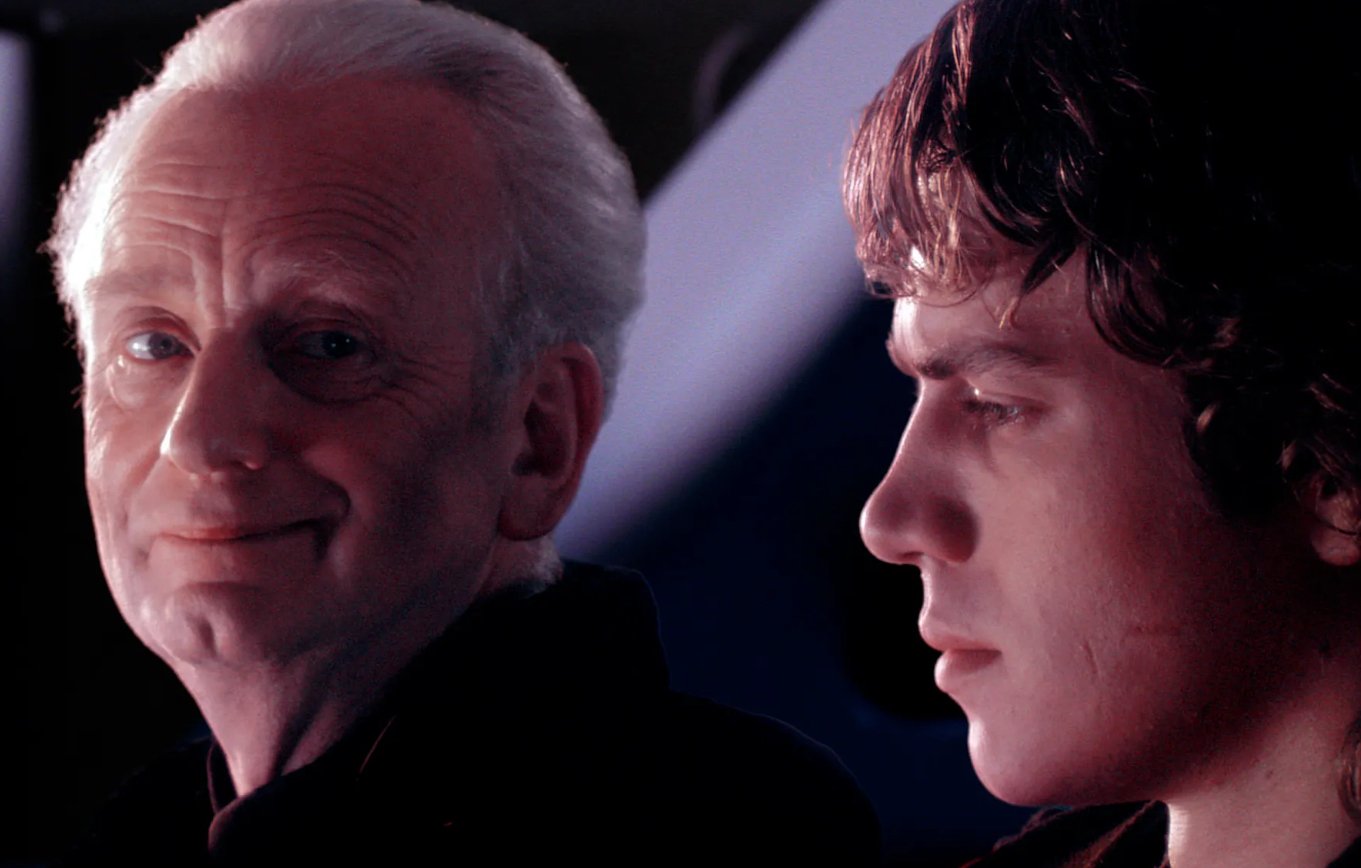
Anakin’s fall to the dark side, so often mocked for its suddenness, reveals on closer inspection a heartbreaking inevitability. His transformation into Darth Vader is not the product of a single fatal choice, but rather a cumulative series of rationalizations, each made in the name of love, safety, and control. In Revenge of the Sith, the road to hell is not paved with malice but with fear and misplaced devotion.
Hayden Christensen, much maligned for his performance at the time, delivers a portrayal that in hindsight feels eerily appropriate. His Anakin is not a swaggering antihero, but a deeply insecure young man, desperate for approval, terrified of loss, and ultimately undone by his inability to master himself. His line readings, sometimes awkward, evoke the stylized, stilted dialogue of classical tragedy — or, perhaps more fittingly, the raw, unpolished speech of someone struggling under the weight of impossible expectations.
Visual Splendor, Narrative Collapse
Technically, Revenge of the Sith is one of Lucas’s most ambitious and fully realized visual achievements. Freed from the constraints of early digital filmmaking that hampered The Phantom Menace, Lucas’s team at ILM rendered a galaxy of astonishing beauty and decay. The shimmering utopian skyline of Coruscant, the volcanic hellscape of Mustafar, the rain-swept gloom of Kamino — these settings are not mere backdrops but emotional landscapes, externalizations of the story’s rising despair.
The duel between Anakin and Obi-Wan Kenobi, set against rivers of flowing lava, is pure operatic spectacle — absurd in its extremity, but moving in its emotional ferocity. John Williams’s score, particularly the mournful “Battle of the Heroes,” elevates the action into the realm of myth.
And yet, Revenge of the Sith does not escape all criticism. The film’s compressed timeline strains plausibility; Padmé’s death is abrupt and narratively unsatisfying; some dialogue remains painfully stilted. But taken as a whole, the film’s flaws feel less like failures and more like the inevitable costs of Lucas’s commitment to crafting a personal, singular vision without the softening influence of external collaborators.
Lucas Unfiltered
This is perhaps the crux of Revenge of the Sith’s redemption: it is unmistakably, unapologetically George Lucas’s movie.
In an era dominated by focus groups, franchise committees, and algorithm-driven storytelling, there is something profoundly moving about a work of art that is so thoroughly the product of one mind’s untempered imagination. Lucas, with all his strengths and weaknesses on full display, dared to tell a tragic, uncompromising story within the framework of what was, ostensibly, a children’s science fiction adventure.
No other Star Wars film feels quite so personal. The Last Jedi may deconstruct the myths, and The Empire Strikes Back may deepen them, but Revenge of the Sith exposes their very creation: the moment when heroes become tyrants, when love becomes fear, and when freedom dies to thunderous applause.
A Film for Our Time
It is also worth noting that Revenge of the Sith’s themes have only grown more resonant with time. In a world increasingly preoccupied with the fragility of democracy, the rise of authoritarianism, and the dangers of fear-driven politics, the film’s warning feels chillingly prescient.
“Fear leads to anger. Anger leads to hate. Hate leads to suffering.” Yoda’s famous line, once dismissed as a New Age platitude, now reads like a grim prophecy etched across the past two decades of global history.
The figure of Anakin Skywalker — a gifted, promising individual who sacrifices principles for the illusion of control — finds grim echoes in contemporary leaders and movements. Revenge of the Sith no longer feels like an outlier in the Star Wars saga; it feels like its dark, beating heart.
The Meme Renaissance
Of course, part of Revenge of the Sith’s resurgence owes itself to the internet’s peculiar ability to resurrect and transform pop culture. The film’s dialogue — once derided for its awkwardness — has achieved memetic immortality. “I have the high ground,” “So this is how liberty dies,” “You underestimate my power” — these lines, quoted endlessly, have been reborn as affectionate shorthand among fans.
But memes, for all their humor, are acts of preservation. They keep alive the images, phrases, and feelings that once defined a generation’s media landscape. In this case, they have acted as a bridge, carrying Revenge of the Sith into the present and encouraging deeper reevaluations among those who grew up in the era of the prequels.
Nostalgia, yes. But also genuine affection.
Thoughts
Revenge of the Sith may never achieve the critical consensus of The Empire Strikes Back. It may never be as universally beloved as the original Star Wars. But it has achieved something rarer: it has endured. It has matured alongside its audience, shedding its early reputation as a disappointment to emerge, battered but resilient, as a work of depth, sadness, and brutal beauty.
It is the Star Wars movie that most fully embraces the mythic tragedy at the saga’s core. It is George Lucas’s clearest artistic statement. And, for a growing legion of fans and critics alike, it is, without apology, the very best Star Wars film.
From ridicule to reverence: the long, strange, glorious redemption of Revenge of the Sith is complete.
And it is magnificent.