Stella McCartney Reframes the Falabella Through Renée Rapp – Vegan

April 2, 2026
2 hours ago


consider
There is an exact kind of endurance that fashion rarely sustains without compromise. The ability to remain visually intact while shifting culturally, ethically, and emotionally is a rarer feat still. With the Falabella, Stella McCartney created something that resists obsolescence not through reinvention, but through recalibration.
First introduced in 2009, the Falabella arrived with a quiet defiance. It did not ask permission to exist without leather in a luxury market that, at the time, largely equated prestige with animal-derived materials. It simply existed—soft, slouched, edged in chain, and materially distinct. The proposition was radical in its restraint: a bag that looked familiar, yet operated under an entirely different value system.
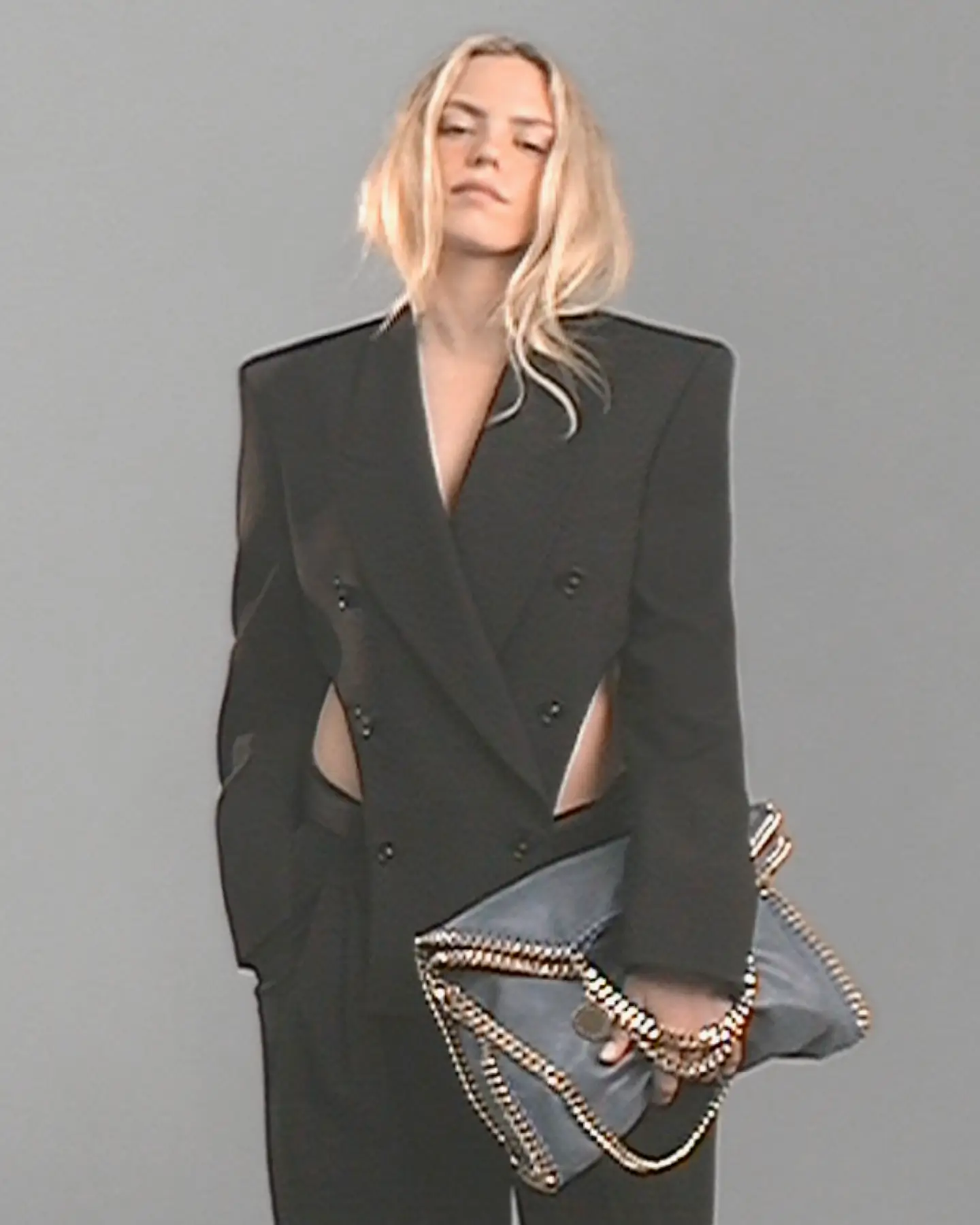
Now, in 2026, that same proposition returns, reframed through a new cultural lens. At its center stands Renée Rapp—a figure whose presence signals not a reinvention of the Falabella, but a recalibration of its voice.
flow
Renée Rapp does not arrive as a conventional campaign face. Her appeal lies not in neutrality, but in articulation. As both a musician and performer, her presence carries a clarity of tone—emotionally precise, culturally attuned, and unafraid of contradiction. She exists within a generation that is fluent in both vulnerability and critique, spectacle and sincerity.
This makes her an unusually fitting counterpart to the Falabella. Where the bag once disrupted material expectations, Rapp disrupts narrative ones. She does not perform aspiration in its traditional sense; instead, she embodies a form of lived authenticity that aligns with the values Stella McCartney has long articulated but rarely needed to dramatize.
The pairing reads less like endorsement and more like alignment. An object and a voice, each already established, meeting at a point of shared intent.
View this post on Instagram
ethic
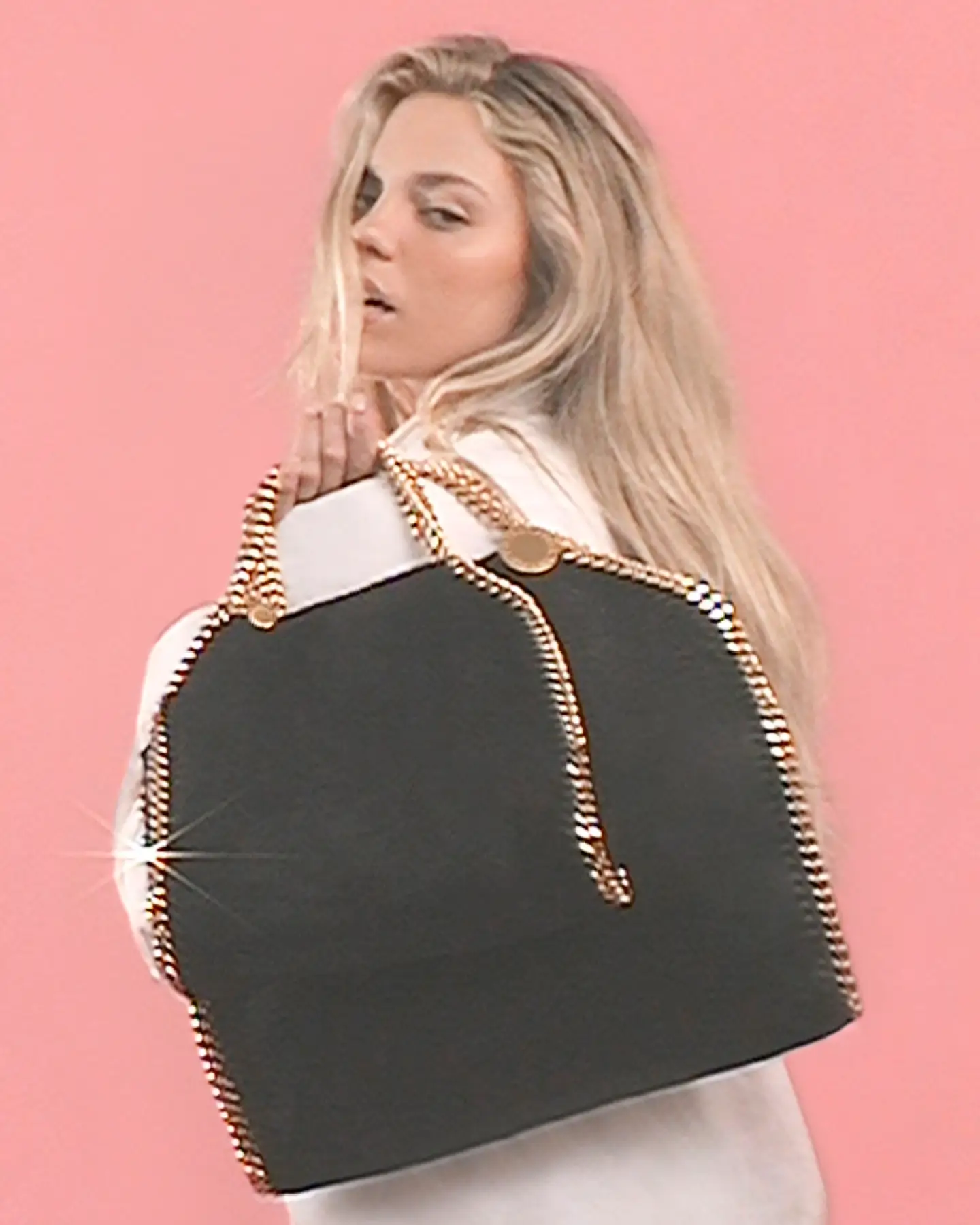
To slowly approach why the Falabella persists, one must look beyond its silhouette. The design is deceptively simple: a soft, unstructured body framed by a diamond-cut chain that traces its edges and forms its handles. Yet beneath that simplicity lies a layered material narrative.
The bag is constructed without leather, fur, or exotic skins—an ethos that has remained non-negotiable for Stella McCartney since the brand’s inception. Instead, it utilizes vegan alternatives, lined with recycled polyester and finished with hardware composed of recycled brass and recyclable aluminium.
In 2009, these choices positioned the Falabella as an outlier. In 2026, they position it as a precursor.
What has changed is not the bag itself, but the context in which it operates. Sustainability is no longer a peripheral concern; it is a central expectation. Yet the Falabella does not need to adapt to meet this expectation—it already did, years before the industry caught up.
This temporal advantage gives the bag a unique authority. It does not participate in the conversation around conscious luxury; it predates it.
lang
The campaign arrives in the immediate wake of Stella McCartney’s March presentation in Paris—a show that staged horses on the runway, a gesture that might have risked theatrical excess were it not so aligned with the brand’s long-standing advocacy for animal welfare.
The presence of horses was not symbolic in the abstract; it was literal, immediate, and grounded in McCartney’s ongoing dialogue around the relationship between fashion and the natural world. It underscored a continuity that is often difficult to maintain in an industry driven by seasonal novelty.
Within this framework, the Falabella functions as an anchor. It is not subject to the volatility of trend cycles in the same way as ready-to-wear. Instead, it absorbs and reflects the brand’s evolving narrative without losing its own identity.
The campaign, then, is not an isolated moment. It is part of a broader continuum—one that links runway spectacle, material innovation, and cultural casting into a cohesive statement.
gen
One of the Falabella’s most distinctive qualities is its ability to move across generations without relying on nostalgia. It does not reference a specific era, nor does it attempt to revive one. Its design language is intentionally non-specific, allowing it to exist in multiple temporal contexts simultaneously.
This is where the casting of Renée Rapp becomes particularly resonant. She does not represent a break from the past, but a continuation of it under new conditions. Her audience spans digital-native youth and a broader cultural spectrum that values transparency and self-definition.
The campaign leverages this cross-generational fluidity without overstating it. There is no overt messaging about legacy or heritage. Instead, the connection is implied through presence: a bag that has been worn for over a decade, now carried by someone whose cultural relevance is firmly rooted in the present.
show
The Falabella’s visual identity is built on a form of soft power. It does not assert itself through rigid structure or overt branding. There is no monogram, no exaggerated hardware beyond the chain, no insistence on visibility.
Instead, it operates through tactility and movement. The slouch of the body, the weight of the chain, the way it shifts with the wearer—these are qualities that resist static representation. They require interaction.
This makes the bag particularly suited to contemporary styling, where fluidity and adaptability are valued over fixed silhouettes. It transitions easily between contexts: day to night, casual to formal, individual to collective.
In this sense, the Falabella aligns with a broader shift in fashion toward pieces that accommodate, rather than dictate, personal expression.
visit
The phrase “conscious luxury” has, in recent years, become both ubiquitous and diluted. It is applied broadly, often without the structural commitments that give it meaning. The Falabella, by contrast, offers a more grounded interpretation.
Its sustainability is not an added feature; it is foundational. The absence of leather is not framed as innovation, but as principle. The use of recycled materials is not a marketing point, but a continuation of an established practice.
This distinction matters. It allows the Falabella to exist outside the cycle of trend-driven sustainability, where new materials and processes are introduced as seasonal talking points. Instead, it presents a model of consistency—one that suggests that true innovation lies not in constant change, but in sustained commitment.
view
What makes this campaign particularly effective is its restraint. It does not attempt to redefine the Falabella, nor does it position Renée Rapp as a transformative force within the brand. Instead, it stages a dialogue between two entities that are already fully formed.
The imagery—intimate, understated, and focused—reflects this approach. There is an emphasis on presence rather than performance, on interaction rather than spectacle. The bag is not elevated above the wearer, nor is the wearer subsumed by the bag.
This balance is difficult to achieve, particularly in an era where campaigns often rely on maximalism to capture attention. Here, the impact is derived from clarity.
auth
As fashion continues to grapple with its environmental and ethical responsibilities, objects like the Falabella occupy a unique position. They serve as both reference points and benchmarks—examples of what it means to integrate values into design without compromising aesthetic integrity.
In 2026, the bag does not need to assert its relevance. It is already embedded within the cultural and material landscape of contemporary fashion. What the campaign with Renée Rapp accomplishes is not a reintroduction, but a reaffirmation.
It reminds us that the most enduring designs are those that can accommodate change without losing their core identity. That can speak to new audiences without altering their language.
fin
The Falabella’s next chapter is not defined by novelty, but by continuity. It is a continuation of an idea that has proven resilient: that luxury can exist without harm, that design can be both desirable and responsible, that an object can carry meaning beyond its form.
In Renée Rapp, Stella McCartney finds not a new face, but a new frequency. A way of articulating the same values in a voice that resonates with the present moment.
The result is a campaign that feels less like a statement and more like a conversation—ongoing, evolving, and, above all, grounded in a shared understanding of what fashion can be.