Stone Island Sound Presents POMPEII / UTILITY: Earl Sweatshirt + MIKE in a Blacked-Out Spatial Frequency

April 12, 2026
5 hours ago
The record does not arrive loudly. It doesn’t need to. In the continuum of contemporary rap—where saturation, immediacy, and algorithmic urgency dominate—POMPEII / UTILITY in its Stone Island Sound edition feels deliberately withheld. Not obscure for the sake of mystique, but composed with a kind of quiet insistence. A refusal to perform at scale.
This is not just a vinyl release. It is a repositioning of what a rap project can be when treated as an object, a spatial condition, a retail intervention. The involvement of Stone Island—a label whose identity has long been anchored in material innovation, surface manipulation, and tactical design—translates seamlessly into this sonic domain. Through its Stone Island Sound imprint, the brand extends its logic beyond garment into atmosphere.
And here, atmosphere is everything.

flow
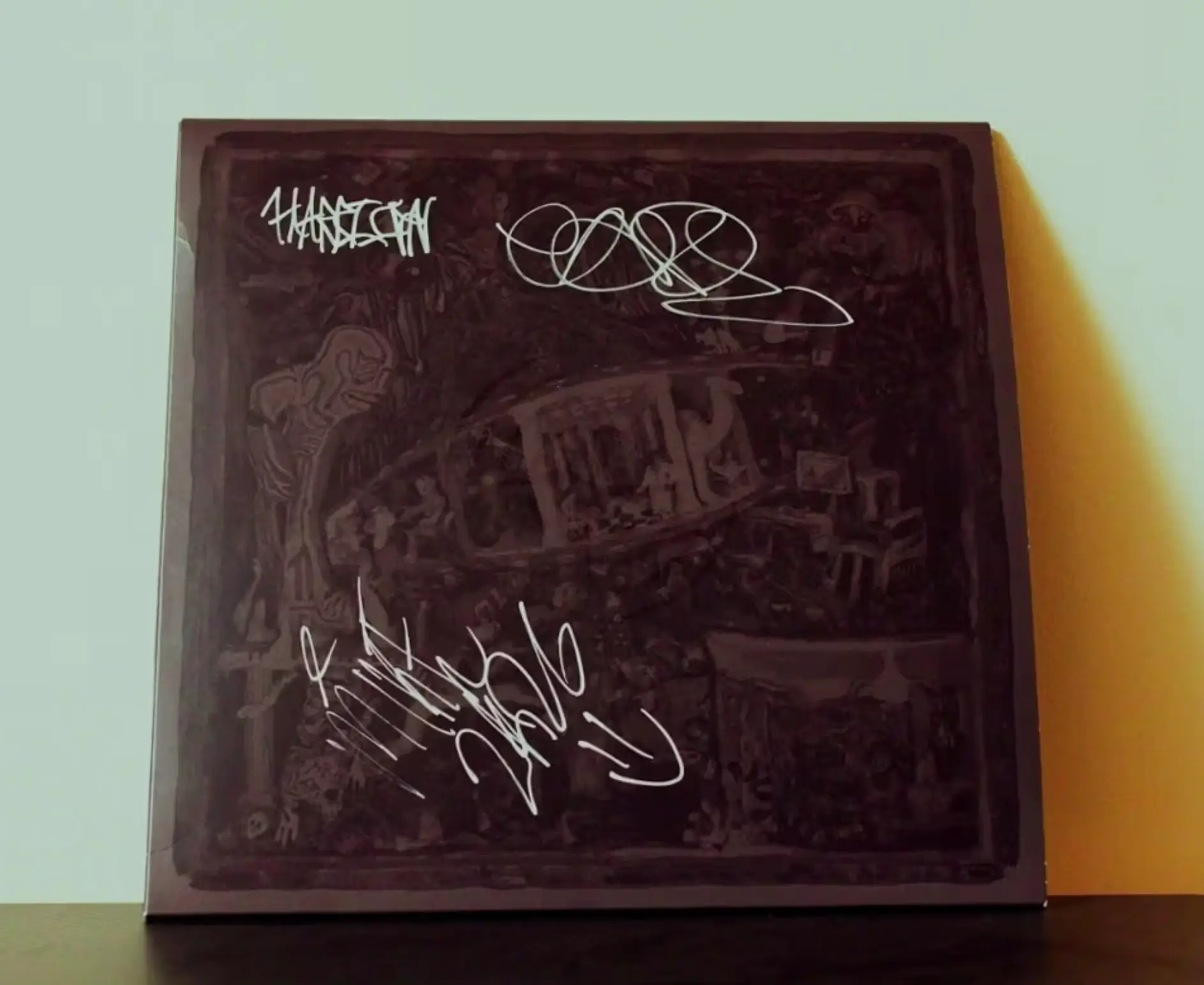
The intervention begins in view. The original artwork by Sharif Farrag is not replaced—it is covered, reframed, submerged under a black overlay. The gesture is deceptively simple. Yet it alters everything.
Where Farrag’s work typically vibrates with organic irregularity—ceramic forms, painterly distortions, tactile unpredictability—the overlay introduces a controlled opacity. Not a full erasure, but a filtration. What remains visible becomes charged with absence. What disappears lingers as suggestion.
This is where the Stone Island language becomes legible. The same philosophy that produces heat-reactive jackets, reflective surfaces, or pigment-dyed textiles operates here in two dimensions. The artwork is not static—it is conditioned. Subject to transformation. Re-contextualized through surface treatment.
Emotionally, the effect is a cooling of immediacy. The viewer is held at a distance. The image becomes less about recognition and more about interpretation. It mirrors the sonic world of the record itself: elliptical, submerged, resistant to clarity.
the pair
Earl’s trajectory has been one of subtraction. From the dense, almost claustrophobic lyricism of his early work to the skeletal frameworks of later releases, his music has consistently moved toward reduction. Bars feel less like declarations and more like fragments—half-thoughts suspended in air.
MIKE operates differently, yet arrives at a similar endpoint. His delivery carries a diaristic intimacy, a stream-of-consciousness cadence that feels both immediate and obscured. His production choices—often self-directed—lean toward loops that feel worn, almost degraded, as if memory itself were the primary instrument.
Together, they form a dialogue that is less collective in the traditional sense and more parallel. Two voices moving through the same terrain without needing to resolve into harmony.
There is no attempt here to “elevate” through spectacle. No chorus engineered for recall. No structural concessions. The music exists in a state of ongoing thought.
amb
The production, credited to Surfgang, functions less as a backbone and more as an environment.
Surfgang’s approach has always resisted polish. Their beats feel eroded, like they’ve existed prior to recording. Loops stutter. Textures blur. There is a deliberate resistance to clarity, a prioritization of mood over structure.
In the context of POMPEII / UTILITY, this becomes crucial. The production does not frame the vocals—it absorbs them. Earl and MIKE’s voices sink into the mix, becoming part of the same material field.
This is not lo-fi as aesthetic shorthand. It is lo-fi as philosophy. A refusal of resolution.
listen
The presentation strategy extends the project beyond the record itself. The album was introduced across Los Angeles, New York City, and London through in-store activations at Stone Island locations.
This is not incidental. It is structural.
Stone Island stores are not neutral retail environments. They are highly controlled spatial experiences—industrial, minimal, precise. Garments are displayed almost as artifacts. Lighting is calibrated. Materials are foregrounded.
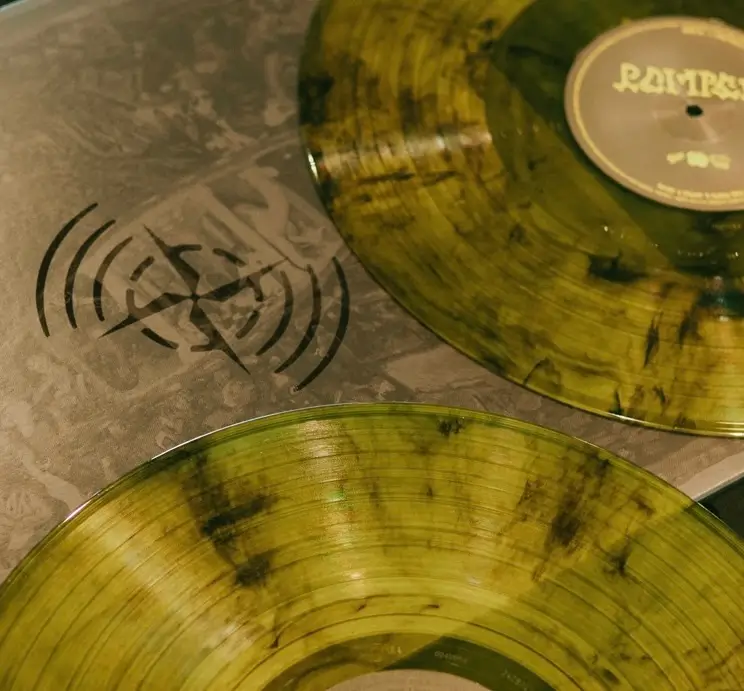
The vinyl itself extends this logic. Available exclusively across a global network—Milan, Paris, Toronto, Miami, Tokyo, alongside the initial cities—it functions as a distributed object. A networked release.
Ownership becomes tied to geography. Access becomes part of the narrative.
View this post on Instagram
capsule
The duality embedded in the title is not decorative. It is structural.
“Pompeii” evokes preservation through catastrophe. A city frozen in time, its details intact precisely because of its destruction. There is a parallel here with the sonic textures of the record—moments captured in a state of suspension, untouched by conventional progression.
“Utility,” by contrast, suggests function. Use. Practicality.
Placed together, the terms create tension. Preservation versus purpose. Memory versus application.
The music sits within that tension. It does not resolve it.
show
Returning to Sharif Farrag, it becomes clear that the artwork’s modification is not an aesthetic afterthought but a conceptual anchor.
Farrag’s work has always been concerned with form under pressure—objects that appear soft, unstable, almost collapsing. By overlaying this with black, Stone Island introduces a second layer of pressure.
The result is an image that feels both present and withheld. Much like the music, it resists full access.
mixo
What makes this project distinct is not simply the pairing of Earl Sweatshirt and MIKE, nor the involvement of Surfgang. It is the integration of a fashion brand—Stone Island—not as sponsor, but as co-author.
Stone Island Sound does not behave like a traditional label. It does not seek chart performance or streaming dominance. Instead, it operates through limited releases, physical formats, and curated collaborations.
This aligns with a broader shift in how music is distributed and valued. In an era of infinite access, scarcity regains meaning. Physicality becomes a differentiator.
The vinyl is not just a format—it is a statement.
subtle
There is a temporal aspect to POMPEII / UTILITY that resists contemporary listening habits.
The record does not reveal itself immediately. It requires repetition. Attention. A willingness to sit with ambiguity.
This is where the vinyl format becomes essential. The act of playing a record—placing the needle, flipping the side—introduces friction. It slows the process. It demands engagement.
In this sense, the project is not just about sound. It is about recalibrating the conditions under which sound is experienced.
again
It would be reductive to categorize POMPEII / UTILITY simply as experimental hip-hop. While it operates within that lineage, its ambitions extend beyond genre.
The project sits at the intersection of music, art, and fashion. It engages with questions of materiality, distribution, and perception.
In doing so, it reflects a broader cultural moment—one where boundaries between disciplines continue to dissolve. Where a record can function simultaneously as artwork, product, and spatial intervention.
impression
There is no spectacle here. No viral moment engineered for circulation.
And yet, the impact is felt precisely because of that restraint.
By refusing the logic of immediacy, POMPEII / UTILITY creates its own temporal space. A slower frequency. One that aligns more closely with the rhythms of thought than with the demands of the feed.
clue
In its Stone Island Sound edition, POMPEII / UTILITY becomes more than a collection of tracks. It becomes a condition.
A blacked-out image that reveals through concealment.
A set of voices that communicate through fragmentation.
A production style that prioritizes atmosphere over structure.
All of it working toward a singular effect: immersion without too much instruction.
There is no clear entry point. No defined conclusion.
Only a field of sound, image, and space—waiting to be navigated.