
Inside the Shhh Global Rollout of the Sunglass Hut x Ray-Ban Capsule

March 31, 2026
27 seconds ago
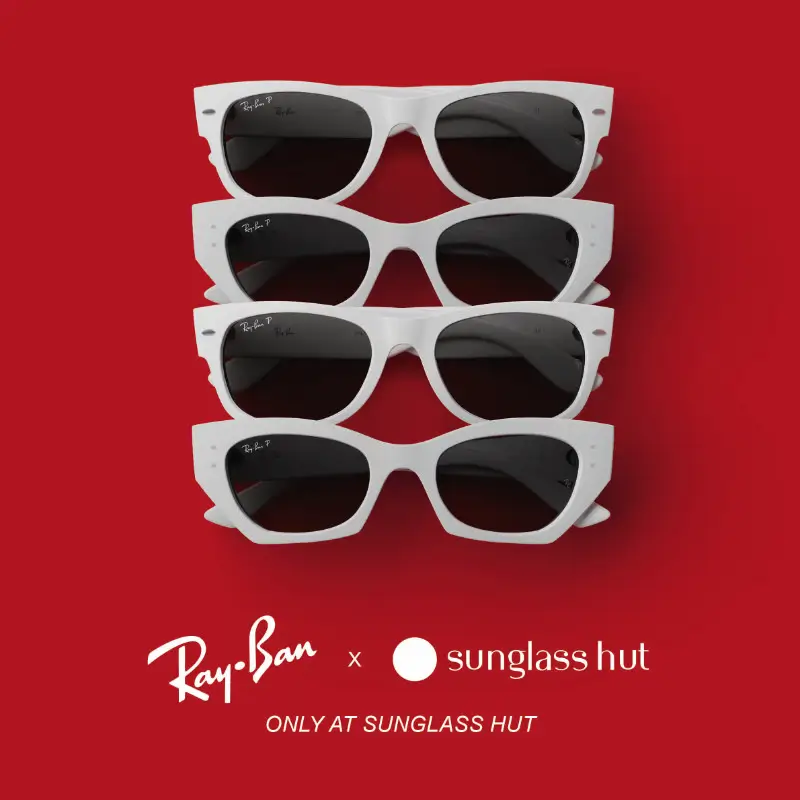
There is a distinct kind of launch that resists announcement. No homepage takeover, no algorithmic saturation, no immediate cascade of social posts engineered for visibility. Instead, it appears almost incidentally—through store windows, campaign stills, and the slow recognition of something new embedded within an existing retail environment.
The Sunglass Hut x Ray-Ban capsule arrives in precisely this manner.
At first glance, its absence from the primary digital surfaces of both Sunglass Hut and Ray-Ban might suggest delay, or even omission. But read more closely, the absence is intentional. It is not a failure of communication; it is a different mode of it.
This is a quiet launch—not in the sense of being hidden, but in the sense of being controlled.
pithy
The contemporary fashion system has, for over a decade, oriented itself toward digital primacy. Drops are announced on social media, amplified through influencer networks, and converted through e-commerce within hours. Visibility precedes experience.
This capsule reverses that sequence.
By positioning Sunglass Hut as the exclusive point of access, the collaboration reframes retail not as endpoint, but as origin. The store becomes the first encounter. The product is discovered physically, not algorithmically.
This shift is subtle but significant. It suggests a recalibration of value—away from immediacy and toward presence. To encounter the capsule is to enter a space curated around it, where lighting, display, and repetition of form construct a narrative that cannot be replicated through a screen.
In this context, exclusivity is infrastructural. It is not merely about limiting supply; it is about controlling environment.
flow
The images associated with the capsule reinforce this logic. White-framed sunglasses—stacked, repeated, layered across faces—are set against a saturated red field. The compositions are graphic, almost diagrammatic. They communicate through arrangement rather than narrative.
And yet, these visuals are not widely disseminated through the usual channels. They circulate within a contained system: retail displays, selective placements, and editorial surfaces.
This is what distinguishes the campaign. It exists, fully formed, but not fully broadcast.
Such an approach reflects a growing tension within fashion marketing. Visibility, once the primary objective, is no longer sufficient. In an environment of constant exposure, restraint can carry greater impact. What is not immediately seen acquires a different kind of value.
stir
Capsule collections have long functioned as sites of experimentation—spaces where brands can test ideas without committing to full-scale production. But in recent years, the capsule has taken on a more strategic role.
For Ray-Ban, whose identity is anchored in a set of enduring silhouettes, the challenge is not reinvention but recalibration. The capsule provides a framework within which these recalibrations can occur.
White frames replace traditional colorways. Proportions are adjusted. Textures are introduced. The result is a series of objects that feel both familiar and new.
For Sunglass Hut, the capsule operates differently. It becomes a means of differentiation within a competitive retail landscape. By offering something unavailable elsewhere, the retailer asserts its relevance—not just as a point of purchase, but as a curator of exclusive product.
The collaboration, then, is not simply about design. It is about alignment—between brand, retailer, and consumer experience.
idea
The absence of prominent digital placement is not a gap; it is a strategy.
In the traditional model, visibility drives demand. But visibility can also dilute specificity. When a product is everywhere, it becomes indistinct. The quiet launch counters this effect by limiting exposure, allowing the product to retain a sense of singularity.
This approach aligns with broader shifts in consumer behavior. There is a growing fatigue with constant marketing, a desire for discovery that feels organic rather than imposed. The quiet launch caters to this sensibility, offering a form of engagement that is less about consumption and more about encounter.
It also introduces a temporal dimension. Without a fixed moment of announcement, the capsule unfolds gradually. It is encountered at different times, in different places, creating a distributed experience rather than a singular event.
coalesce
Understanding this strategy requires situating it within the broader framework of EssilorLuxottica, the entity that encompasses both Ray-Ban and Sunglass Hut.
This vertical integration allows for a level of control that is uncommon in fashion. Product design, manufacturing, distribution, and retail are all contained within a single system. This enables experiments in rollout and positioning that would be difficult to execute across independent entities.
The quiet launch can be seen as one such experiment. It leverages the integrated structure to test a different model of engagement—one that prioritizes retail experience over digital amplification.
It also reflects a confidence in the product itself. When the entire system is aligned, there is less need for external validation. The product can be introduced on its own terms.
show
Within the capsule, form becomes the primary vehicle of communication. The repetition of white frames across different silhouettes creates a visual continuity that binds the collection together.
Zena sharpens the cat-eye into a more architectural expression. Mega Wayfarer II expands the familiar into something more assertive. RB4441D softens edges, introducing fluidity. Wayfarer Puffer adds volume, pushing the silhouette into a more sculptural territory.
Each model operates within the same visual language, differing only in proportion and texture. This creates a system in which variation is contained, controlled.
The effect is cumulative. Encountering multiple pairs together—whether in store or in campaign imagery—reinforces the collection’s identity. It becomes recognizable not through individual pieces, but through their collective presence.
venue
If the digital space is de-emphasized, the store takes on a new role. It becomes not just a site of transaction, but a medium through which the collection is communicated.
Displays are arranged to emphasize repetition and contrast. White frames stand out against darker surroundings. The red campaign color is echoed in signage and backdrops. Lighting is calibrated to highlight the contours of each piece.
This attention to environment transforms the act of viewing into an experience. The customer is not simply browsing; they are engaging with a curated narrative.
In this sense, Sunglass Hut operates less like a traditional retailer and more like a gallery. The products are presented as objects of design, their context carefully constructed.
transparent
The quiet launch does not eliminate visibility; it redefines it.
Instead of mass exposure, the capsule achieves a more targeted form of presence. It appears in specific locations, at specific moments, to specific audiences. It is shared through editorial coverage, through word of mouth, through the gradual accumulation of encounters.
This form of visibility is less immediate but potentially more enduring. It allows the collection to build recognition over time, rather than peaking at a single moment.
It also aligns with the idea of the capsule as a controlled release. By limiting both distribution and communication, the collaboration maintains a sense of coherence.
position
The aesthetic of the capsule—white frames, gray lenses, restrained branding—resonates with broader cultural currents. There is a movement toward reduction, toward objects that communicate through clarity rather than excess.
In this context, the quiet launch reinforces the product’s positioning. It suggests confidence, a refusal to compete within the noise of constant promotion.
It also reflects a shift in how luxury and premium products are introduced. Rather than relying on spectacle, they can rely on precision—of design, of placement, of timing.
fin
The Sunglass Hut x Ray-Ban capsule does not announce itself loudly. It does not seek immediate ubiquity. Instead, it operates through control—of distribution, of imagery, of timing.
This control is its defining feature.
By privileging retail over digital, by limiting exposure, by refining rather than reinventing, the collaboration articulates a different vision of how products can exist within the contemporary landscape.