SXSW 2026: A Week Where Music, Cinema, and Innovation Collide in Austin

March 13, 2026
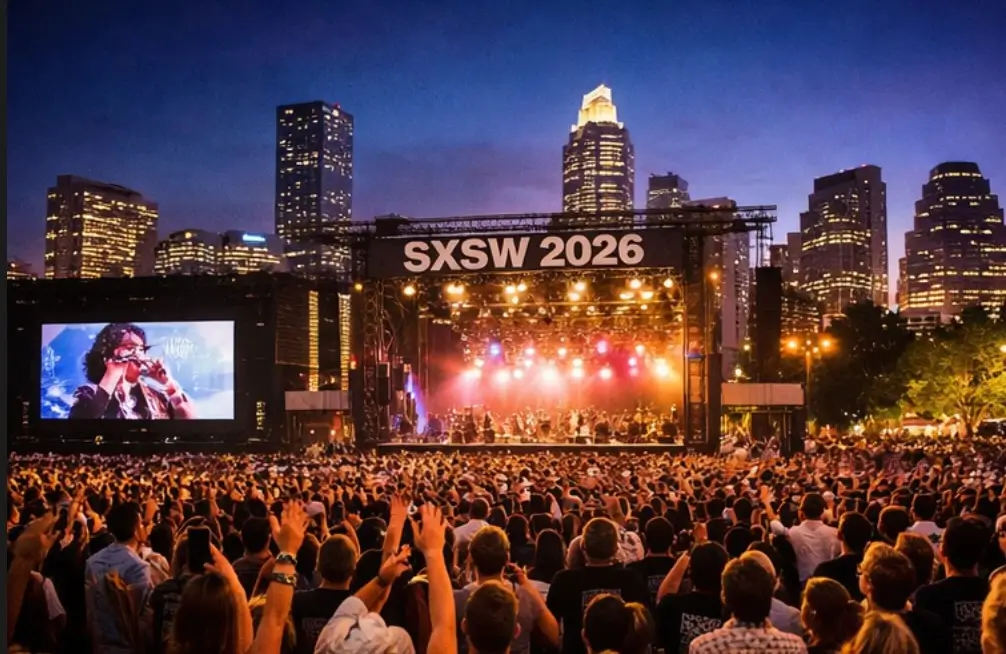
Each March, the city of Austin transforms into one of the most vibrant cultural laboratories in the world. The annual South by Southwest—known globally as SXSW—has long operated as a meeting ground for artists, technologists, filmmakers, entrepreneurs, musicians, and designers eager to exchange ideas and preview the cultural landscape of the near future. What began in 1987 as a modest music conference has evolved into a sprawling, multidisciplinary festival that influences how entertainment, technology, and creative industries evolve.
The 2026 edition of SXSW carries particular weight. It marks the festival’s 40th anniversary, a milestone that reflects four decades of creative experimentation and cultural influence. For many observers, SXSW has become a kind of cultural barometer: the place where emerging technologies are introduced, indie films begin their journey toward wider recognition, and musicians perform their earliest breakout shows before global success.
This year’s festival promises an especially compelling convergence of themes. Artificial intelligence, immersive storytelling, digital art, music discovery, and film innovation all appear at the center of the 2026 program. At the same time, the festival’s physical structure has evolved, encouraging new kinds of interaction between creators and audiences.
Below is a deep exploration of what makes SXSW 2026 so exciting—and why the festival remains one of the most important cultural gatherings in the world.
idea
The enduring power of SXSW comes from its ability to bring seemingly unrelated industries into conversation with each other. Musicians share stages with startup founders. Filmmakers collaborate with virtual reality developers. Fashion designers meet game designers and digital artists. The result is a festival environment where ideas move quickly between disciplines.
Over time, SXSW has launched countless careers and companies. Early Twitter adopters famously helped propel Twitterinto global prominence during the 2007 festival. Independent filmmakers have premiered projects that later became major award contenders. Musicians who once played small club showcases have gone on to dominate global charts.
This spirit of discovery remains central to the festival’s identity. SXSW isn’t just about established talent—it’s about spotting the future before it becomes obvious.
flow
One of the most notable changes in 2026 involves the festival’s physical structure. The Austin Convention Center—long considered the central hub of SXSW—is currently undergoing redevelopment. As a result, the festival has expanded outward across the city.
Instead of a single centralized campus, events now unfold across:
-
theaters
-
hotels
-
music venues
-
pop-up exhibition spaces
-
neighborhood creative hubs
This decentralized approach may ultimately benefit the festival. SXSW has always thrived on exploration, and spreading programming across the city encourages attendees to experience Austin itself as part of the event.
The change also brings the festival closer to its original atmosphere, when early SXSW attendees discovered music and ideas by wandering between venues rather than staying inside one massive convention complex.
In a sense, the city itself becomes the stage.
film
Film has become one of the most important pillars of SXSW programming. The festival’s film section is known for spotlighting projects that blend independent storytelling with strong commercial potential.
Several premieres are already generating strong anticipation in 2026. Among them is “I Love Boosters,” a darkly comedic crime story featuring performances by Keke Palmer and Demi Moore. The film’s premiere has attracted attention for its blend of satire and character-driven storytelling.
Another documentary receiving significant discussion is “Manhood,” which explores contemporary masculinity and evolving cultural expectations surrounding identity, body image, and self-presentation.
These premieres represent the type of storytelling SXSW often highlights: films that engage directly with contemporary culture while experimenting with narrative tone and format.
SXSW has historically served as a launching pad for filmmakers who go on to major recognition. Directors frequently use the festival to present projects that might otherwise struggle to find immediate distribution. When audiences respond strongly, distributors often move quickly to acquire rights.
In this sense, SXSW functions as both a festival and a marketplace—a place where creative risk and commercial opportunity intersect.
music
Music remains the festival’s original foundation. SXSW’s music program is famous for presenting thousands of artists across hundreds of performances throughout Austin.
One of the most exciting aspects of the music festival is its unpredictability. Major acts frequently perform alongside emerging artists still at the earliest stages of their careers.
Among performers associated with SXSW 2026 programming are artists such as Ty Dolla $ign and Jack Johnson. Yet the true spirit of SXSW lies in the discovery of musicians who arrive without widespread recognition.
Historically, SXSW has helped introduce audiences to artists who later became global stars. Bands such as Billie Eilishand The White Stripes both performed early festival showcases before achieving mainstream prominence.
The environment that allows this discovery is unique. Rather than traditional concerts, SXSW music programming consists of dozens of overlapping showcases taking place simultaneously across the city.
Attendees might wander into a small club out of curiosity and encounter an artist who later becomes internationally famous. That element of surprise remains one of the festival’s most enduring attractions.
View this post on Instagram
style
In recent years, SXSW has increasingly focused on the intersection between technology and creative industries. Artificial intelligence has emerged as one of the most prominent topics of discussion.
Panels throughout the 2026 festival examine how AI is transforming fields such as filmmaking, music production, visual art, and storytelling.
Key themes include:
-
AI-assisted creativity
-
generative design tools
-
machine learning in film editing
-
ethical considerations surrounding automated media creation
The technology industry has historically used SXSW as a place to introduce experimental ideas. Today’s AI debates echo earlier conversations about social media, mobile apps, and digital streaming that once dominated SXSW panels.
The difference now is the speed of change. Artificial intelligence is reshaping creative production at a remarkable pace, and many festival sessions aim to address both its potential and its risks.
For artists and technologists alike, SXSW offers a rare opportunity to discuss these transformations directly with peers across multiple disciplines.
social
Another exciting area of the festival involves immersive media experiences. Virtual reality, augmented reality, and mixed reality technologies are increasingly being used to create new forms of storytelling.
At SXSW 2026, immersive exhibitions allow audiences to step directly inside narrative environments. Instead of watching a story unfold on a screen, participants move through digital worlds designed by filmmakers and interactive artists.
This format reflects broader shifts in entertainment. Younger audiences raised on video games and digital platforms often expect interactive experiences rather than passive viewing.
SXSW’s immersive programming explores how narrative structures can evolve in response to these expectations.
For creators interested in pushing storytelling beyond traditional formats, these exhibitions represent some of the most experimental work at the festival.
culture
Although SXSW is often described as a technology and music festival, fashion and design have increasingly become part of the conversation.
Streetwear labels, design studios, and digital artists frequently use the festival as a platform to showcase collaborations and installations. These projects highlight the growing overlap between fashion culture and digital media.
Many installations explore how physical objects and digital environments can interact. Designers create spaces that combine architecture, projection mapping, and sculptural elements to produce immersive experiences.
For audiences interested in the intersection of fashion, art, and technology, SXSW offers an environment where creative boundaries are intentionally blurred.
The festival’s emphasis on interdisciplinary collaboration means that a filmmaker might end up collaborating with a fashion designer or a digital sculptor.
These encounters often lead to projects that extend far beyond the festival itself.
globe
SXSW has become an important global gathering point for creative industries. Cultural delegations from around the world participate in programming that highlights international music scenes, startup ecosystems, and film industries.
Spaces such as the British Music Embassy and international innovation hubs provide platforms for artists and entrepreneurs from different countries to present their work.
This global perspective has become increasingly important as creative industries operate across borders. Streaming platforms distribute films internationally. Musicians collaborate with producers in different continents. Technology startups launch products simultaneously in multiple markets.
SXSW’s international presence reflects this interconnected creative economy.
For many participants, the festival represents an opportunity to establish partnerships that extend across cultures and industries.
xp
While official programming attracts significant attention, many festival veterans argue that the most memorable SXSW moments happen outside the official schedule.
Austin becomes filled with:
-
outdoor concerts
-
pop-up exhibitions
-
brand activations
-
late-night DJ sets
-
collaborative art installations
These unofficial events create an atmosphere that extends beyond traditional festival boundaries.
A visitor might begin the evening attending a panel on artificial intelligence and end the night at a rooftop concert featuring an emerging band performing their first international showcase.
This fluid movement between formal programming and spontaneous discovery defines the SXSW experience.
why
In an era dominated by digital communication, SXSW demonstrates the continuing importance of physical gatherings where creators can exchange ideas directly.
The festival allows people from different industries to interact in ways that rarely happen elsewhere. A musician might share a stage with a software developer. A filmmaker might collaborate with a virtual reality designer. A fashion brand might partner with a digital artist.
These unexpected interactions often produce new creative directions.
SXSW thrives precisely because it refuses to define itself narrowly. It is not just a music festival, or a film festival, or a technology conference. It is all of those things simultaneously.
That hybridity makes SXSW uniquely positioned to capture the evolving shape of contemporary culture.
fin
SXSW 2026 represents both a celebration of the festival’s history and a glimpse of its future. The decentralized structure, new technological themes, and diverse programming suggest that the festival continues to evolve.
For attendees, the excitement lies in the possibility of discovery. Somewhere in Austin this year, a filmmaker may present their first feature. A musician may perform a set that changes their career. A technologist may unveil an idea that reshapes an entire industry.
That sense of possibility—of witnessing culture being created in real time—is what keeps people returning to SXSW year after year.
And after four decades, the festival still succeeds at its most important mission: bringing together creative minds who believe the future can be invented.

No comments yet.