review: The Beatles, Sgt. Pepper, and the Velocity of Reinvention

April 9, 2026
16 hours ago
a pace
By the spring of 1967, The Beatles had already done something structurally implausible. Eight albums in five years. Not iterations, not refinements—transformations. Each release recalibrated the one before it, as if the group were chasing a moving idea of themselves rather than building a stable identity. Pop music, until then, had largely operated within cycles—release, tour, repeat. The Beatles dissolved that rhythm. They accelerated it, fractured it, then abandoned it entirely.
When Sgt. Pepper’s Lonely Hearts Club Band arrived in May 1967, it did not feel like a continuation. It felt like a pivot point. Not only for the band, but for the architecture of recorded music itself.
The numbers are often cited because they seem to resist belief: 27 weeks at number one in the UK, a commercial gravity that pulled the industry toward it. But statistics alone fail to articulate what was happening. The album did not just sell—it reorganized expectation. It suggested that pop could hold narrative weight, sonic experimentation, view identity, and conceptual ambition without collapsing under its own density.
View this post on Instagram
Craig Green’s (designer) observation—that their output feels “non-human”—is less hyperbole than diagnosis. There is something inhuman about that velocity, not because it lacks feeling, but because it exceeds the rhythms we associate with creative labor.
stir
To comprehend Sgt. Pepper, you have to consider the compression that precedes it. Between 1962 and 1966, The Beatles released a sequence of albums that, in another era, might have defined entire careers individually. Please Please Me. A Hard Day’s Night. Rubber Soul. Revolver. Each one contains enough invention to sustain its own mythology.
But what is striking is not just the quality—it is the directional instability. They refused to stay still long enough for any one identity to calcify. The clean, harmonized optimism of early singles gives way to introspection, then to studio experimentation, then to something approaching abstraction.
John Lennon, at 26, was already moving between acerbic wit and something more fragmented, more interior. Paul McCartney, the structuralist, began to think in terms of arrangement and composition beyond the limitations of live performance. George Harrison introduced non-Western instrumentation and philosophical frameworks, expanding the palette. Ringo Starr anchored it all with a rhythmic sensibility that was deceptively innovative—less about virtuosity, more about feel.
By Revolver in 1966, the studio had already become an instrument. Tape loops, reversed sounds, varispeed recording—techniques that would become standard were, at that moment, speculative. Yet even Revolver feels like a preface when placed next to Sgt. Pepper.
flow
One of the quiet revolutions of Sgt. Pepper is spatial. The album does not feel like a collection of songs; it feels like an environment. This is where George Martin becomes essential—not just as a producer, but as a translator between imagination and execution.
Freed from the necessity of touring, The Beatles retreated into the studio. But “retreat” is misleading. What they built was expansive. The constraints of four-track recording did not limit them; they forced ingenuity. Tracks were layered, bounced, recombined—sound treated as material rather than documentation.
“A Day in the Life” is often cited, and for good reason. Its orchestral swell—an accumulation of dissonance resolving into something almost cosmic—feels less like composition and more like an event. It doesn’t just play; it unfolds.
What emerges across the album is a shift in how music is experienced. Songs are no longer discrete units. They bleed into one another. They suggest continuity. The fictional band—Sgt. Pepper’s Lonely Hearts Club Band—becomes a framing device, a way of recontextualizing The Beatles as something slightly removed from themselves.
This distance matters. It allows for experimentation without the burden of expectation. It creates space.
show
The word “psychedelic” is often applied too loosely to this period, reduced to color, distortion, surface. But in Sgt. Pepper, psychedelia functions structurally. It is not just aesthetic—it is a way of reorganizing perception.
“Lucy in the Sky with Diamonds” destabilizes narrative. “Being for the Benefit of Mr. Kite!” reconstructs a Victorian circus through tape manipulation, creating something that feels both nostalgic and uncanny. Even the brighter moments—“With a Little Help from My Friends”—carry an undercurrent of dislocation, as if familiarity itself has been subtly altered.
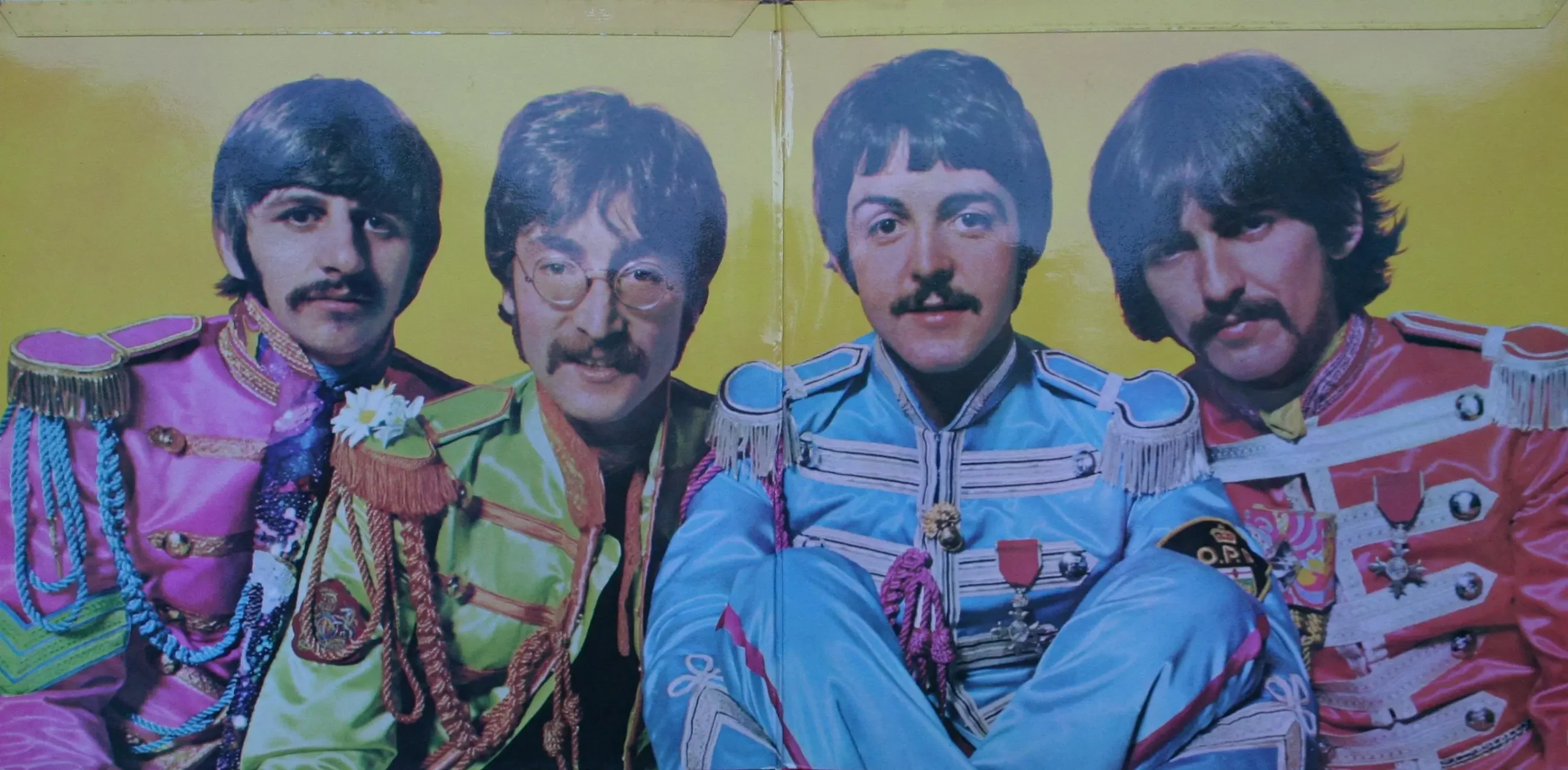
The album cover, designed by Peter Blake and Jann Haworth, mirrors this density. A collage of cultural figures—writers, actors, musicians—compressed into a single image. It is both celebratory and overwhelming, a view equivalent of the album’s sonic layering.
This is where Sgt. Pepper extends beyond music. It becomes a total object—sound, image, concept intertwined.
live
It is difficult to separate the achievement from the age at which it occurred. Twenty-six. Twenty-four. These are not ages typically associated with mastery, let alone reinvention at this scale.
There is a tendency to mythologize youth as a period of limitless possibility. But what The Beatles demonstrate is something more precise: not just possibility, but urgency. A refusal to defer. A sense that each project must exceed the last, not incrementally, but fundamentally.
This is where Craig Green’s observation resonates most clearly. The output feels “non-human” not because it lacks human qualities, but because it compresses time. What might take decades—experimentation, failure, reinvention—happens here in rapid succession.
And yet, it does not feel rushed. That is the paradox. The work carries the weight of deliberation, even as it accelerates.
format
Before Sgt. Pepper, the album was often secondary—a collection of singles, a convenient packaging. After it, the album becomes a statement. A unified work.
This shift cannot be overstated. It alters how artists think about release cycles, about cohesion, about audience engagement. It creates the conditions for what would later be called the “concept album,” but even that term feels insufficient. Sgt. Pepper is not rigidly conceptual; it is fluid, suggestive.
The influence radiates outward. Progressive rock, art pop, even contemporary hip-hop—all inherit something from this moment. The idea that a record can construct a world, not just present songs.
culture
Released into the atmosphere of 1967—the so-called Summer of Love—the album does not simply reflect its context; it amplifies it. It becomes part of a feedback loop between music, fashion, art, and social change.
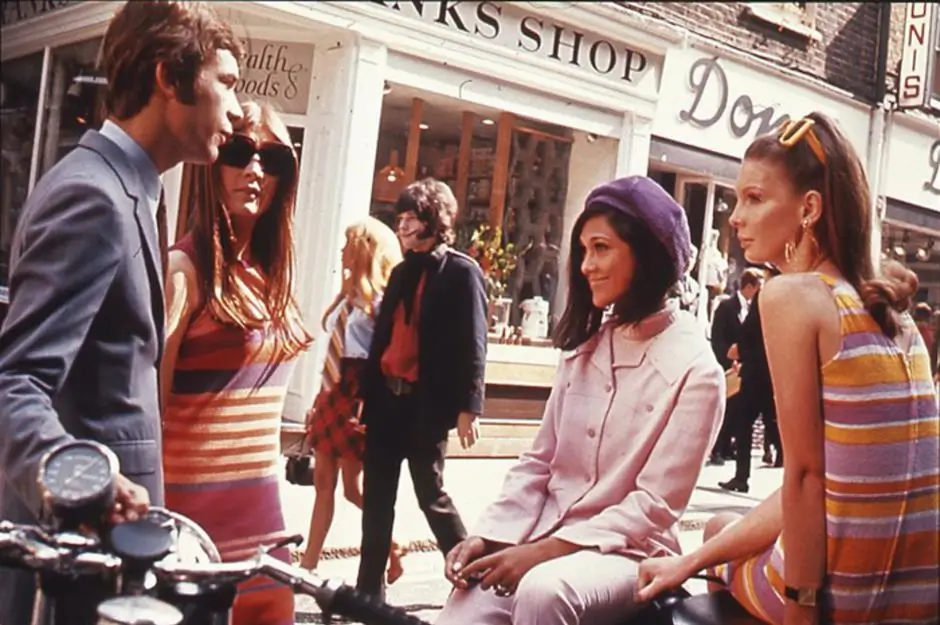
London, in particular, becomes a focal point. Carnaby Street. Boutique culture. A sense that youth is not just a demographic, but a force. The Beatles, whether intentionally or not, become central to this shift. Not as leaders in a traditional sense, but as accelerants.
The uniforms on the album cover—military-inspired, but rendered in saturated color—capture this ambiguity. Authority reimagined as play. Structure reinterpreted as style.
fragile
For all its innovation, Sgt. Pepper carries an undercurrent of fragility. The closing chord of “A Day in the Life” does not resolve so much as linger. There is a sense of suspension, of something held in place.
This is perhaps where the album reveals its most human dimension. Beneath the experimentation, the orchestration, the conceptual framing, there is uncertainty. A recognition that the structures being dismantled—musical, cultural—do not have clear replacements.
It is tempting to view the album as a culmination, a peak. But it is also a threshold. What follows is not a continuation of Sgt. Pepper, but a fragmentation—The White Album, Abbey Road, each moving in different directions.
myth
Over time, Sgt. Pepper has been absorbed into canon. It is cited, ranked, analyzed. Its innovations cataloged. But canonization can flatten experience. It can turn something volatile into something fixed.
To return to the album now is to rediscover its instability. Its refusal to settle. It does not feel like a solved problem; it feels like an open question.
What does it mean to create at that speed? To evolve without pause? To resist the gravitational pull of expectation?
These questions extend beyond music. They touch on design, fashion, art—any field where reinvention is both necessity and risk. Craig Green’s reflection is not just about The Beatles; it is about a condition. A moment when output and imagination align at a frequency that feels almost unsustainable.
clue
There is a tendency to look back at Sgt. Pepper as an isolated phenomenon. But its true significance lies in what it enables. It expands the field of possibility. It suggests that boundaries—between genres, between disciplines—are permeable.
In contemporary terms, this might seem obvious. But in 1967, it was radical.
The Beatles did not just change what music sounded like. They changed what it could be.
And they did it quickly. Almost impossibly so.