The Dancing House: Prague’s Bold Step into Modernity

April 11, 2025
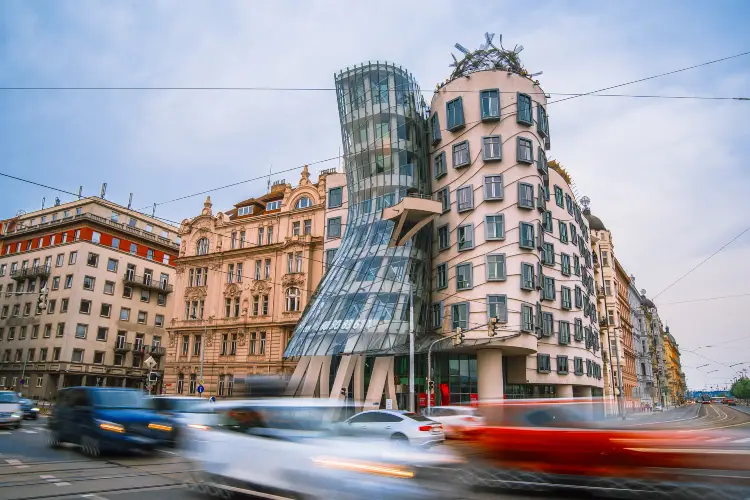
In the heart of Prague, where spires pierce the sky and cobblestones echo with centuries of history, a building dances. It doesn’t echo the Gothic verticality of the Old Town nor does it replicate the ornate curves of Baroque palaces. Instead, it twirls—a composition of glass and stone, of asymmetry and rhythm. This is Tančící dům, or The Dancing House—a monument to movement, disruption, and dialogue.
Designed by Vlado Milunić and Frank Gehry, The Dancing House emerged in 1996 as a deconstructivist landmark on Rašínovo nábřeží, defying Prague’s architectural canon while ultimately becoming one of its most beloved icons. Sometimes called Fred and Ginger, the building embodies both metaphor and material—a structure that dances while it stands still.
The Site: A Scar Turned Stage
The location of The Dancing House holds emotional and historical weight. The building stands at the corner of Rašín Embankment and Jiráskovo Square, overlooking the Vltava River. In 1945, an American bombing raid destroyed the neoclassical building that once occupied the site—collateral damage in the closing months of World War II.
For decades, the lot remained empty, a scar in the city’s fabric, shadowed by the oppressive era of communist rule. It wasn’t until the Velvet Revolution of 1989 and the subsequent democratization of Czechoslovakia that new conversations around the urban landscape began. Architect Vlado Milunić proposed a bold new concept: a building that would celebrate freedom and symbolize movement—not just in structure, but in society.
The Architects: A Meeting of Minds
Milunić, a Croatian-Czech architect, was known for experimental structures that embraced asymmetry and social commentary. He imagined the building as a dialogue between static and dynamic forces—“a man and a woman dancing together, liberated from the constraints of totalitarianism.” But to bring this vision to life on an international scale, he enlisted the help of Frank Gehry, the Canadian-American starchitect renowned for his expressive forms and disregard for convention.
Gehry, fresh off of transformative projects like the Vitra Design Museum and his early studies for the Guggenheim Bilbao, accepted the invitation with characteristic humility. He even initially resisted the idea of naming the building “Fred and Ginger,” fearing it might trivialize the architectural intention. Nevertheless, the nickname stuck, and the collaboration thrived.
Together, they created a provocative yet poetic intervention—a building that did not imitate its neighbors, but rather danced with them in respectful contrast.
The Structure: Stone Meets Glass in Performance
The Dancing House is comprised of two interlocking towers, each representing one half of the dancing duo. The stone tower, cylindrical and grounded, symbolizes Fred Astaire. It’s composed of 99 concrete panels of varying shapes, each slightly different—testament to the complexity of its design and execution. The façade, though rigid in material, twists gently as it ascends, creating the illusion of a rotating torso.
The glass tower, representing Ginger Rogers, curves inward and flows outward like a swirling dress caught mid-spin. Its transparent façade is supported by steel beams that act as ribs—visible yet elegant. Together, these towers lean toward each other, creating a dynamic tension, a visual suggestion of momentum. Their movement is imagined, but their relationship is palpable.
Capping the structure is a sculptural metal dome called “Medusa” or “Mary,” made of intertwined steel mesh—simultaneously chaotic and celestial. It resembles a tangle of hair, an electric cloud, or a spark of creative energy, giving the building both a crown and a conscience.
Deconstructivism: Dancing with Rules
The Dancing House is often cited as a textbook example of deconstructivist architecture, a style that emerged in the late 20th century as a reaction to rigid modernism and postmodern pastiche. Inspired by the ideas of Jacques Derrida and developed by architects like Zaha Hadid and Daniel Libeskind, deconstructivism embraces fragmentation, non-linear design, and unexpected juxtapositions.
In Prague—a city that proudly wears its medieval and Renaissance legacy—such an approach could have been met with disdain. And initially, it was. Critics called it a “drunken building” and accused it of violating the skyline. But over time, public sentiment evolved. Locals began to appreciate the building’s daring. Visitors flocked to photograph it. Architects applauded its structural audacity.
The building did not destroy the harmony of the city; it redefined it, introducing a new voice into an ancient conversation.
Function and Flow: Living Inside the Metaphor
Though sculptural in appearance, The Dancing House is far from a conceptual art piece—it is fully functional, housing a mix of commercial and cultural spaces.
- Offices occupy much of the interior, offering creative workspaces with sweeping views of Prague.
- The Ginger & Fred Restaurant, located on the top floor, provides haute cuisine paired with panoramic vistas. The dining room is encased in curved glass, allowing guests to eat within the metaphor itself—inside the skirt, beneath the dance.
- The Dancing House Gallery, a more recent addition, curates rotating exhibitions that explore Czech and international contemporary art, adding another layer of cultural engagement.
- Since 2016, the building has also included the Dancing House Hotel, allowing guests to spend the night inside one of Prague’s most photographed structures.
This integration of art, commerce, and hospitality reflects the multidimensional identity of the building. It is not simply a monument to be admired—it is a place to be lived in, worked in, and experienced.
Cultural Reception: From Disruption to Devotion
In the years since its unveiling, The Dancing House has undergone a remarkable transformation in public perception. Where it once drew ire, it now draws praise. Where it once felt like an interloper, it now feels like an essential character in the city’s story.
It represents more than architectural boldness. It represents Prague’s journey from post-war occupation to artistic liberation. It mirrors the city’s willingness to evolve—to let the past and future coexist in kinetic tension.
Internationally, the building has become a symbol of Prague’s modern identity. It appears on stamps, in music videos, on beer labels and banknotes. It is studied in architectural schools. It is posted on Instagram. It is beloved not because it blends in, but because it doesn’t.
Legacy and Longevity: Will the Dance Continue?
As The Dancing House approaches 30 years of age, it continues to defy time. Its materials—glass, concrete, steel—have aged gracefully. Its message feels no less urgent. In fact, as global cities grapple with issues of architectural homogenization, gentrification, and cultural stasis, the Dancing House stands as a reminder that boldness can become beloved.
Architecturally, it has paved the way for other contemporary interventions in heritage-rich cities. It has proven that contrast can enhance rather than diminish. That conversation, not conformity, is the lifeblood of urbanism.
And in its literal form—a building inspired by dancers—it reminds us that architecture doesn’t always have to stand still. It can curve. It can swirl. It can suggest music, even in silence.
Impression
To visit The Dancing House is to experience a paradox: a static structure that feels like it might twirl off the block. It invites us to see movement in stone, to feel grace in glass, to trust that even in a city defined by history, there is room for risk.
Vlado Milunić once said that the building was a symbol of freedom—freedom to create, to challenge, to dance. Frank Gehry said that it was “like two people dancing who don’t know each other well, but want to.” Between those perspectives lies the magic of the building: it is elegant, but not rigid; emotional, but not chaotic.
In the choreography of cities, most buildings march in formation. The Dancing House, however, twirls, offering an eternal performance on the banks of the Vltava.
And for that, Prague doesn’t just accept it.
Prague applauds.