The Only Two Things You Really Need to Keep Mosquitoes Away This Summer

July 6, 2025
We hate mosquitoes. Those buzzing, bloodthirsty nuisances can turn a perfect summer evening into a frantic dance of slaps and curses. In response to our collective loathing, entire industries have flourished, peddling every conceivable anti-mosquito gadget and potion: citronella candles, wristbands, ultrasonic devices, herbal sprays, you name it. But the hard truth? Almost all of them don’t work—or at least, don’t work well enough to matter.
For decades, we’ve been bombarded with so-called “solutions” to our mosquito woes. Strolling through any big-box store in early summer is like stepping into a carnival of anti-mosquito promises: brightly colored citronella buckets, designer bracelets, battery-powered zappers that emit a reassuring but useless “zap.” Unfortunately, most of these are either scientifically unsound or so limited in effect that they offer more psychological comfort than actual protection.
Mythbusting the Popular Alternatives
Let’s start with the darlings of the backyard aesthetic: citronella candles. They smell like lemony hope and promise to shoo mosquitoes away from your patio soirée. Yet multiple studies, including research by the Journal of Insect Science, have shown that citronella candles are no more effective than plain candles. While they may have a minimal effect directly next to the flame, mosquitoes are largely undeterred.
Then there are bug zappers, whose satisfying crackle makes us believe they’re doing us a service. In reality, they primarily kill harmless or beneficial insects like moths and beetles. Mosquitoes, which are drawn to carbon dioxide and body heat rather than light, mostly ignore zappers altogether.
Wristbands? They only protect your wrists. Unless you’re planning to string them together into a full-body mosquito armor (not recommended), they offer virtually no real defense.
Ultrasonic repellent devices, marketed with sleek designs and futuristic promises, have also failed rigorous scientific scrutiny. Controlled studies have repeatedly demonstrated their ineffectiveness. Despite the appealing “tech” allure, mosquitoes simply aren’t phased by high-pitched tones.
The Reality: Only Two Tools Matter
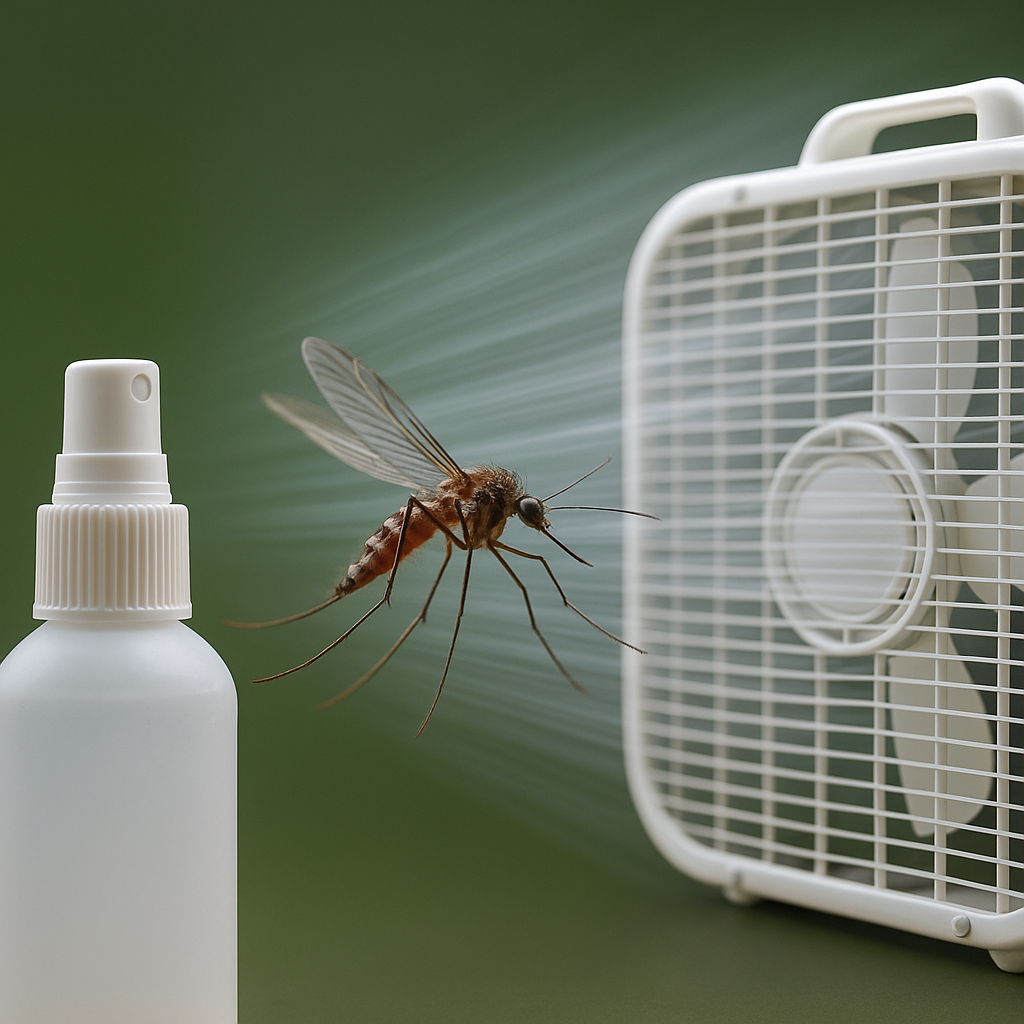
So what works? After decades of hype, marketing spin, and pseudo-science, the simplest truth remains: the two things you really need to keep mosquitoes off your skin this summer are a good bug spray and a fan.
No backyard labyrinth of candles. No sci-fi wrist gadgets. Just a bottle of spray and a sturdy box fan.
Bug Spray: The Chemical Shield
Let’s get one thing straight: bug spray works. But not just any bug spray — it needs to contain one of three proven active ingredients: DEET, picaridin, or oil of lemon eucalyptus.
DEET has been the gold standard since its development in 1946 by the U.S. Army. Despite past scare campaigns, DEET has consistently been reviewed and approved by the Environmental Protection Agency (EPA). Used properly, it poses no significant risk to human health.
Picaridin, a synthetic compound developed in the 1980s, offers similar efficacy without DEET’s distinct odor and greasy feel. It’s widely favored by those who want reliable protection but dislike the sensory drawbacks of DEET.
Oil of lemon eucalyptus, the only naturally derived option among the three, has shown solid performance in field studies. While not as long-lasting as DEET or picaridin, it offers a good alternative for those seeking a more “natural” option with EPA-backed credibility.
Look for an EPA registration number on the label — this is your guarantee that the product has been evaluated for effectiveness and safety. Many “natural” or “organic” repellents fail to provide meaningful protection and lack this registration.
Among user favorites, Cutter Skinsations deserves a shoutout. With 7% DEET, it strikes a balance between effectiveness and comfort, lacking the heavy scent and sticky residue that often deter people from using repellents. For more intense mosquito environments — say, deep woods or swampy campsites — higher DEET concentrations (up to 30%) provide longer protection.
The Humble Fan: A Mechanical Barrier
The second, equally important tool is elegantly simple: a fan. Whether a large box fan or a smaller oscillating one, this common appliance acts as an invisible force field.
Mosquitoes are weak flyers. Unlike houseflies or bees, they lack robust flight muscles and are easily pushed off course by even modest airflow. When air is still and humid, mosquitoes hover and zero in on body heat and exhaled carbon dioxide. Introduce a breeze — artificial or natural — and they struggle to maintain direction or even stay airborne.
A box fan set at the edge of your porch or patio can do wonders. Not only does it provide immediate, physical deterrence, but it also reduces the concentration of CO2 and scents that guide mosquitoes toward you.
A good fan costs less than a set of novelty citronella candles and doesn’t require constant re-lighting or reapplication. In practical terms, it’s one of the most cost-effective and reliable anti-mosquito tools available.
Bonus Strategies: Common Sense Prevails
While bug spray and a fan are your mainstay defenses, a few simple additional measures can help keep mosquito populations down around your home:
-
Eliminate breeding grounds: Mosquitoes lay eggs in stagnant water. Empty buckets, clean gutters, and regularly change birdbath water to disrupt their reproductive cycle.
-
Consider a “bucket of doom” trap: A simple DIY solution involving water, hay, and mosquito larvicide tablets can reduce local larvae populations.
-
Wear appropriate clothing: Long sleeves and pants, while not exactly summer favorites, offer straightforward protection.
Yet it’s important to acknowledge that these methods are supplementary. When you’re already outside, dressed in shorts, sipping your drink under the stars, your immediate tools are still chemical repellents and a fan.
Why We Keep Falling for Gimmicks
If two tools are all we need, why do so many alternative products thrive? The answer lies in psychology and aesthetics.
We crave easy fixes that look attractive. A sleek wristband feels modern and non-intrusive; a candle lends cozy ambiance to a gathering. The idea of a “natural” solution appeals to our desire for safety and environmental stewardship. These products play on emotional desires rather than hard science.
Furthermore, the marketing of these items taps into a uniquely human vulnerability: our aversion to chemicals and our hope for gentle, passive defenses. But biology does not bend to our preferences — mosquitoes seek blood, and they are impervious to wishful thinking.
Debunking the Fear of DEET
Many people avoid DEET due to misunderstandings about its safety. Myths have circulated for years, painting it as a dangerous toxin. In truth, decades of scientific review show that DEET is remarkably safe when used correctly.
Don’t drink it, inhale it in large quantities, or apply it to open wounds — common-sense precautions. But as a topical repellent? It remains one of the most rigorously studied and effective substances available.
The Ritual of Summer Evenings
Despite our antagonism toward mosquitoes, there’s something beautifully communal about summer evenings. Friends gather on patios, lanterns glow, laughter drifts into warm air. The intrusion of mosquitoes can feel like a violation of this sacred ritual.
Arming yourself with an effective spray and setting up a fan becomes not just a matter of personal comfort but a preservation of these moments. You reclaim the evening, trading anxious swats and welts for unbroken conversation and relaxation.
Impression
When it comes to mosquitoes, the landscape is cluttered with noise and ineffective solutions. By cutting through the clutter, we return to the basics: chemical repellents that have stood up to decades of scientific scrutiny and the simple mechanical brilliance of a fan.
In embracing these straightforward strategies, we affirm a small but vital truth: not every problem requires a gadget-laden solution. Sometimes, the simplest methods are the most effective — and the most liberating.
So this summer, skip the citronella carnival and embrace what works. Spray up, turn on the fan, and step outside confidently. The night is yours.