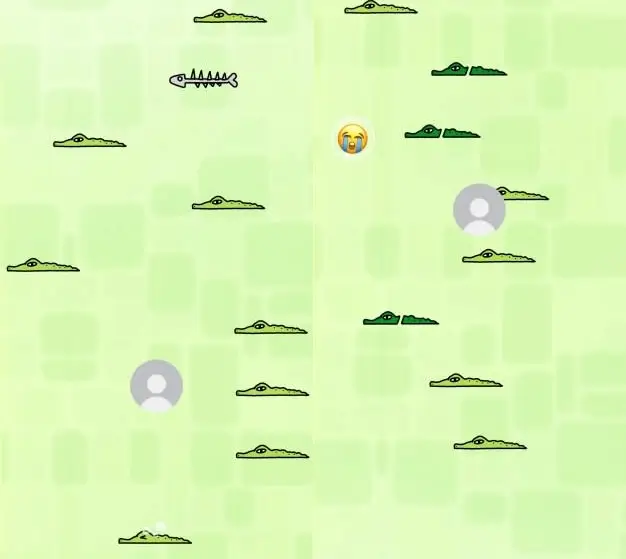
There is a quiet shift underway inside TikTok—one that doesn’t announce itself through splash screens or update notes, but instead reveals itself through curiosity. A hidden alligator-themed game, now rolling out globally inside direct messages, reframes what a social platform can be when it stops demanding attention and starts rewarding discovery.
It is not a feature designed to dominate headlines. It is, instead, designed to be stumbled upon.
stir
Direct messaging on TikTok has historically functioned as a supporting layer—an auxiliary space where links, clips, and reactions circulate between users. The introduction of a hidden game disrupts that hierarchy. It turns the DM from a passive conduit into an active environment.
The alligator game appears only when triggered, often through specific gestures or keywords exchanged between users. There is no universal prompt. No visible entry point. The result is a feature that feels almost illicit, as though it exists slightly outside the platform’s official architecture.
Once activated, the transition is seamless. The chat interface softens into a game layer: a cartoon alligator rendered in clean, tactile graphics, responding to taps and timed interactions. The mechanics are intentionally minimal—quick loops, immediate feedback, no onboarding friction.
This is not gaming as competition. It is gaming as interruption.
show
What distinguishes the alligator game is not its complexity but its tone. The visual language leans into a kind of understated whimsy—rounded edges, soft color palettes, responsive animations. It echoes the broader design ethos that has come to define TikTok’s interface: intuitive, immediate, and quietly addictive.
There is also a subtle nostalgia embedded in the experience. The game recalls an earlier era of mobile interaction, when simple tap-based mechanics defined engagement. Yet here, that simplicity is reframed within a hyper-connected ecosystem, where the act of playing is inherently social.
You do not discover the game alone. You are shown it. Sent it. Taught it through a loop of content that mirrors the very platform it inhabits.
idea
The hidden nature of the feature is not incidental—it is strategic. In an environment saturated with updates and announcements, invisibility becomes a form of distinction.
Users who encounter the game gain a kind of social capital. They become intermediaries, sharing activation methods through videos and messages, effectively turning discovery into content. The platform, in turn, benefits from this organic circulation. The feature markets itself without ever being formally marketed.
This dynamic reflects a broader shift in digital design. Features are no longer simply released; they are seeded. Their visibility emerges through user behavior rather than corporate messaging.
min
The alligator game is emblematic of a larger trend: the rise of micro-experiences within platforms. These are not full-fledged features with dedicated tabs or ecosystems. They are moments—brief, contained, and repeatable.
For TikTok, this approach offers several advantages. It increases dwell time without requiring new content. It deepens user engagement without overwhelming the interface. And perhaps most importantly, it introduces variability into a platform that can otherwise feel rhythmically predictable.
Scrolling is linear. Micro-experiences are not.
By embedding a game within DMs, TikTok disrupts the expected flow of interaction. A conversation can suddenly pivot into play, then back again, without leaving the app. The boundary between communication and entertainment dissolves.
imagine
Unlike traditional mobile games, which often isolate the player, TikTok’s alligator game is inherently relational. It exists within a conversation, shaped by the dynamics of that exchange.
One user triggers it. Another responds. The game becomes a shared moment, a brief detour from the linearity of text. In this sense, it functions less as a game and more as a gesture—an extension of communication rather than a separate activity.
This aligns with TikTok’s broader philosophy, where content is rarely static. Videos invite duets, stitches, remixes. The alligator game extends that logic into messaging, turning interaction itself into a form of play.
psych
There is a psychological dimension to hidden features that conventional updates cannot replicate. They create a sense of exclusivity, even when widely available. The act of finding—or being shown—something secret triggers a different kind of engagement.
It is not just about usage; it is about ownership. Users feel as though they have accessed something not everyone knows about, even if that knowledge spreads rapidly.
TikTok leverages this dynamic with precision. By withholding formal explanation, it allows the community to construct its own narratives around the feature. Tutorials emerge. Speculation circulates. The platform becomes a site of interpretation as much as interaction.
shh
What makes the rollout particularly notable is its quietness. There has been no major press push, no coordinated campaign. The feature exists, and its presence is confirmed primarily through user experience.
This approach reflects confidence in the platform’s internal ecosystem. TikTok does not need to announce; it needs only to introduce. The community will do the rest.
It also signals a shift in how features are valued. Visibility is no longer the primary metric of success. Engagement is. A hidden game that circulates organically can generate more sustained interaction than a prominently advertised update.
xp
The alligator game may appear minor, even whimsical. But it offers a glimpse into a broader evolution.
Social platforms are increasingly moving toward hybrid environments—spaces where communication, entertainment, and interaction coexist fluidly. The boundaries between these categories are dissolving, replaced by layered experiences that adapt to user behavior.
In this context, the game is less an endpoint than a prototype. It suggests a future where messaging is not just about text or media, but about interaction in its widest sense.
What other forms might this take? More games, certainly. But also tools, experiments, and experiences that emerge and disappear, shaping the platform in ways that are felt more than formally recognized.
a resist
There is a restraint to TikTok’s approach that feels deliberate. In an industry often defined by overstatement, the decision to embed a feature quietly—almost invisibly—reads as a form of confidence.
The alligator game does not demand attention. It earns it.
And in doing so, it repositions the role of the platform itself. TikTok is no longer just a place where content is consumed or shared. It is a space where interaction can take unexpected forms, where the boundaries of what a “feature” is are continually renegotiated.
The alligator, playful and unassuming, becomes a symbol of that shift. Not a headline, but a signal—small, precise, and quietly transformative.