Review: tinyBook Flip Signals the Return of Minimalist Smartphones

March 22, 2026
Most smartphones are engineered as instruments of perpetual engagement. Their surfaces glow insistently, their notifications punctuate silence, and their interfaces are calibrated for frictionless return. The cost of checking is negligible—so negligible, in fact, that it becomes reflex. This is not incidental. It is a design philosophy embedded at every level of contemporary device-making: remove friction, increase dependence.
Against this backdrop, the tinyBook Flip—conceived by the design studio Pixel Dynamics—arrives not as a product, but as a provocation. It challenges the foundational assumption that a phone must constantly demand attention to justify its existence. Instead, it imagines a device that recedes. That waits. That, in a radical inversion of the modern interface paradigm, seeks to disappear.
What emerges is not simply a new form factor, but a new behavioral contract between user and machine.
idea
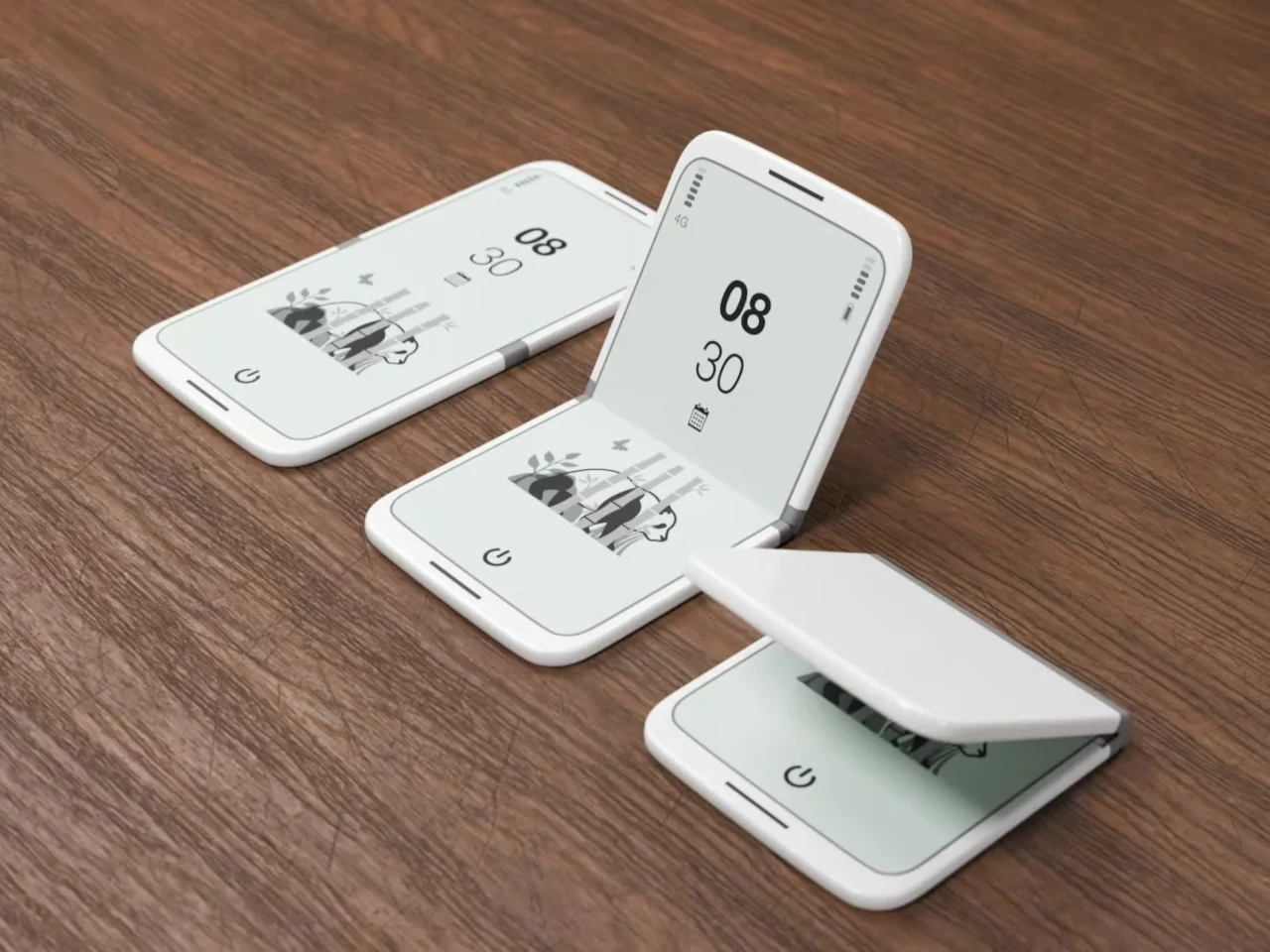
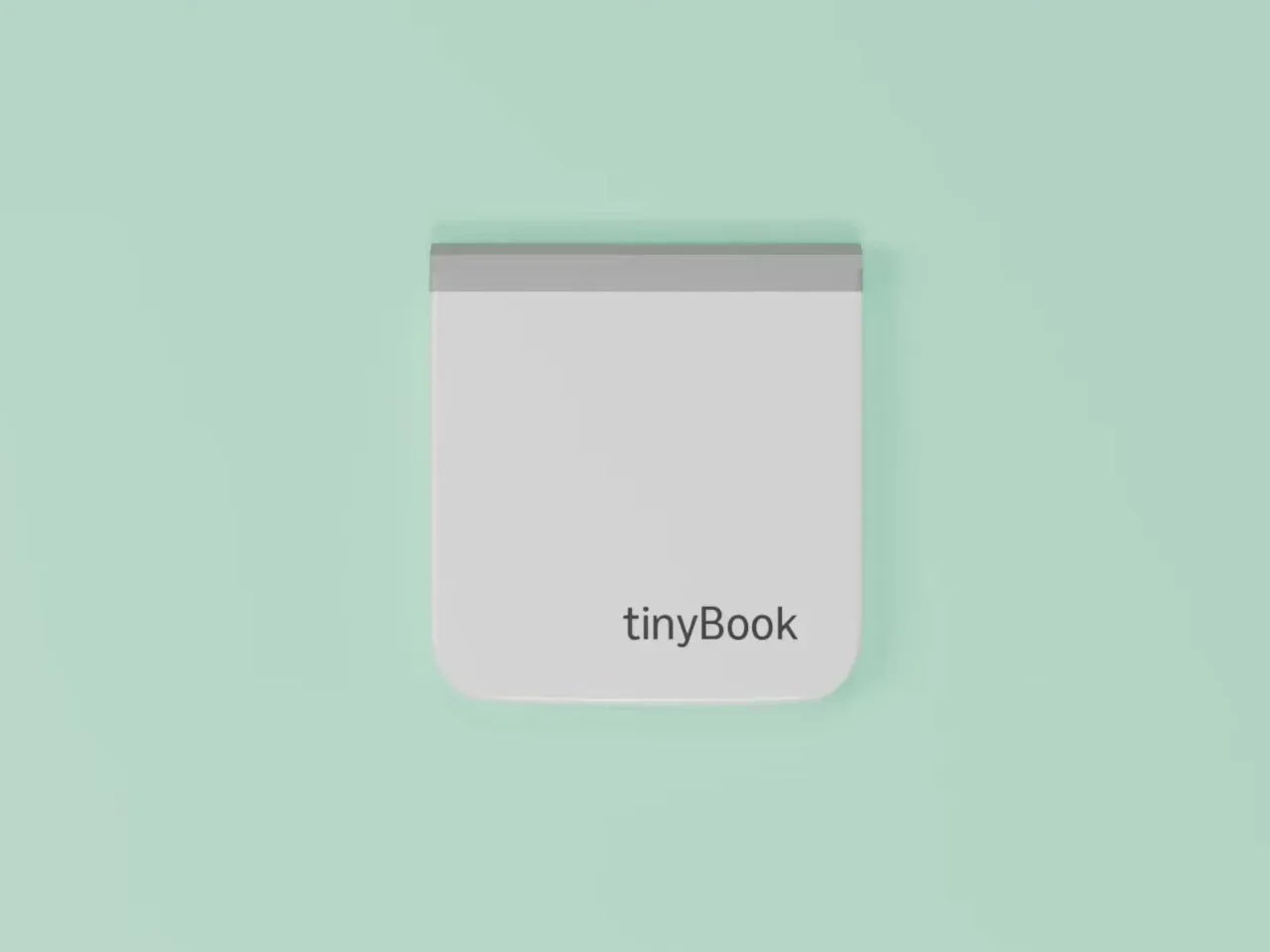
Closed, the tinyBook Flip is deliberately unremarkable. Its near-square silhouette, softened by rounded corners and finished in a matte white exterior, evokes something analog—perhaps a folded notecard, perhaps a small field notebook. Crucially, it does not resemble a phone.
There is no outward-facing display. No secondary screen offering a drip feed of alerts. No always-on clock gently insisting on awareness. When shut, the device offers nothing to look at. It is visually silent.
This absence is the design.
In a world where most devices are engineered to be legible at a glance—to broadcast status, urgency, and activity—the tinyBook Flip withholds. It refuses ambient presence. It does not perform usefulness when idle. Instead, it embraces opacity, inviting a different kind of relationship: one based on intentional interaction rather than habitual glance.
slow
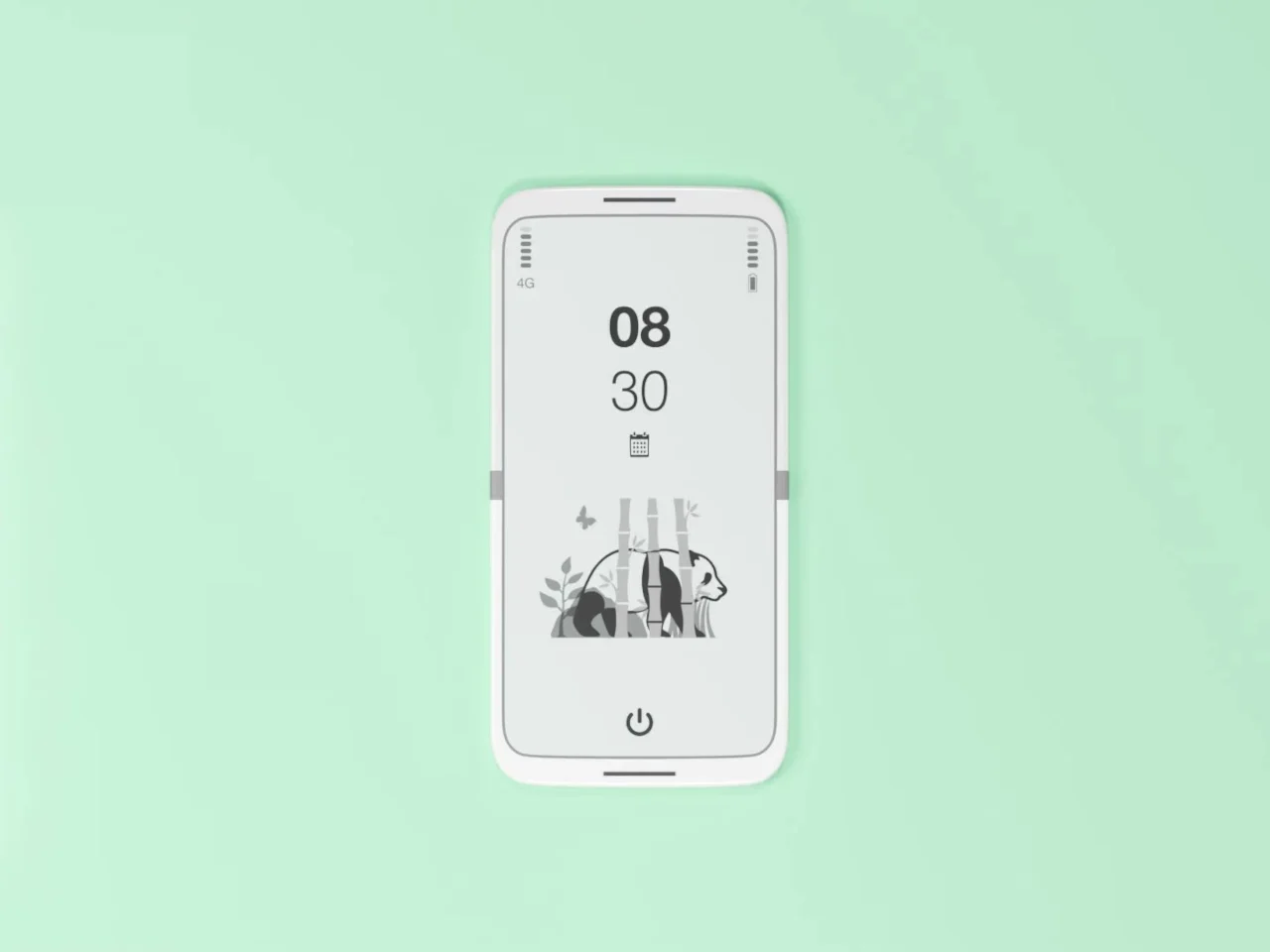
At the center of the tinyBook Flip is a 6.1-inch E Ink display—a choice that fundamentally reshapes the device’s purpose. Unlike OLED or LCD panels, E Ink does not refresh continuously. It updates in discrete intervals. It does not glow; it reflects.
This difference is not merely technical. It is experiential.
An E Ink screen resists speed. It introduces micro-delays that disrupt compulsive scrolling. Animations are minimal or absent. Color, if present at all, is subdued. The interface becomes quieter, more deliberate. Reading replaces swiping. Pausing replaces refreshing.
In this sense, the tinyBook Flip aligns more closely with devices like e-readers than with smartphones. It privileges depth over immediacy, comprehension over stimulation. The act of using it becomes more akin to opening a book than unlocking a feed.
There is also a physiological dimension. Without backlighting in the traditional sense, E Ink reduces eye strain and eliminates the blue-light emissions associated with disrupted sleep cycles. The device is not only less distracting—it is less invasive.
stir
Modern smartphones have spent over a decade eliminating friction. Face recognition replaces passcodes. Infinite scroll replaces pagination. Push notifications replace intention. Every barrier removed is a pathway reinforced.
The tinyBook Flip reverses this logic.
By requiring the user to physically open the device to access its screen, it reintroduces a moment of choice. A hinge becomes a gate. Interaction is no longer ambient; it is deliberate. You must decide to engage.
This small gesture—opening a device—has outsized implications. It interrupts autopilot behavior. It creates a threshold between being and checking. It transforms use from reflex into action.
Designers often speak of “user journeys” in terms of efficiency. Here, the journey is intentionally slowed. The friction is not a flaw; it is the point.
flow
The tinyBook Flip’s materiality reinforces its conceptual stance. The matte white finish avoids the high-gloss reflectivity typical of flagship devices. It neither mirrors the environment nor calls attention to fingerprints. It feels, visually at least, soft.
Rounded edges further reduce visual aggression. There are no sharp lines, no metallic flourishes, no chromatic accents signaling performance or power. The device does not compete for attention; it diffuses it.
This aesthetic restraint aligns with a broader movement in industrial design toward calm technology—objects that integrate into life without dominating it. The tinyBook Flip belongs to this lineage, alongside products that prioritize tactility, quietness, and emotional neutrality over spectacle.
sustain
Platforms, apps, and devices are co-designed to maximize engagement. Metrics such as screen time, daily active users, and session length are not byproducts—they are goals.
Hardware plays a crucial role in this system. Bright displays, haptic feedback, high refresh rates—all contribute to a feedback loop that rewards interaction.
The tinyBook Flip opts out.
Its E Ink display is ill-suited for video consumption. Its lack of an external screen eliminates passive notifications. Its folding mechanism discourages idle checking. In effect, it is a device that resists monetization through attention.
This resistance is, in itself, a form of critique. It asks whether a phone must be a portal to endless content, or whether it can instead be a tool—finite, purposeful, bounded.
show
There is a subtle but powerful psychological shift that occurs when a device is no longer visually present. Traditional smartphones, even when not in use, occupy attention. Their screens—black or lit—signal potential. They remind.
By contrast, the tinyBook Flip, when closed, withdraws from perception. It does not advertise its capabilities. It does not suggest missed messages or pending updates. It becomes, effectively, invisible.
This invisibility reduces cognitive load. Without constant visual cues, the mind is less likely to deter toward the device. The absence of prompts creates space—space for focus, for boredom, for thought.
In a culture increasingly concerned with digital well-being, this design choice is not trivial. It addresses not just how we use devices, but how devices use us.
compare
Of course, such a radical rethinking of the smartphone comes with trade-offs. An E Ink display cannot match the vibrancy or responsiveness of OLED. Certain applications—video streaming, gaming, real-time navigation—would be compromised or impractical.
But these limitations are also clarifying. They force a reevaluation of what a phone is for.
If stripped of entertainment and constant connectivity, what remains? Communication. Reading. Writing. Perhaps navigation, in a simplified form. The essentials.
The tinyBook Flip suggests that a device can be designed around these essentials, rather than around the full spectrum of digital possibility. It is not about doing everything. It is about doing enough—and doing it well.
frame
There is an unmistakable lineage connecting the tinyBook Flip to analog objects. Its proportions echo pocket notebooks. Its opening gesture mirrors the act of turning a cover. Its E Ink display, with its paper-like texture, bridges the tactile gap between digital and physical reading.
This lineage is not nostalgic—it is strategic. By referencing familiar, low-stimulation objects, the device anchors itself in a different behavioral context. It invites slower rhythms. It suggests use cases aligned with reflection rather than reaction.
In this sense, the tinyBook Flip is less a smartphone and more a hybrid artifact: part notebook, part communicator, part digital minimalism manifesto.
design
The most compelling aspect of the tinyBook Flip is that it operates as an argument. Not through marketing copy or feature lists, but through form.
Every design decision—the absence of an external display, the use of E Ink, the folding mechanism, the subdued material palette—articulates a position. Together, they propose that technology need not be synonymous with intrusion. That usefulness can coexist with restraint. That the best interface, at times, is no interface at all.
This is not to suggest that the tinyBook Flip will replace conventional smartphones. Its value lies elsewhere. It expands the conversation. It demonstrates that alternative paradigms are possible.
fin
As conversations around digital well-being, attention, and mental health continue to gain traction, devices like the tinyBook Flip feel increasingly relevant. They offer not solutions, but directions—pathways toward more intentional relationships with technology.
In the end, the question it poses is deceptively simple: what if a phone respected your attention as much as it sought it?
The answer, as imagined by Pixel Dynamics, is a device that folds away. That waits to be opened. That, in choosing absence over presence, redefines what it means to be indispensable.
Not because it demands your time—but because it gives it back.