TODO PASA “Sol” Clavo Jacket: A Trial of Fragments, Not a Style

April 9, 2026
15 hours ago
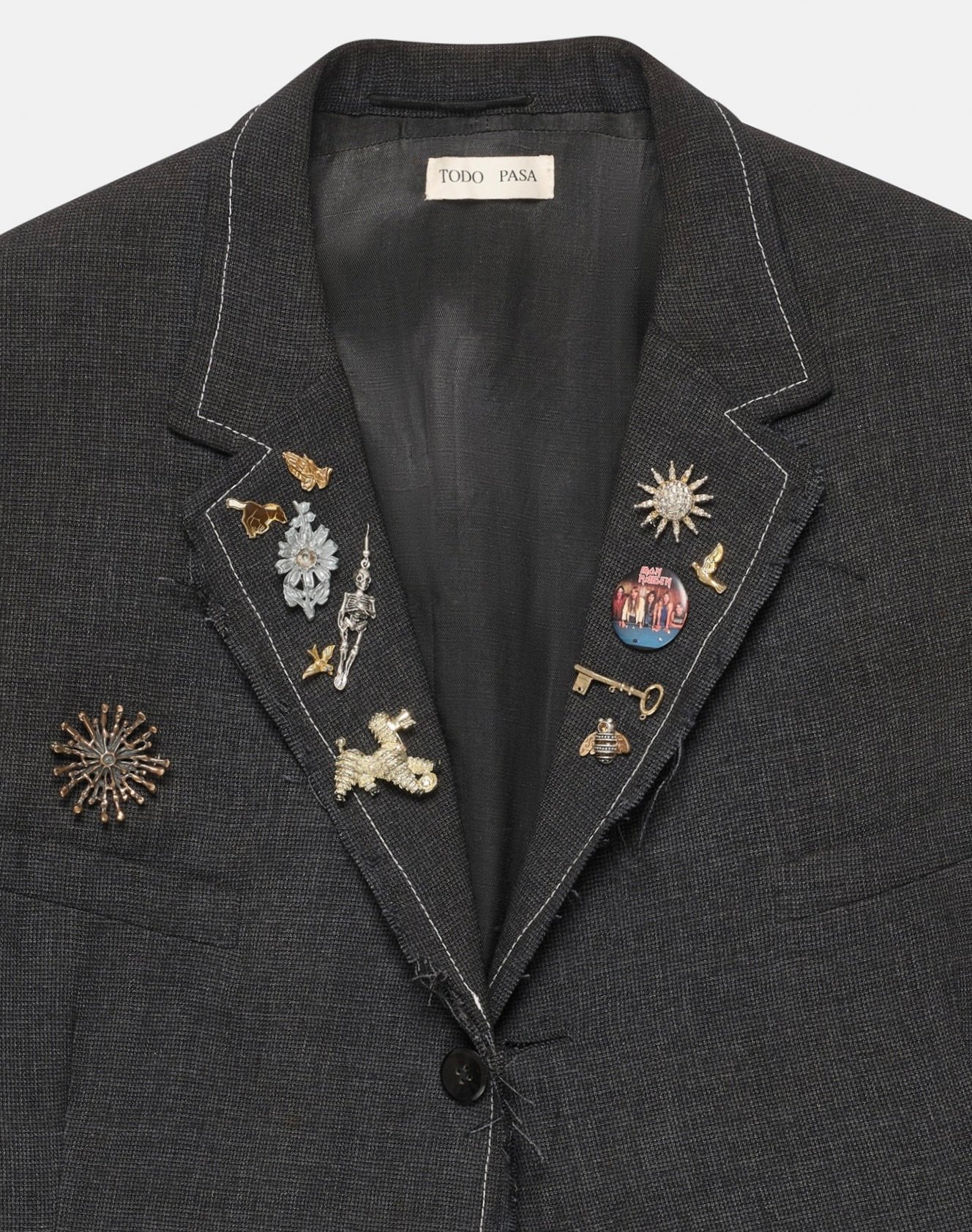
The immediate mistake is to read the “Sol” Clavo Jacket by Todo Pasa as either nostalgic or experimental. It is neither. It does not revive the past, and it does not attempt to speculate on the future. Instead, it occupies a third position—one that treats garments as already-lived objects, regardless of when they are made.
That distinction matters because it reframes authorship.
The jacket does not present itself as the product of a single moment of design. It behaves as if it has passed through multiple hands, multiple conditions, multiple uses. It looks less like something created than something carried forward.
This is where its history begins—not in a timeline, but in a method.
stir
“Todo pasa”—everything passes—is not branding language. It is a structural premise. The phrase appears across Latin American contexts, often tied to cycles of loss, endurance, and return. It suggests that nothing is fixed, but also that nothing disappears entirely.
In fashion, this idea is usually translated superficially—distressing, patina, artificial aging. Todo Pasa avoids that shorthand. Instead, it treats impermanence as a design condition.
The “Sol” Clavo Jacket is not aged. It is pre-disrupted.
It begins in a state that most garments reach only after time: frayed edges, visible construction, accumulated surface detail. But crucially, this is not simulation. The garment is not pretending to be old—it is structured to behave as if time has already intervened.
This is the difference between aesthetic and system.
View this post on Instagram
bespoke
The choice of a blazer is deliberate. Tailoring carries authority. It is one of the most codified forms in fashion—precision, hierarchy, control.
By using this structure, Todo Pasa sets up a tension: order as a base, disorder as intervention.
The jacket retains:
- Standard lapel geometry
- Familiar button stance
- Balanced proportions
But these are immediately destabilized.
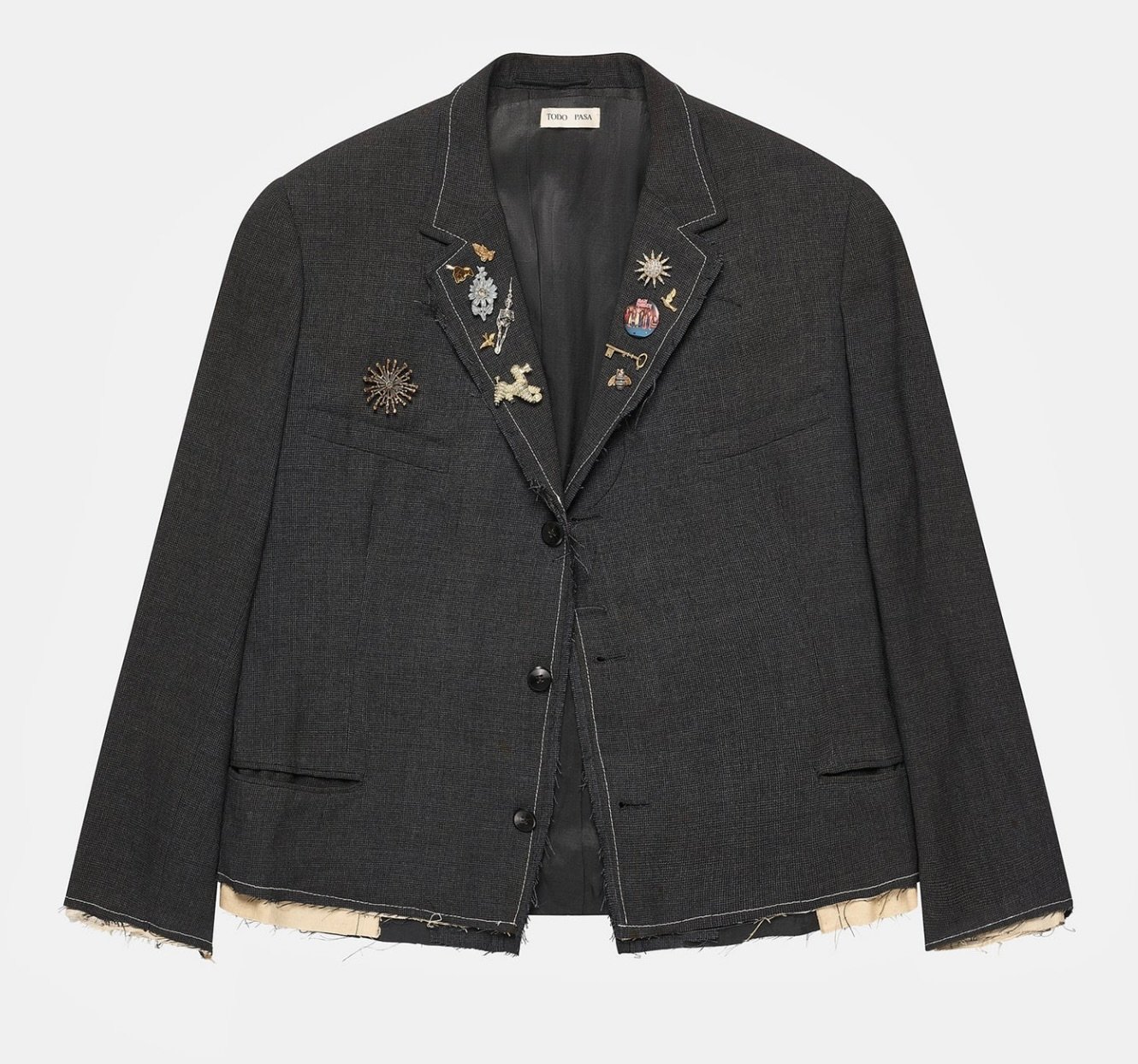
The hem is left open, revealing the internal architecture. The stitching is not concealed but emphasized—white thread tracing lines that are usually invisible. The edges appear interrupted rather than cut clean.
This is not destruction. It is exposure.
The jacket reveals its own construction not as a technical detail, but as a visual language. It asks the wearer—and the viewer—to consider how the garment is made, and by extension, how it might continue to be altered.
flow
The word “clavo” introduces a harder edge. A nail does not gently attach—it pierces. It fixes by force.
The pins across the lapel operate within that logic. They are not seamlessly integrated. They interrupt the surface. They create points of tension.
Each object—sunburst, key, animal form, badge—feels independent. There is no unified design language tying them together. They resist coherence.
This is where the jacket becomes critical.
In traditional fashion, ornament is subordinated to design. It follows rules—symmetry, balance, theme. Here, ornament behaves like memory: fragmented, inconsistent, layered over time.
The pins do not decorate the jacket. They complicate it.
theme
The sun appears among the objects, but it does not dominate. It is one element among many, slightly elevated but not centralized.
Symbolically, the sun is stability—cycles, repetition, continuity. But in this context, it is destabilized. It shares space with unrelated objects. It does not organize them.
This is a critical move.
Rather than using the sun as a unifying symbol, Todo Pasa allows it to exist as a fragment. It becomes one reference among others, stripped of its authority to define meaning.
The result is a system without hierarchy.
friction
Most garments operate within a closed narrative. They are designed, produced, finished. The wearer enters after the fact.
The “Sol” Clavo Jacket rejects this structure.
It presents itself as already incomplete. The raw hems suggest that the process has been interrupted. The pins suggest that additions have been made—and could be made again.
This shifts the role of the wearer.
You are not receiving a finished object. You are entering a process that has already begun.
The jacket becomes a platform rather than a product.
hx
Historically, garments were not replaced—they were maintained. Repaired, patched, modified. Each intervention left a mark.
Over time, these marks accumulated, creating garments that were not uniform but layered. Each repair was both functional and expressive.
Modern fashion largely abandoned this logic in favor of newness. Distressing and vintage treatments attempt to reintroduce it, but often as surface effect.
The “Sol” Clavo Jacket aligns more closely with the original practice—not by replicating old garments, but by reintroducing the idea that clothing is never finished.
It restores continuity between making and wearing.
rebel
There is no clear category for this jacket.
It is not formal, despite its tailoring.
It is not casual, despite its distressing.
It is not avant-garde, despite its conceptual framing.
This ambiguity is intentional.
In a market that depends on clear segmentation—formal vs. casual, classic vs. experimental—the jacket resists placement. It exists across categories without resolving into any of them.
This is not a stylistic choice. It is a structural one.
By refusing classification, the jacket maintains its instability.
strad
There is a subtle but important distinction in how the jacket handles material.
The wool remains intact—no artificial tearing or exaggerated distress. The rawness appears primarily at the edges and seams, where construction is naturally exposed.
This suggests restraint. The garment does not simulate damage; it reveals process.
Similarly, the pins are not oversized or theatrical. They feel sourced rather than designed, scaled to remain within the garment’s proportions.
This balance prevents the jacket from becoming costume.
It remains grounded, even as it disrupts expectations.
wear
To wear the “Sol” Clavo Jacket is to accept its instability.
It does not dictate styling. It does not resolve an outfit. Instead, it introduces variables.
You might:
- Add additional pins
- Remove existing ones
- Allow the edges to fray further
- Pair it with structured garments or disrupt it further
Each decision alters the jacket.
This is where the philosophy of Todo Pasa becomes operational. The garment changes not because it is designed to, but because it allows itself to.
show
The idea of “prevailing” usually implies endurance—remaining unchanged over time.
The “Sol” Clavo Jacket proposes a different model.
It prevails by changing.
By allowing additions, removals, wear, and intervention, it maintains relevance without needing to be preserved. It does not resist time; it integrates it.
This is a quieter form of durability—one that does not rely on material strength alone, but on conceptual openness.
pos
In a landscape saturated with references—archives, revivals, reinterpretations—the jacket’s most significant move is its refusal to anchor itself to a specific past.
It does not cite directly. It does not replicate.
Instead, it engages with process: how garments are made, altered, lived in.
This positions it outside of trend cycles. It is not responding to a moment; it is addressing a condition.
That condition—impermanence, accumulation, interruption—is not new. But it is rarely treated with this level of structural clarity.
fin
The “Sol” Clavo Jacket does not offer resolution.
It does not aim to be definitive, iconic, or even complete. Instead, it proposes a different understanding of clothing—one where garments are not static objects but ongoing states.
It begins mid-process. It invites continuation. It resists closure.
And in doing so, it reframes the role of design—not as the act of finishing, but as the act of starting something that does not end.