Trump’s Gold Coin and Possible Making of Memory at 250

March 22, 2026
As the United States approaches its 250th anniversary in 2026, the nation is entering a period of reflection rarely experienced at this scale. Known as the United States Semiquincentennial, the milestone marks two and a half centuries since the signing of the Declaration of Independence. It is a moment defined not only by celebration, but by interpretation—how history is remembered, who is commemorated, and what symbols are chosen to represent national identity.
Within that context, a proposal to issue a commemorative gold coin honoring Donald Trump has advanced through a federal review panel, igniting both interest and debate. The approval does not finalize the coin’s production, but it marks a significant step in a process that merges art, politics, and cultural storytelling.
At stake is more than a collectible object. It is the question of how contemporary figures are positioned within the long arc of American history—and how currency, one of the most enduring forms of public symbolism, becomes a medium for that narrative.
NEW – Commission of Fine Arts, composed entirely of Trump appointees, will weigh whether to approve a commemorative U.S. gold coin featuring Donald Trump to be released by the U.S. Mint — WaPo pic.twitter.com/97kzBVimV3
— Disclose.tv (@disclosetv) March 19, 2026
flow
Commemorative coins have long served as a bridge between national events and public memory. Produced under the oversight of institutions like the United States Mint, these coins are not intended for everyday circulation. Instead, they are designed as collectible artifacts, often tied to anniversaries, historical milestones, or significant individuals.
From early 20th-century issues celebrating expositions and statehood anniversaries to modern releases honoring civil rights leaders, military service, and cultural icons, the tradition reflects a broader effort to encode history into tangible form.
The process is deliberate and multi-layered. Proposals typically pass through advisory bodies such as the Citizens Coinage Advisory Committee and the Commission of Fine Arts. These panels evaluate not only artistic merit but also historical appropriateness, symbolism, and public resonance.
The advancement of a Trump commemorative coin through this framework places it within that lineage—while also distinguishing it as a particularly contemporary and politically charged entry.
idea
Gold coins occupy a distinct position within the commemorative hierarchy. Unlike silver or clad coins, gold issues are typically produced in limited quantities, often at higher price points, and are associated with prestige and permanence.
The decision to propose a gold coin for Donald Trump aligns with this tradition. It suggests an intent to frame the subject within a narrative of significance and durability—qualities historically associated with the metal itself.
Timing is equally critical. The Semiquincentennial provides a rare alignment of historical attention and institutional focus. It creates a framework within which new commemorations can be contextualized not as isolated gestures, but as part of a broader national reflection.
In this environment, the introduction of contemporary figures into commemorative programs becomes both more visible and more contested.
consider
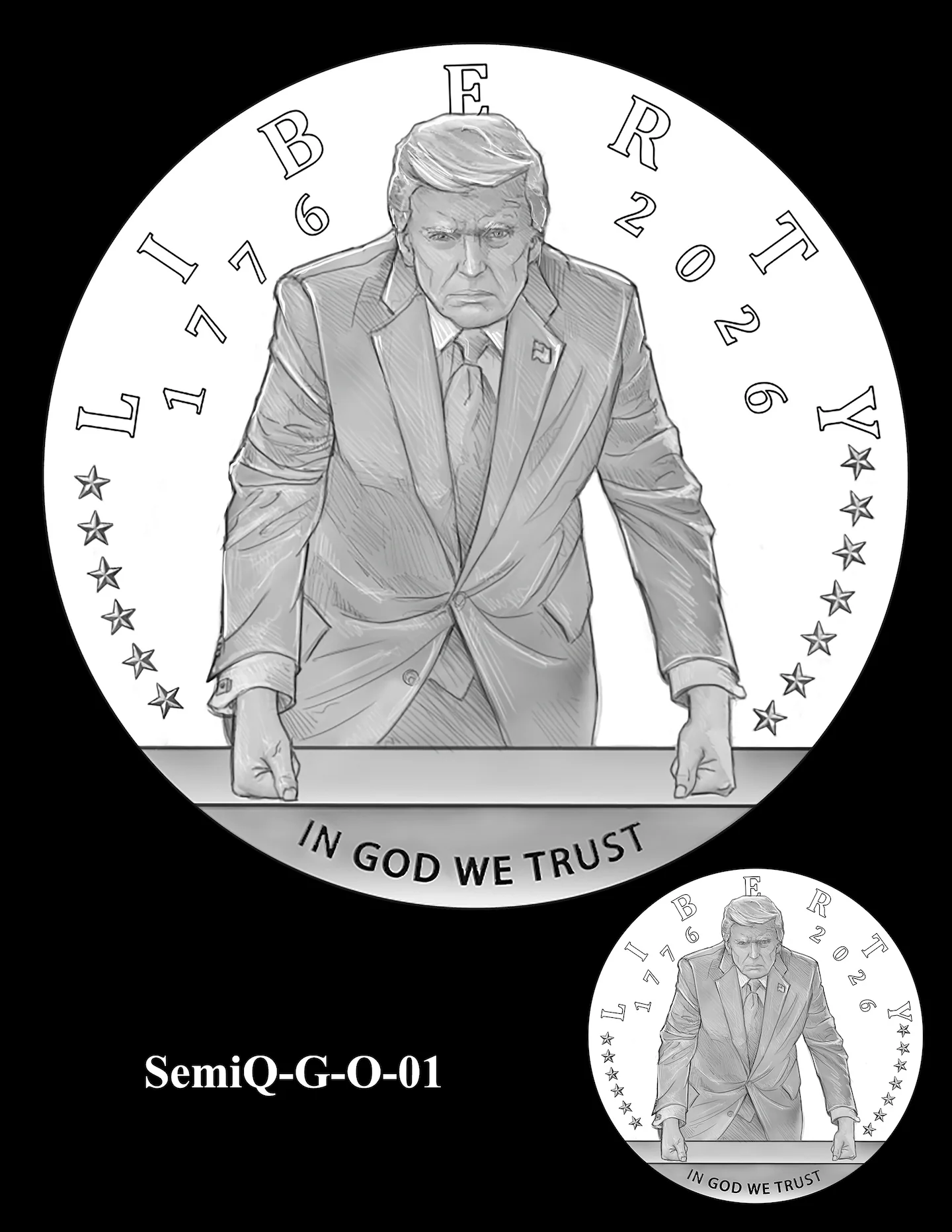
Although final designs have not been publicly confirmed, the development of a commemorative coin typically involves extensive exploration of visual language. Portraiture, inscriptions, and symbolic elements must work together within the constraints of a small surface area.
For a figure like Donald Trump, design considerations are particularly complex. The portrait must balance recognizability with artistic interpretation. The reverse side—often used to convey broader themes—may incorporate national symbols such as eagles, stars, or references to the anniversary itself.
Typography, edge inscriptions, and finish (proof vs. uncirculated) further contribute to the coin’s identity. Every detail is scrutinized, not only for aesthetic quality but for its ability to communicate meaning.
In this sense, the coin functions as a miniature monument. It compresses narrative, symbolism, and material value into a single object.
compare
Any effort to commemorate a recent political figure is likely to generate debate, and this proposal is no exception. Supporters may view the coin as a recognition of a presidency that conjured a defining role in early 21st-century American politics. Critics may question the timing, arguing that historical perspective requires distance.
This tension is not unique to this case. Throughout history, commemorative programs have reflected the dynamics of their time—sometimes celebrating figures who later become more contested, or overlooking individuals who gain recognition only in retrospect.
What distinguishes the current moment is the immediacy of the conversation. In an era of real-time media and polarized discourse, the symbolic weight of such decisions is amplified.
limit
Beyond symbolism, commemorative coins operate within a defined economic ecosystem. Produced in limited runs, they are marketed to collectors, investors, and institutions. Pricing typically reflects both the intrinsic value of the metal and the perceived significance of the subject.
Gold coins, in particular, often function as dual-purpose assets: collectible objects and stores of value. Their appeal extends beyond numismatic circles into broader markets concerned with precious metals.
A Trump commemorative gold coin would likely attract attention from multiple segments:
- traditional coin collectors
- political memorabilia enthusiasts
- investors seeking gold exposure
- cultural observers interested in the intersection of politics and design
This multi-layered demand underscores the unique position of commemorative coins at the intersection of culture and commerce.
pass
The approval by a federal panel represents a critical milestone, but it is not the final step. Additional approvals, legislative authorization, and design finalization are typically required before production can begin.
The United States Mint, in coordination with advisory bodies and government stakeholders, will continue to refine the proposal. Public feedback, market considerations, and alignment with broader Semiquincentennial programming may all influence the outcome.
If ultimately authorized, the coin would join a broader suite of commemorative initiatives tied to the 250th anniversary—each contributing to a multifaceted narrative of American history.
broad
The United States Semiquincentennial is not a single event but a constellation of projects, exhibitions, and commemorations spanning multiple years. It invites reflection on the nation’s founding ideals, its evolution, and its future trajectory.
Within this framework, the inclusion of contemporary figures raises important questions:
- how should recent history be represented?
- what criteria determine commemoration?
- how do institutions balance inclusivity, accuracy, and public sentiment?
These questions extend beyond any single coin. They speak to the broader challenge of narrating a complex, ongoing history.
fin
Coins occupy a unique position within material culture. They are both ubiquitous and enduring—handled daily, yet capable of lasting centuries. Unlike large monuments, they circulate. They move through hands, across regions, and through time.
A commemorative coin, however, shifts this dynamic. It is preserved rather than spent, collected rather than circulated. It becomes an object of intention, a piece of history held rather than used.
In this context, a Trump commemorative gold coin would function as a marker of its moment—a reflection of how the United States chose to represent itself at the threshold of its 250th year.