UCLA Wins With Clarity: Cori Close, Struct, And The End Of Waiting

April 6, 2026
32 minutes ago
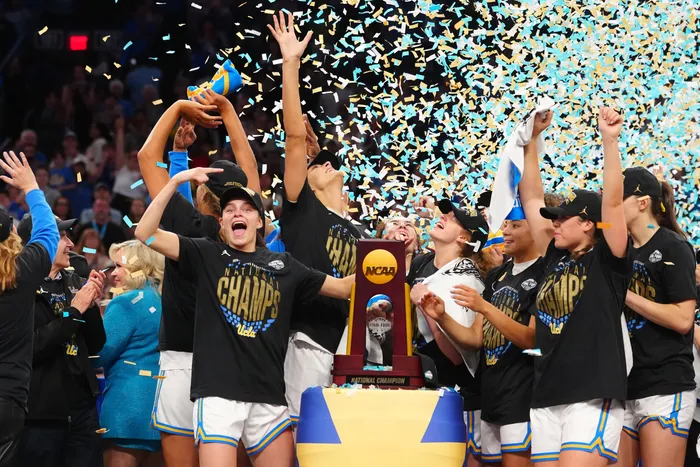
There was no ambiguity in the outcome, and more importantly, no ambiguity in what it meant. The UCLA Bruins women’s basketball did not simply defeat the South Carolina Gamecocks women’s basketball 79–51—they established control early, sustained it without disruption, and finished without concession. The margin reads decisive; the performance felt structured from the opening sequence.
This was UCLA’s first national title since 1978, when the program won under the Association for Intercollegiate Athletics for Women. It is also its first in the era governed by the NCAA, which formalized the women’s tournament in 1982. The gap between those two championships is not simply a span of years—it marks a transition between two entirely different systems of visibility, competition, and institutional investment.
This victory resolves that gap. It does not rely on nostalgia or symbolic continuity. It stands on execution.
FIRST. EVER. NCAA NATIONAL CHAMPIONS. UCLA. 🏆
UCLA defeats South Carolina to win the National Championship.#WFinalFour pic.twitter.com/8iDpp5OlFb
— NCAA March Madness (@MarchMadnessWBB) April 5, 2026
stir
Championship games often unfold in stages—adjustments, momentum swings, recalibrations. This one did not require them. UCLA established its defensive presence immediately, setting the tone through disciplined rotations and controlled physicality. South Carolina, a program built on strength and structure, was forced into inefficient possessions early and rarely recovered.
The difference was not speed or shot-making alone. It was control of space.
UCLA dictated where actions began and where they ended. Entry passes were delayed. Driving lanes closed before they fully formed. Help defense arrived before breakdowns occurred. The result was not a sequence of highlights but a steady limitation of options.
On offense, UCLA avoided stagnation. The ball moved with purpose—not excessive, not decorative. Each pass shifted defensive alignment, creating incremental advantages rather than relying on isolated plays. The lead expanded through consistency, not bursts.
By halftime, the trajectory was established. By the fourth quarter, it was confirmed.
her
At the center of the performance is Cori Close, whose first national championship arrives after more than a decade of program building. Her postgame statement—“All year we’ve been saying the talent is our floor, but our character will determine our ceiling”—is not a motivational abstraction. It reflects how this team operates.
UCLA’s roster is constructed through multiple channels. High school recruits form the developmental core, while transfers provide experience and positional reinforcement. In many programs, this combination creates imbalance—different timelines, different expectations. UCLA avoided that outcome by maintaining system integrity.
Roles were defined early and maintained. Rotations were consistent. Players understood not only their responsibilities, but how those responsibilities connected to others on the floor.
Character, in this context, is not rhetorical. It is functional. It allows players to accept reduced roles when necessary, expand them when required, and maintain consistency regardless of circumstance.
Close’s approach does not eliminate individuality. It organizes it.
influ
Cori Close spent 17 years under the mentorship of John Wooden. That influence is evident, but not in direct replication.
Wooden’s philosophy emphasized preparation, discipline, and internal standards over external outcomes. His teams were known for precision and consistency—qualities that depended on stability within the roster and system.
Close operates in a different environment. The modern college game is defined by movement—transfers, early departures, shifting rosters. Stability is no longer guaranteed.
What Close retains from Wooden is not the structure itself, but the priority of structure. Practices emphasize repetition and clarity. Decision-making is simplified through defined principles. Accountability is internal, not performative.
The result is a team that appears composed regardless of situation. That composure was visible throughout the championship game. There were no extended lapses, no visible frustration, no reliance on improvisation under pressure.
The influence is present, but adapted.
frame
UCLA’s previous national title in 1978 occurred under a different governing body and a different cultural context. The Association for Intercollegiate Athletics for Women operated with limited resources but played a foundational role in establishing women’s collegiate sports.
When the NCAA assumed control in 1982, the structure changed significantly. Increased funding, broader exposure, and expanded competition reshaped the landscape. Programs that adapted quickly established long-term dominance.
UCLA, despite its institutional reputation, did not convert early success into sustained national prominence. The program remained competitive but did not consistently contend for championships.
This victory represents alignment with the current structure. It is not a continuation of the past—it is a re-entry into relevance under present conditions.
redistribution
The transfer portal has introduced a new layer of complexity to roster building. Programs can accelerate development by adding experienced players, but risk disrupting internal cohesion.
UCLA’s approach avoided that disruption. Transfers were integrated into existing systems rather than redefining them. Their roles complemented established players rather than competing with them.
This required clarity from the coaching staff and adaptability from the players. Expectations were communicated early. Playing time was earned through adherence to system principles rather than individual output alone.
The result was continuity across lineups. Substitutions did not alter identity. Bench units maintained the same defensive intensity and offensive structure as starters.
This consistency is what allowed UCLA to sustain control throughout the championship game. There was no drop-off in execution, regardless of personnel on the floor.
team
The South Carolina Gamecocks women’s basketball entered the game as a benchmark program. Known for physical defense, rebounding dominance, and structured offense, South Carolina represents one of the most consistent systems in the sport.
UCLA did not attempt to match that identity directly. Instead, it applied pressure in different areas.
Defensively, UCLA limited interior access, forcing South Carolina into perimeter decision-making. Offensively, it spaced the floor effectively, reducing the impact of South Carolina’s interior defense.
The difference was not effort or preparation. It was alignment of strengths.
UCLA executed its system without deviation. South Carolina was required to adjust, and those adjustments did not produce consistent results.
idea
There is a tendency to frame championship performances around individual moments—key shots, defining plays, visible emotion. This game does not conform to that pattern.
UCLA’s performance was defined by execution across all phases:
- Defensive positioning limited high-percentage opportunities
- Rebounding secured possession and prevented second chances
- Ball movement created efficient scoring opportunities
- Turnover control minimized transition exposure
None of these elements were isolated. They operated simultaneously.
The absence of visible struggle is what made the performance notable. Control was maintained without escalation.
stance
For Cori Close, this championship confirms the effectiveness of her approach. It does not require reinterpretation or justification.
Her tenure at UCLA has been marked by incremental improvement. Recruiting classes improved in quality. Player development became more consistent. System identity became clearer.
This title is the result of those accumulated steps.
It also establishes a reference point for future seasons. Expectations will increase. Opponents will adjust. The challenge will shift from construction to maintenance.
Close has demonstrated the ability to build. Sustaining success will require the same level of clarity and discipline.
flow
UCLA’s championship alters its position within women’s college basketball. It is no longer a program defined by potential or history. It is a current title holder with a functioning system.
This changes recruiting dynamics. It increases national visibility. It places UCLA within the group of programs expected to compete consistently at the highest level.
Maintaining that position will depend on several factors:
- Continued integration of incoming players
- Effective use of the transfer portal without disrupting cohesion
- Retention of system principles under increased scrutiny
The foundation is established. The next phase will test its durability.
role
Close’s statement regarding talent and character reflects a prioritization that is visible in the team’s performance.
Talent enables execution. Character ensures consistency.
In high-pressure situations, talent can fluctuate. Shots may not fall. Matchups may shift. Character determines whether execution continues regardless of those variables.
UCLA’s championship game performance demonstrated this consistency. There were no extended scoring droughts, no defensive lapses that altered momentum, no visible loss of focus.
This is not incidental. It is a result of preparation and expectation.
fin
The 79–51 result is definitive. The context surrounding it adds dimension, but does not complicate it.
UCLA won because it maintained control of the game from start to finish.
It won because its roster functioned as a unit without fragmentation.
It won because its coaching staff established and preserved system clarity.
For the UCLA Bruins women’s basketball, the outcome closes a historical gap and establishes a present standard.
For Cori Close, it confirms a method built over time and applied without deviation.
And for the broader structure of women’s college basketball, it introduces a program operating with precision rather than reliance on singular identity.