Vans OTW Half Cab 33 “Steve Caballero” × Bedwin & The Heartbreakers

April 6, 2026
2 hours ago
The Half Cab has always existed in a state of quiet defiance. It was never designed as a finished object. It was cut into existence—literally—by Steve Caballero, who took scissors to his own high-top Vans to create something more responsive, more grounded, more his. That act of modification still defines the silhouette decades later. Every reinterpretation of the Half Cab is, in some way, an echo of that original gesture: alteration as identity.
The VANS OTW Half Cab 33 “Steve Caballero” × BEDWIN & THE HEARTBREAKERS doesn’t disrupt that lineage. It doesn’t attempt spectacle. Instead, it moves in a more precise direction—one that feels almost editorial in its restraint. This is a shoe that reconstructs rather than reinvents, filtering skate heritage through Tokyo streetwear and Vans’ own evolving design language.
what
A subdivision that reframes Vans classics through material upgrades and subtle architectural shifts. OTW is less about nostalgia and more about recalibration.
On the Half Cab 33, that recalibration appears in:
- premium suede and leather paneling
- refined stitching, including moc-style detailing
- upgraded cushioning and internal structure
- in some versions, hybrid or Vibram-assisted outsoles
These changes don’t alter the silhouette’s identity. They sharpen it. The proportions remain intact—mid-cut, padded collar, compact stance—but the tactile experience shifts. It becomes less disposable, more considered. Less skatepark-only, more cross-context.
The “33” designation itself references Vans’ internal code for the Half Cab (Style 33), anchoring the shoe in its technical lineage even as the materials evolve.
flow
The intervention from BEDWIN & THE HEARTBREAKERS is where the narrative deepens. Founded by Masafumi Watanabe, BEDWIN has always operated in a space between American cultural archetypes and Japanese reinterpretation. Their work rarely feels loud. It feels lived-in—like garments and objects that have already passed through time.
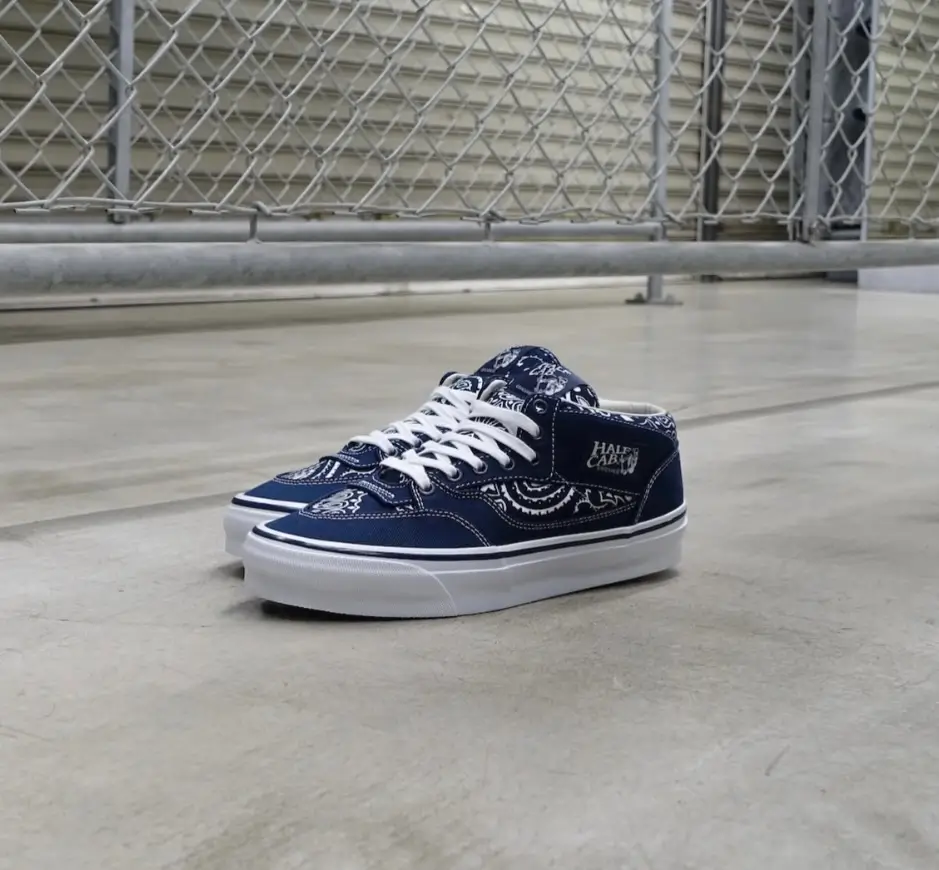
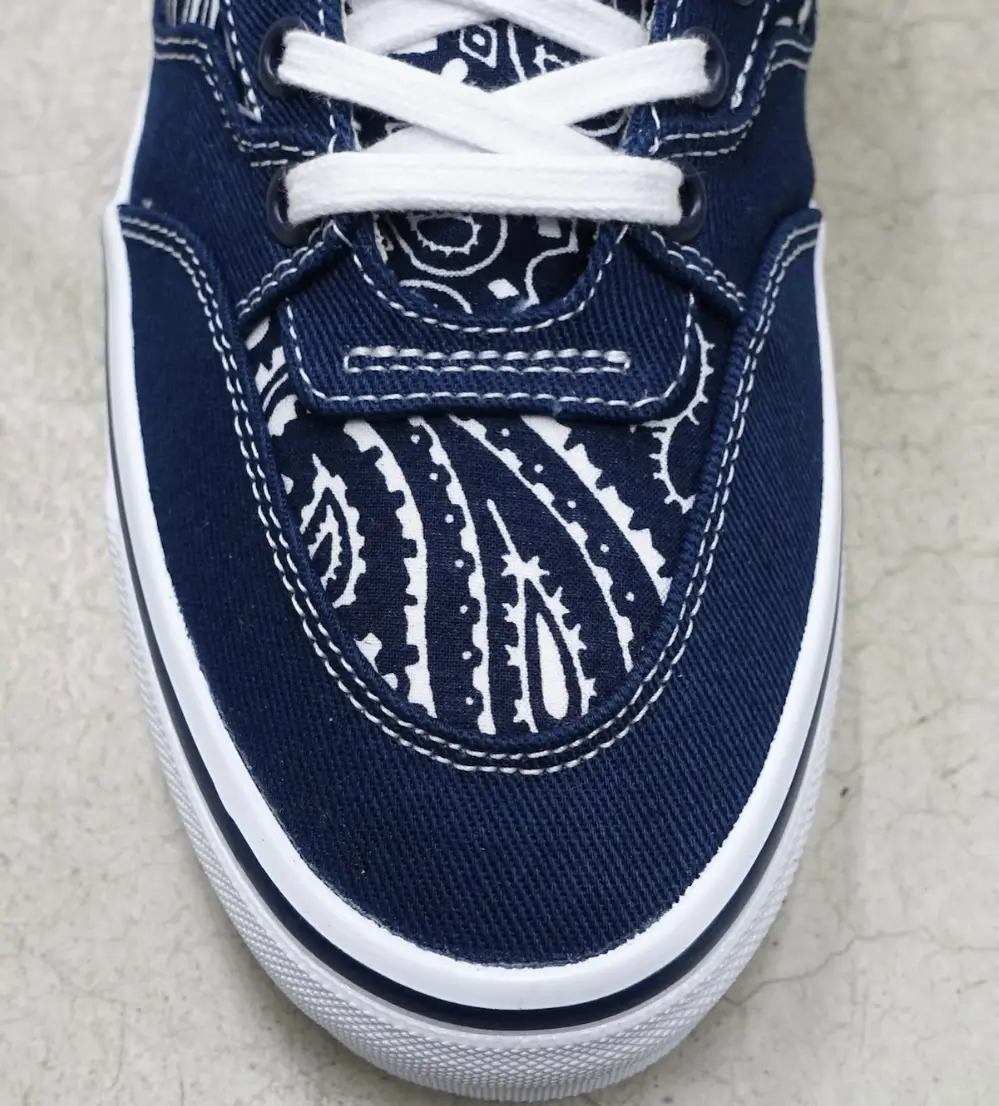
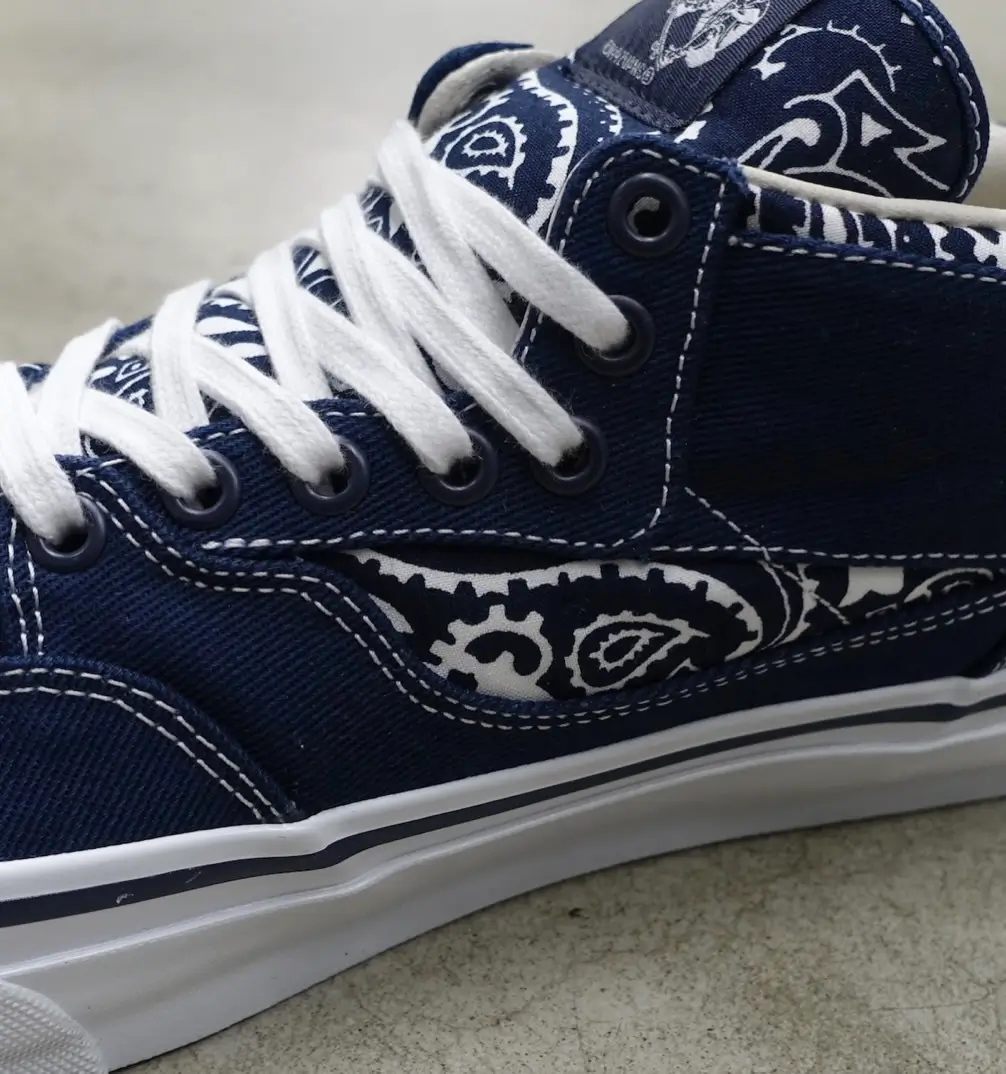
For this collaboration, BEDWIN draws from bandana culture, but not in the obvious sense. There’s no aggressive contrast, no high-saturation paisley explosion. Instead, the reference is subdued, almost absorbed into the shoe:
- tonal navy palettes that flatten contrast
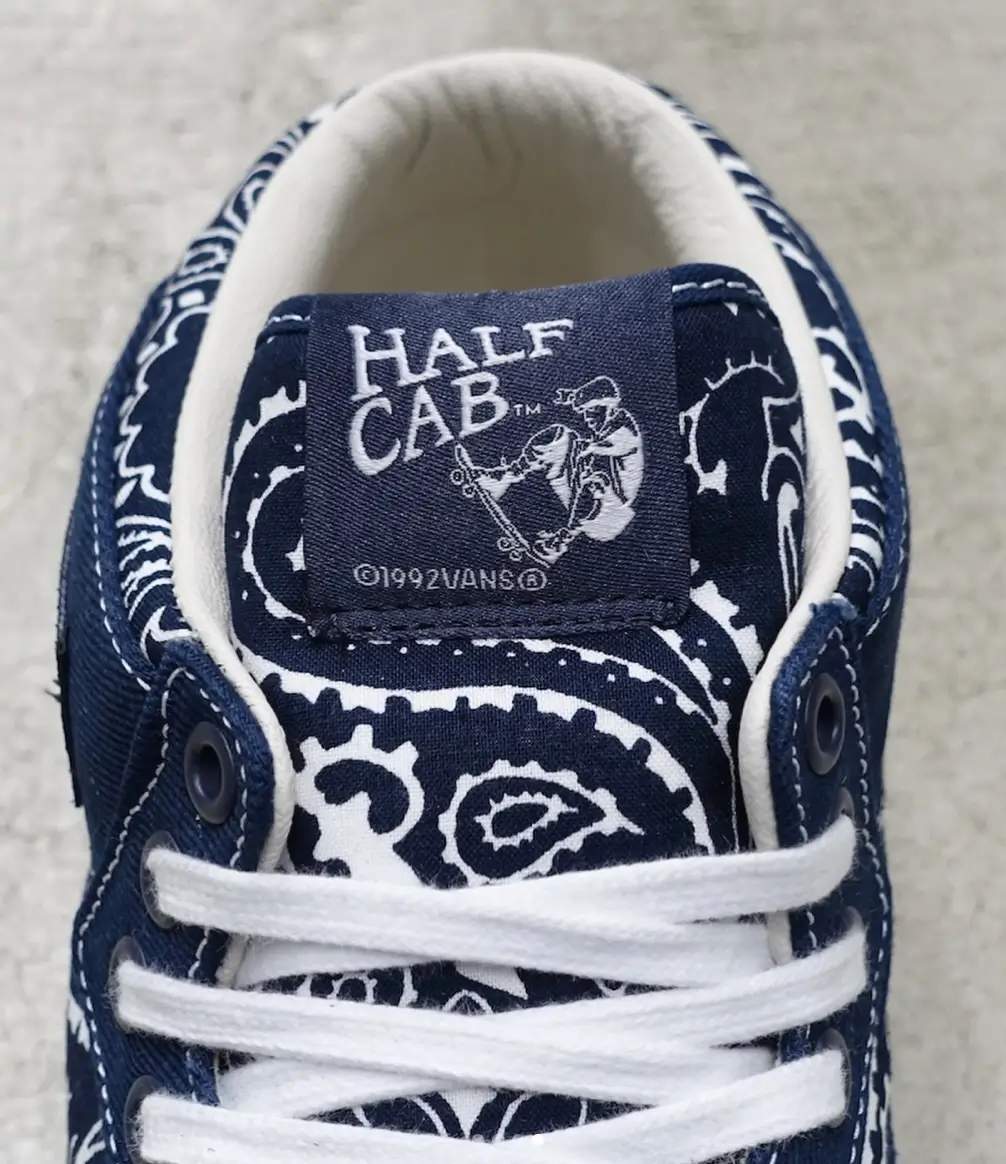
- faint paisley patterning that emerges only up close
- paneling that suggests patchwork without fully declaring it
This is important. The bandana here isn’t treated as a graphic—it’s treated as texture memory. Something embedded, not applied.
Watanabe has spoken in the past about customizing items in his youth—adding bandana elements to garments as a personal signature. That gesture carries through here, but matured. Less DIY chaos, more controlled nostalgia.
imply
Even within this layered reinterpretation, the presence of Steve Caballero remains foundational. His influence isn’t aesthetic—it’s structural. The Half Cab’s defining characteristics are all still here:
- the shortened collar that allows ankle freedom
- the padded tongue and upper for impact protection
- the low center of gravity that enhances board feel
What’s interesting is how this collaboration treats that legacy. It doesn’t mythologize Caballero in an overt way. There are no oversized logos or commemorative flourishes. Instead, his influence is treated as infrastructure—something embedded so deeply it no longer needs to be announced.
That restraint feels intentional. It aligns with the overall tone of the shoe: quiet, deliberate, resistant to excess.
story
Where most collaborations rely on contrast—different colors, bold branding, visual tension—this one relies on material coherence.
The upper works within a tight palette:
- deep navy
- muted indigo
- washed tonal variations
Within that, the bandana motif dissolves into the surface. You don’t read it immediately. You discover it. That shift—from instant recognition to gradual perception—changes how the shoe functions in space. It doesn’t demand attention. It rewards attention.
The stitching plays a role here as well. Moc-style seams and panel edges introduce a sense of craft, almost bordering on footwear traditionally associated with hand construction. It softens the skate identity without erasing it.
position
This collab exists in a very specific tier within the Vans ecosystem.
At one end, you have core skate releases: functional, accessible, designed for heavy use. At the other, you have more overt fashion collaborations—projects that push Vans silhouettes into luxury-adjacent territory.
The BEDWIN × OTW Half Cab 33 sits in between:
- too refined to be purely utilitarian
- too restrained to be overtly fashion
That middle space is where Vans has been increasingly effective. It allows the brand to maintain credibility within skate culture while expanding into broader design conversations.
theme
What makes this shoe compelling isn’t innovation in the traditional sense. There’s no new cushioning system, no radical outsole geometry, no disruptive design language. Instead, the innovation is editorial.
It’s about selection:
- selecting which elements of the archive to preserve
- selecting which cultural references to introduce
- selecting how visible those references should be
In that sense, the shoe behaves more like a curated exhibition than a product drop. Each detail feels placed, not added.
wear
On foot, the effect is immediate but not overwhelming. The tonal palette makes the shoe easy to integrate into almost any wardrobe, while the underlying detail provides depth.
It pairs naturally with:
- washed denim
- fatigues or workwear trousers
- minimal tailoring with a street edge
What it avoids is the need for coordination. It doesn’t ask the rest of the outfit to respond. It exists independently, adding texture rather than dictating direction.
sum
The VANS OTW Half Cab 33 “Steve Caballero” × BEDWIN & THE HEARTBREAKERS doesn’t try to redefine the Half Cab. It doesn’t need to. The silhouette already carries its own mythology.
What this collaboration does instead is reframe that mythology through material and memory. It takes a shoe born from modification and applies a different kind of modification—one rooted in culture, craft, and restraint.
It’s not a loud release.
It’s a precise one.
And in that precision, it feels enduring.