Willy Spiller’s Schoolgirls on the A-Train (1978) Captures New York in Motion

April 2, 2026
2 hours ago
unscripted
In 1977, a young Swiss photographer named Willy Spiller entered New York City not through its avenues of spectacle, but through its arteries of necessity. The subway—humid, volatile, and rhythmically relentless—became his first true encounter with the city’s interior life. What he found below ground was not merely transit, but compression: of class, of language, of tension, of fleeting intimacy.
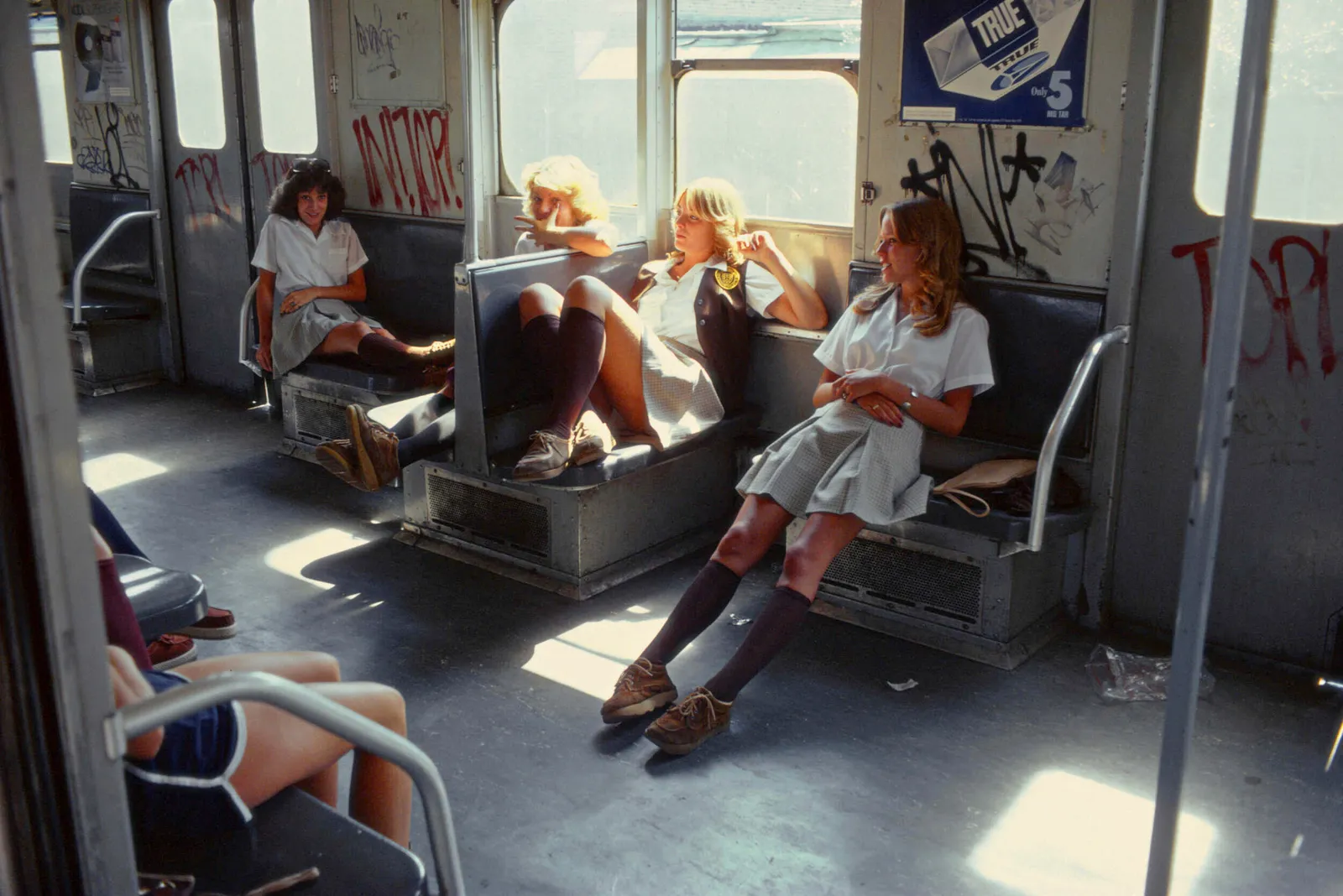
Schoolgirls on the A-Train to Far Rockaway, New York, 1978 emerges from this discovery not as a singular image, but as a distilled philosophy. Spiller’s practice, shaped by the limitations of film and the discipline of observation, resists excess. He does not chase the spectacular. Instead, he waits for the moment when the ordinary folds into something quietly cinematic.
As Bill Shapiro recalls, Spiller was both overwhelmed and seduced by the subway’s raw immediacy. That paradox—fear and fascination—lingers in the photograph. The image is not loud, but it hums. It carries the vibration of steel on rail, of conversations half-heard, of glances exchanged and withdrawn before they can settle into meaning.
idea
The A train, perhaps more than any other line, embodies distance. It stretches from Manhattan’s density outward to the edges of Queens, terminating in Far Rockaway—a place defined as much by its remove as by its connection. Within this context, the schoolgirls are suspended between worlds.
They are not yet fixed. Their identities are still assembling, still responsive to environment, to peer, to the subtle negotiations of adolescence. The train becomes a threshold space—neither origin nor destination, but something in between.
Spiller recognizes this and composes accordingly. The frame does not privilege a single subject; instead, it elicits multiplicity to breathe. Each girl exists within her own narrative, yet the photograph insists on their collective presence. They are together, but not unified. Connected, but not synchronized.
This is the condition of the city itself.
lang
Clothing, in Spiller’s photograph, is not ornamental. It is communicative. The late 1970s in New York were marked by improvisation—a style language assembled from scarcity, from thrift, from the collision of subcultures.
The schoolgirls’ attire reflects this ecology. Textures, silhouettes, and combinations suggest both conformity and divergence. There is an awareness of self-presentation, but it is not yet fully codified. Fashion here is less about declaration and more about experimentation.
Gesture, too, becomes a form of speech. A tilt of the head, a folded arm, a glance directed inward or outward—these micro-movements carry weight. Spiller captures them without interruption. His camera does not demand performance; it registers presence.
In this way, the photograph operates as a lexicon of youth. Not a definitive translation, but a series of fragments that invite interpretation.
resistance
The subway enforces closeness. Bodies are compressed into shared air, shared motion, shared discomfort. And yet, intimacy remains elusive.
In Schoolgirls on the A-Train, this paradox is palpable. The subjects occupy the same physical space, but their emotional distances vary. Some lean into conversation; others retreat into themselves. Eye contact is selective, provisional.
Spiller’s framing respects this dynamic. He does not collapse the distances between his subjects. Instead, he preserves the subtle boundaries that define urban coexistence. The result is a composition that feels both crowded and spacious—a visual articulation of how people can be together without truly knowing one another.
This tension is central to the photograph’s enduring resonance. It reflects not just a moment in 1978, but a persistent condition of city life.
discip
Film, in Spiller’s era, imposed a form of restraint that is largely absent today. Each frame carried cost—financial, material, temporal. To shoot was to decide. To decide was to exclude.
Spiller’s archive of approximately 2,000 images, accumulated over eight years, speaks to this discipline. Schoolgirls on the A-Train is not accidental; it is chosen. It represents a convergence of timing, intuition, and patience.
There is no excess in the image. No redundancy. Every element feels necessary, even if its significance is not immediately legible.
This economy of attention is what gives the photograph its density. It invites prolonged looking. It resists quick consumption. In an era saturated with images, this quality feels increasingly rare.
aware
To be young in a city like New York is to be visible. Not necessarily recognized, but seen. The subway amplifies this visibility, placing individuals into a shared field of observation.
For the schoolgirls, this visibility is both ordinary and formative. They are aware of one another, of the adults around them, of the implicit codes governing behavior in public space.
Spiller captures this awareness without dramatizing it. There is no overt tension, no staged confrontation. Instead, there is a quiet negotiation—a calibration of self in relation to others.
This is adolescence not as private introspection, but as a public condition. A process of becoming that unfolds in real time, in shared environments, under the gaze of strangers.
stir
One of the most compelling aspects of Spiller’s work is its refusal to resolve. The photograph offers no conclusion, no narrative arc. It is a beginning without an end.
Who are these girls? Where are they coming from? What awaits them at Far Rockaway?
The image does not answer. It does not attempt to. Instead, it positions the viewer within the uncertainty.
This openness is not a lack, but a strategy. It acknowledges the limits of representation. It recognizes that every photograph is partial, that every moment contains more than can be captured.
In this sense, Schoolgirls on the A-Train aligns with a broader tradition of documentary photography that values ambiguity over explanation. It trusts the viewer to engage, to imagine, to project.
fracture
The late 1970s in New York were marked by instability—economic decline, infrastructural decay, rising crime. The subway, in particular, became a symbol of the city’s challenges.
And yet, Spiller’s photograph resists the dominant narrative of dysfunction. It does not deny the context, but it reframes it.
Within the same space often described as chaotic, he finds moments of composure, of style, of quiet interaction. The schoolgirls are not defined by the city’s crises; they exist alongside them, within them, but not reduced to them.
This complexity is crucial. It prevents the photograph from becoming illustrative in a reductive sense. It does not serve as evidence of a condition; it serves as an exploration of lived experience.
morale
Photography, particularly in public space, carries ethical implications. To photograph strangers is to engage in an act of appropriation—to take a moment that does not belong to you and render it visible to others.
Spiller navigates this terrain with a degree of sensitivity that is evident in his work. There is no sense of intrusion, no exploitation of vulnerability. The subjects are not diminished by the act of being photographed.
Instead, there is a kind of mutual anonymity. The photographer remains unseen; the subjects remain unnamed. The image exists in a space between recognition and obscurity.
This balance is delicate, and it is part of what allows the photograph to endure without feeling extractive.
show
Looking at Schoolgirls on the A-Train today is an encounter with layered time. The photograph is anchored in 1978, but it is experienced in the present.
For some viewers, it may evoke personal memory—a recollection of youth, of commuting, of navigating the city’s interior spaces. For others, it may function as a historical artifact, a glimpse into a world that no longer exists in the same form.
Spiller’s image accommodates both readings. It is specific enough to be situated, yet open enough to be reinterpreted.
This temporal elasticity is one of photography’s defining qualities. It allows images to persist, to accumulate meaning as contexts shift.
still
In a culture increasingly defined by speed, by immediacy, by the constant production and consumption of images, Spiller’s work offers an alternative model.
It suggests that attention—sustained, deliberate, patient attention—is itself a form of resistance. To look carefully is to slow down. To slow down is to create space for nuance, for complexity, for ambiguity.
Schoolgirls on the A-Train embodies this ethos. It does not demand attention through spectacle. It earns it through subtlety.
The photograph asks the viewer to remain with it, to notice the details that might otherwise be overlooked: the interplay of gazes, the distribution of bodies, the textures of fabric, the ambient tension of a shared space in motion.
fwd
Ultimately, the photograph exists in a state of suspension. The train is moving, but the image is still. The subjects are in transit, but the moment is fixed.
This tension—between movement and stillness, between departure and arrival—is what gives the image its enduring charge.
The schoolgirls are not yet where they are going. They are not who they will become. They are, in this moment, in between.
And it is precisely this in-betweenness that Spiller captures with such precision and care. Not as a void, but as a space of possibility.
A space where identities are still forming, where narratives are still unfolding, where the city reveals itself not through grand gestures, but through the quiet accumulation of moments like this one.
fin
Spiller’s New York is not a city he owns or defines. It is a city he witnesses. His photographs do not attempt to summarize or explain. They observe, they suggest, they leave room.
Schoolgirls on the A-Train to Far Rockaway, New York, 1978 stands as a testament to that approach. It is a fragment, but a complete one. A moment that does not resolve, but continues to resonate.
In the end, the photograph offers no grand thesis. It offers something more subtle, and perhaps more enduring: a way of seeing.