YUJI Zip-Up Cardigan: The Architecture of Knit, Rewritten in Volume

April 4, 2026
2 hours ago
stir
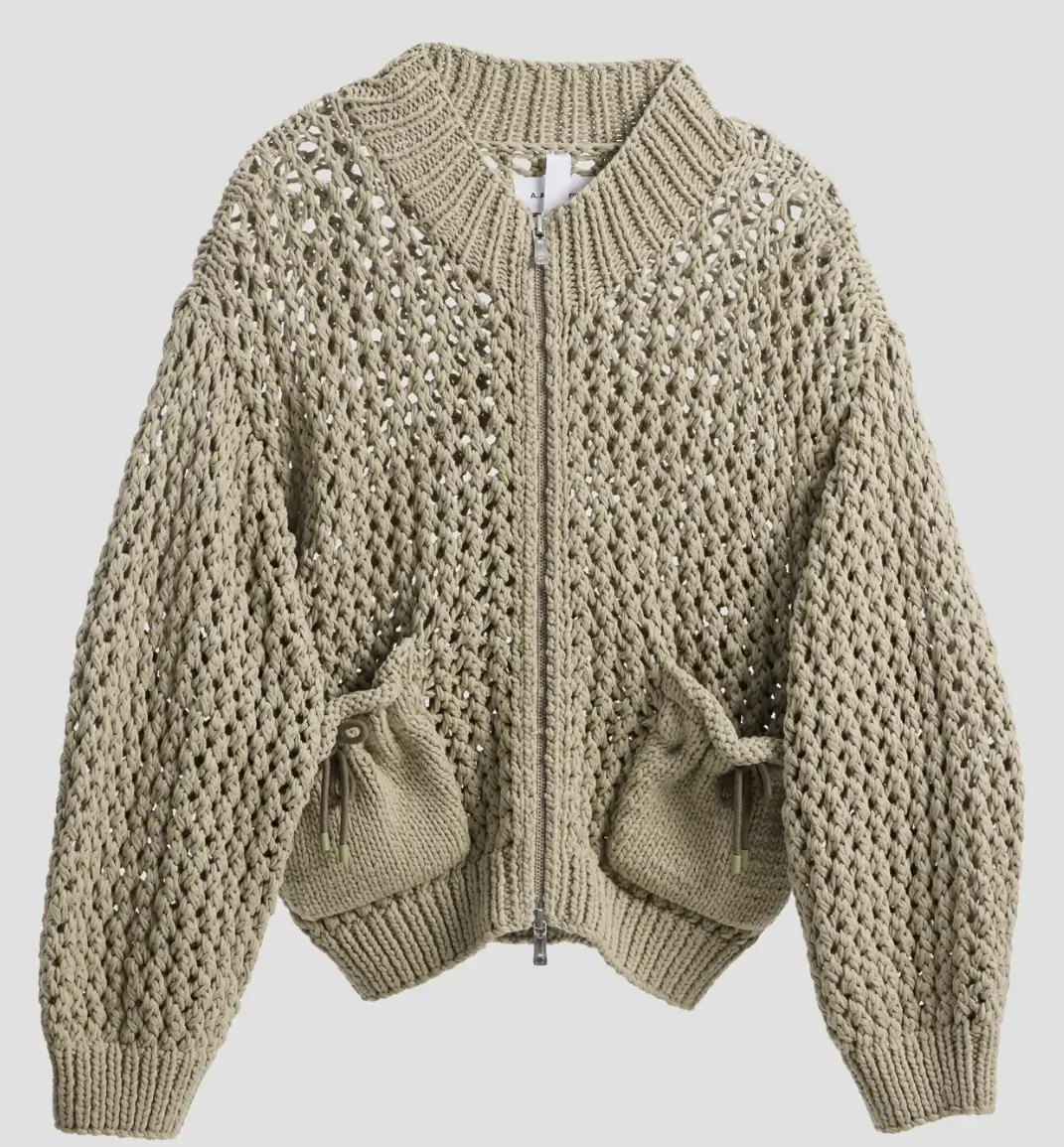
There are garments that follow the body, and there are garments that reorganize it. The YUJI ZIP-UP CARDIGAN belongs firmly to the latter. At first glance, it reads as a cardigan—familiar, utilitarian, anchored in the long lineage of knitwear as comfort. But that recognition is quickly unsettled. The surface does not lie flat. The structure does not conform. What appears traditional is, in fact, re-engineered.
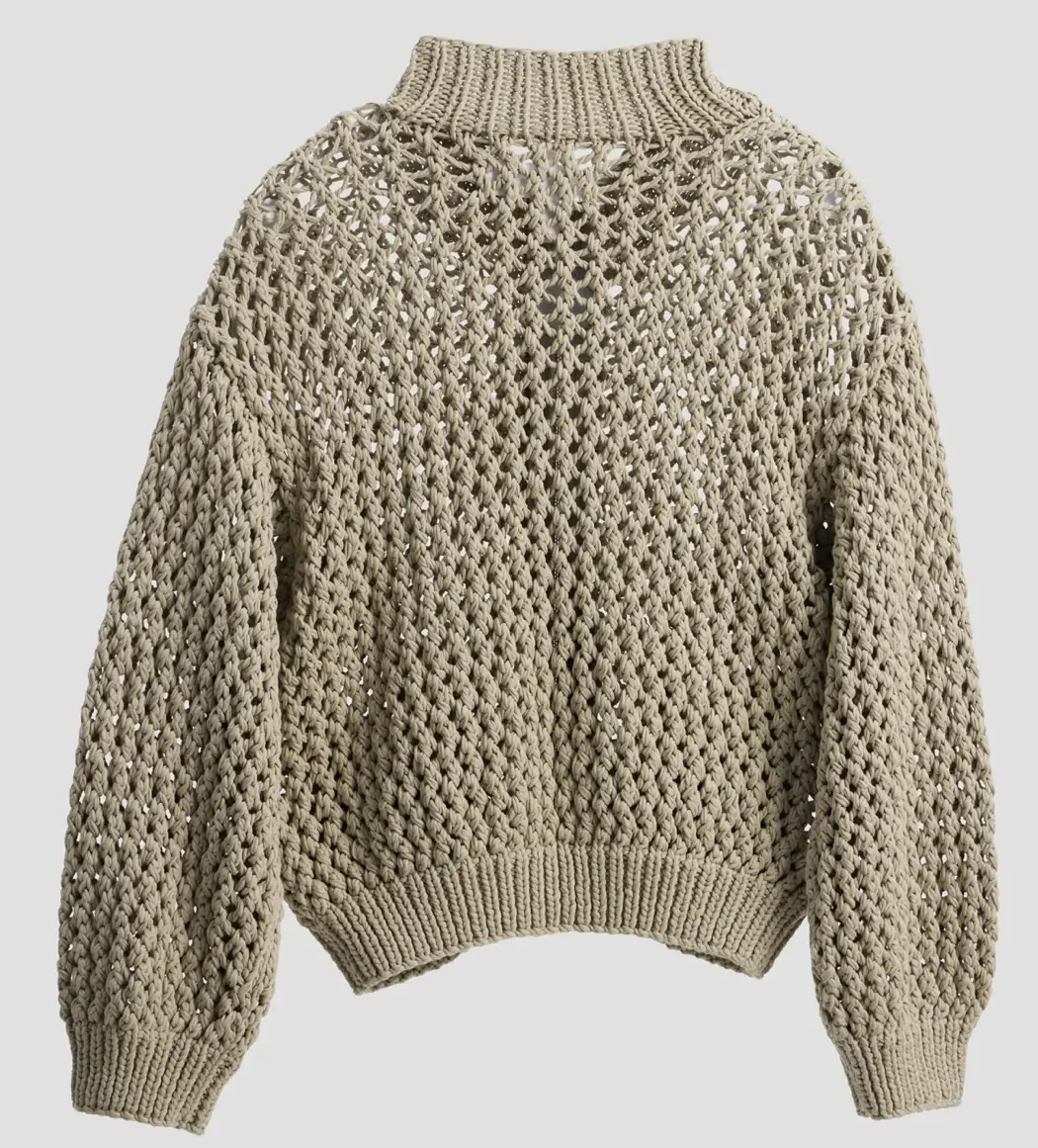
The defining gesture is its Big Gauge Lace development—a phrase that suggests delicacy, but delivers something far more architectural. This is not lace in the ornamental sense. It is lace expanded, scaled beyond its expected intimacy into something structural, almost infrastructural. The knit opens up, breathes outward, becomes spatial.
What emerges is a garment that behaves less like fabric and more like form.
View this post on Instagram
idea
The term “big gauge” is often technical, referring to the spacing of stitches, the thickness of yarn, the scale at which knitting operates. In the YUJI ZIP-UP CARDIGAN, this technicality becomes expressive.
The enlarged gauge transforms the knit into a visible system. Each loop, each opening, each intersection is legible. Nothing is concealed. The construction becomes the aesthetic.
But more than visibility, the scale alters perception. Traditional knitwear sits close to the body, its texture secondary to silhouette. Here, texture becomes the silhouette. The garment projects outward, creating volume through structure rather than padding or layering.
This is where the cardigan begins to shift from clothing to object. It is worn, but it also occupies space.
struct
Lace carries historical weight—associated with fragility, intricacy, ornament. It is often applied, decorative, secondary. The YUJI cardigan reverses this hierarchy.
The lace is not applied; it is the garment.
Its openness is not ornamental but functional. It creates airflow, lightness, and a dynamic interaction between body and environment. The wearer is partially revealed, partially obscured. The garment becomes a mediator, filtering visibility.
This interplay introduces a subtle tension. The cardigan is bold, even assertive in its volume, yet porous. It holds presence without becoming opaque.
surge
What distinguishes this piece most clearly is its 3D knit construction. This is not a flat textile shaped after the fact. The form is embedded in the knitting process itself.
The fabric carries depth. It rises and recedes. It holds structure without stiffness.
This is a crucial distinction in contemporary knitwear. Advances in knitting technology have allowed designers to think beyond surface—to treat yarn as a medium capable of volume, contour, and architecture.
The YUJI ZIP-UP CARDIGAN embraces this fully. Its three-dimensionality is not an effect; it is the foundation.
The result is a garment that does not collapse when unworn. It retains memory. It holds shape.
spread
The silhouette is boxy, but not in the reductive sense often associated with oversized garments. Here, the boxy fit is a deliberate spatial strategy.
It creates distance between garment and body. That distance allows the knit to perform—to be seen, to project, to occupy its own volume.
Comfort is often cited in discussions of boxy silhouettes, but here comfort is secondary to articulation. The looseness is not just about ease; it is about clarity. It ensures that the structure of the garment is not compromised by the contours of the body.
The wearer becomes a support, rather than the focus.
zip
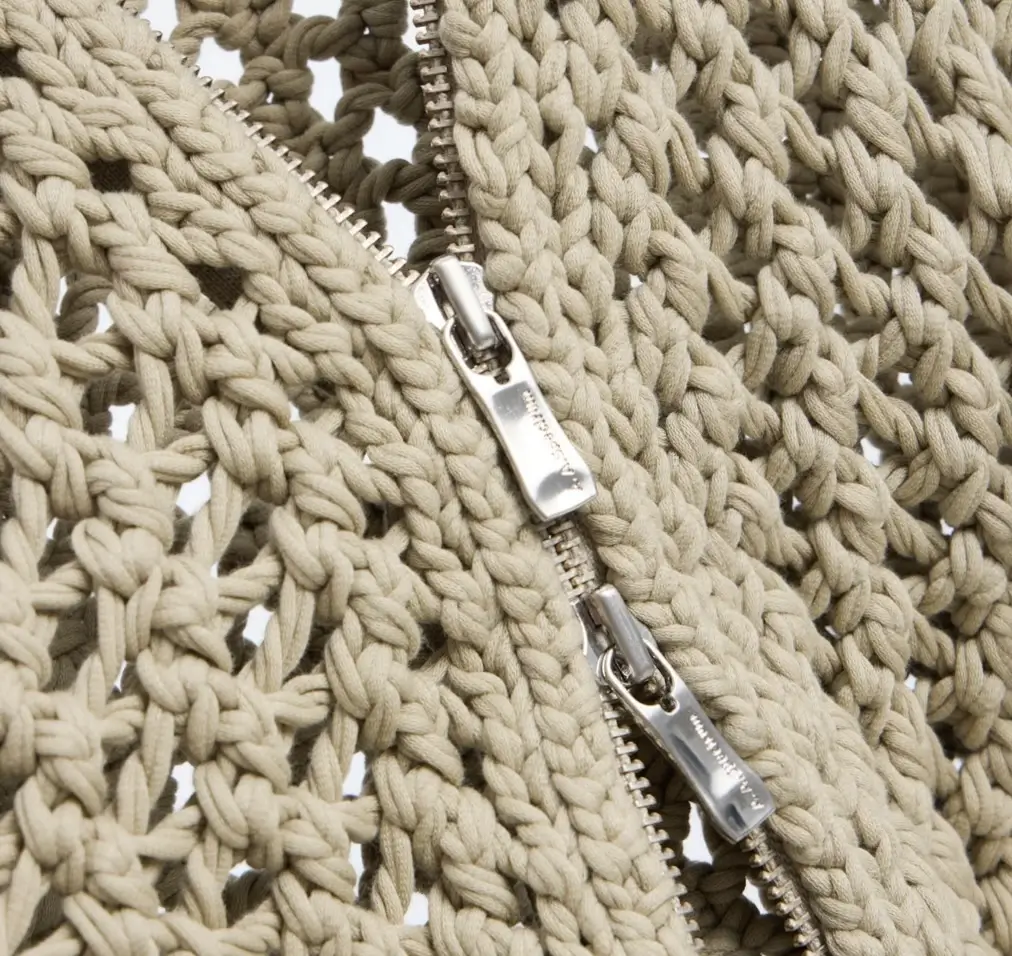
The metallic zipper introduces a different language entirely. Where the knit is soft, organic, and expansive, the zipper is linear, precise, industrial.
This contrast is intentional. It anchors the garment, providing a point of control within the otherwise fluid structure. The zipper defines the front, establishes orientation, and introduces a subtle rigidity.
It also situates the cardigan firmly in the present. Without it, the piece might drift too far into abstraction or craft. The metallic element pulls it back into contemporary design, into the vocabulary of outerwear, of utility.
It is both functional and symbolic—a line that cuts through softness.
disrupt
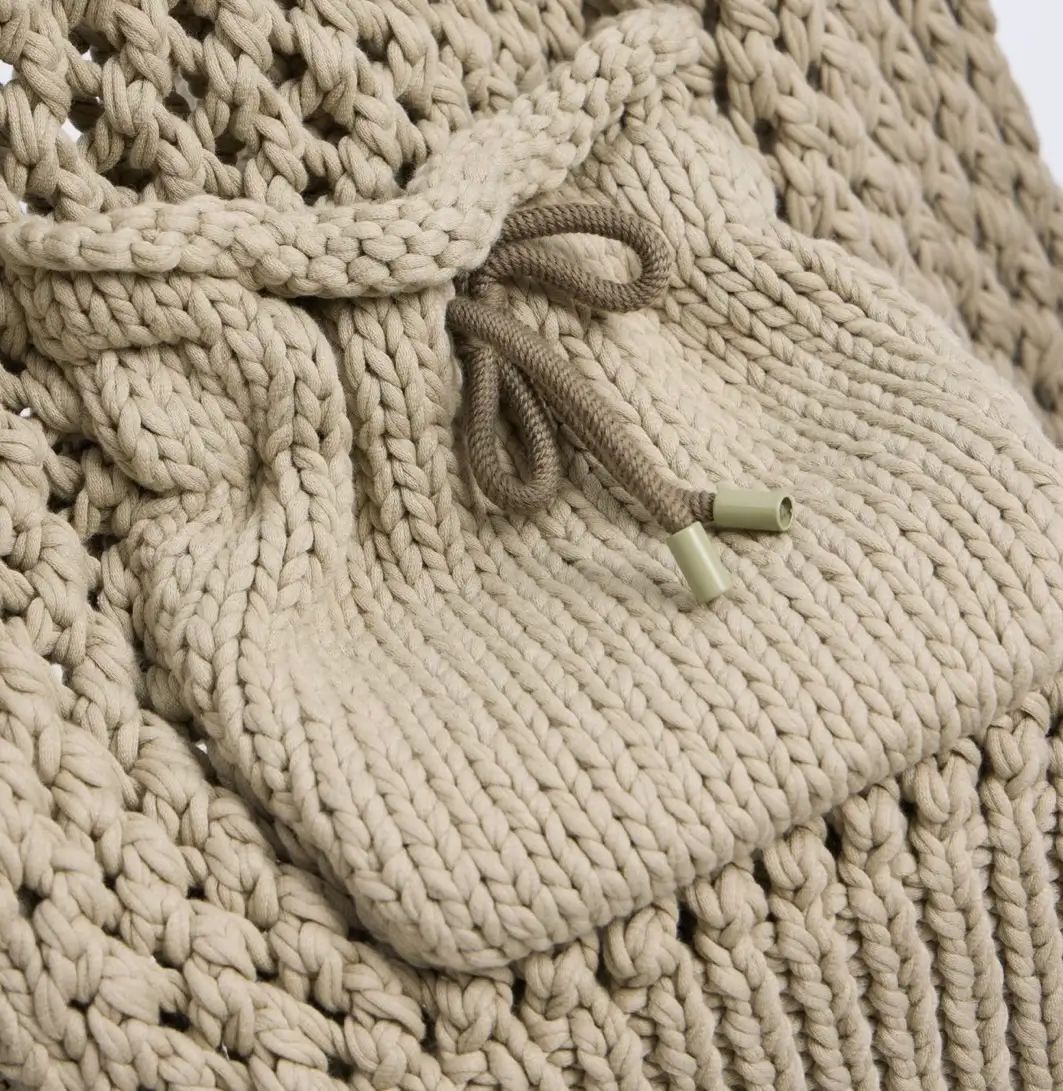
The front pockets are not merely additions; they are interventions. Their placement interrupts the continuity of the knit, creating moments of pause within the system.
They introduce asymmetry, even when aligned. Their presence shifts the visual rhythm, preventing the garment from becoming too uniform.
Functionally, they ground the piece. They remind the wearer that this is still clothing, still usable. But aesthetically, they operate as disruptions—small breaks in the otherwise continuous field of lace.
These interruptions are essential. They keep the garment from becoming overly resolved.
eco
The YUJI ZIP-UP CARDIGAN is constructed from a blend of organic cotton and recycled nylon yarn—a combination that speaks to a growing shift within fashion toward material responsibility.
Organic cotton reduces the environmental impact associated with conventional cotton production—less water, fewer chemicals, more sustainable cultivation practices. Recycled nylon repurposes existing material, diverting waste and reducing reliance on virgin synthetic fibers.
But beyond sustainability as a concept, the material blend also serves the design. Cotton provides softness and breathability, while nylon introduces strength and resilience. Together, they allow the knit to maintain its structure while remaining wearable.
This is where ethics and aesthetics converge. The material is not an afterthought; it is integral to the garment’s performance.
show
Too often, sustainable fashion is framed as a compromise—an exchange between ethics and design. The YUJI cardigan rejects this premise.
Its sustainability is embedded, not advertised. It does not rely on visual cues to signal its eco-consciousness. Instead, it integrates responsible materials into a design that stands on its own terms.
This is a critical shift. Sustainability becomes a baseline, not a feature. The garment is first and foremost compelling—visually, structurally, conceptually—and its environmental considerations operate in parallel.
garment
Like a well-constructed piece of contemporary art, the YUJI ZIP-UP CARDIGAN operates as a system. Each element—gauge, lace, volume, zipper, pocket—interacts with the others.
Remove one, and the balance shifts.
The openness of the lace requires the structure of the knit. The volume of the silhouette requires the control of the zipper. The uniformity of the system requires the disruption of the pockets.
This interdependence creates a garment that feels considered, rather than styled. It is not assembled; it is constructed.
wear
To wear the YUJI cardigan is to engage with its structure. It does not disappear into the background. It demands awareness—of space, of movement, of layering.
The openness of the knit invites interaction. What is worn underneath becomes part of the composition. The garment extends beyond itself, incorporating the wearer’s choices.
This makes it inherently adaptable. It can read differently depending on context—over a simple tee, it becomes sculptural; over a patterned layer, it becomes a filter.
The wearer is not passive. They complete the garment.
contempo
The YUJI ZIP-UP CARDIGAN sits within a broader movement in fashion—one that treats knitwear not as secondary, but as central. Advances in knitting technology, combined with a renewed interest in craft, have expanded what knitwear can do.
It is no longer confined to softness or tradition. It can be structural, experimental, forward-looking.
This piece embodies that shift. It demonstrates how knit can move beyond comfort into articulation—how it can define space, rather than simply cover it.
sum
The YUJI ZIP-UP CARDIGAN ultimately repositions knitwear as architecture. It builds rather than drapes. It constructs rather than decorates.
Its Big Gauge Lace becomes a framework. Its 3D knit becomes volume. Its boxy silhouette becomes space.
And within that space, the wearer moves—not confined, but supported.
It is a garment that does not simply exist on the body, but alongside it. A structure that expands outward, holds its own form, and invites interaction.
Not just worn. Built.