Yusuke Hanai’s Untitled (c. 2020): West Coast Philosophy Through a Japanese Lens

March 6, 2026
rebel
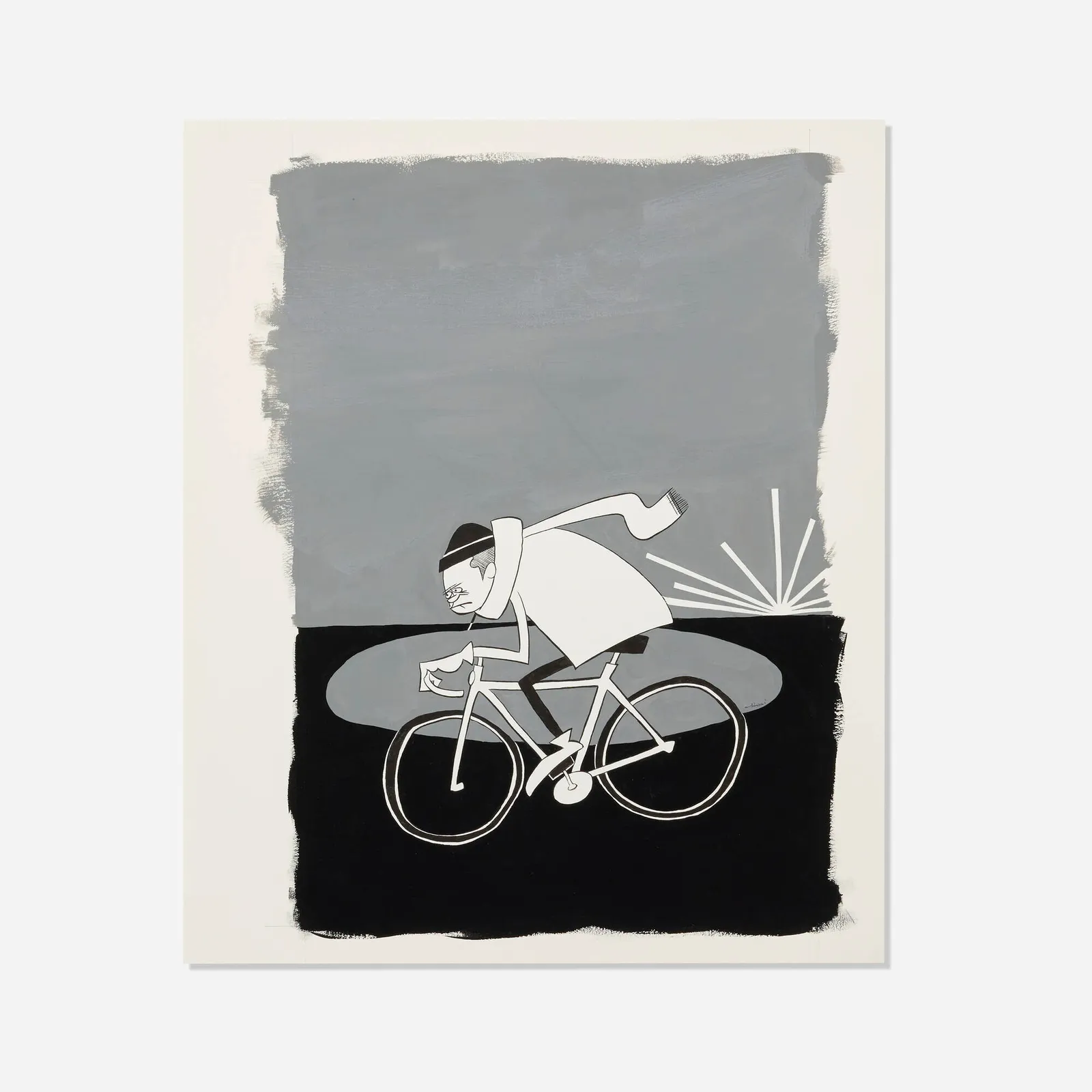
The work Untitled (c. 2020) by Japanese artist Yusuke Hanai represents a deceptively simple moment within contemporary art—an image rendered in acrylic on paper that feels effortless at first glance, yet carries layers of cultural memory, humor, and existential reflection.
Executed as a unique work on paper, the drawing occupies a fascinating space within Hanai’s broader practice. While the artist is widely recognized for paintings, sculptures, and commercial collaborations, his works on paper often feel closest to the core of his sensibility. They capture the immediacy of an idea before it evolves into a larger object or installation.
The piece surfaced through the auction house Rago/Wright/LAMA/Toomey & Co., where it was catalogued as Lot 104. Despite its modest scale, the work encapsulates the aesthetic philosophy that has made Hanai one of the most recognizable contemporary artists working between Japanese illustration traditions and American counterculture iconography.
idea
Born in 1978 in Kanagawa, Japan, Hanai grew up surrounded by the visual language of surf magazines, skate culture, and imported American graphics. His hometown lies near the coastal surf town of Zushi, an environment that shaped both his outlook and artistic vocabulary. Waves, beach culture, and a relaxed West Coast sensibility permeate his work—even when the imagery itself does not depict literal surfers.
Hanai eventually moved to the United States to study art, an experience that deepened his fascination with American subcultures. The artist became especially captivated by the psychedelic graphics of Rick Griffin, whose work for the Grateful Dead helped define the visual identity of the San Francisco counterculture of the late 1960s.
Another major influence comes from the literary world: the Beat Generation. Writers like Jack Kerouac introduced a philosophy of wandering, existential searching, and spontaneous creativity that resonates strongly within Hanai’s imagery.
These references—surf culture, psychedelic posters, Beat literature—might seem geographically distant from Japan, but Hanai’s work transforms them into a hybrid language. The result is neither purely American nor traditionally Japanese. Instead, it reflects the experience of an artist moving between cultures, absorbing visual codes and reinterpreting them through personal memory.
lang
Perhaps the most recognizable aspect of Hanai’s work is his “slacker character.” These figures appear relaxed, detached, sometimes confused or contemplative. They smoke cigarettes, stare into the distance, or lounge in awkward poses. Their faces are simplified, almost cartoonish, yet they convey surprisingly complex emotional states.
In Untitled (c. 2020), this archetype emerges once again. The character—drawn with minimal lines and solid acrylic tones—appears caught in a moment of introspection. Hanai’s figures rarely perform dramatic actions. Instead, they exist in small, quiet situations that evoke the ordinary absurdities of life.
This narrative ambiguity is central to the artist’s appeal. Viewers recognize the humor immediately, yet they also sense a deeper commentary on modern existence: boredom, alienation, and the search for meaning in everyday moments.
In this sense, Hanai’s figures function almost like visual haiku—simple compositions that hint at philosophical reflection without spelling it out.
mat
Unlike Hanai’s larger canvases or sculptural works, Untitled was created with acrylic on paper, a medium that emphasizes immediacy. Works on paper often preserve the artist’s first instinct, allowing gestures and linework to remain visible in ways that large-scale paintings sometimes obscure.
Condition notes reveal that the artwork displays diagonal scuffs through the center of the composition, visible primarily under raking light. Such marks are not unusual for works on paper and often testify to the piece’s physical history. The verso retains masking tape at three corners, indicating it may have once been mounted or temporarily displayed.
Despite these minor imperfections, the work “presents well,” according to the catalog description. It remains unframed, allowing collectors or curators to choose how best to present it within a gallery or private setting.
flow
One of the reasons Hanai’s art resonates globally is his ability to balance humor and melancholy. His characters often appear slightly ridiculous—long noses, drooping eyes, or exaggerated expressions—but they never feel cruelly caricatured. Instead, they embody the awkwardness of being human.
This balance echoes traditions from both Japanese and American visual culture.
Japanese illustration has long embraced simplified characters capable of expressing deep emotion through minimal design. At the same time, American underground comics of the 1960s and 1970s—particularly those circulating in surf and skate communities—embraced absurd humor and anti-establishment attitudes.
Hanai merges these traditions seamlessly. His characters might belong equally in a Japanese manga panel or on a vintage California surfboard sticker.
stir
The American West Coast occupies a mythical position in global culture: sunshine, freedom, music, rebellion. Hanai approaches this mythology with affection but also subtle irony.
In his work, the West Coast dream is not always glamorous. Instead, it is inhabited by slightly weary characters who seem unsure whether they have actually achieved that dream.
This ambivalence makes his imagery feel contemporary. Rather than celebrating a nostalgic vision of California, Hanai examines what happens after the party ends—when the surfboards are put away and the characters are left contemplating their lives.
influ
Beyond gallery exhibitions, Hanai has become known for collaborations with lifestyle and fashion brands. His distinctive characters translate easily into product design, making him a natural partner for companies rooted in youth culture.
He has worked with brands including:
-
Vans
-
Burton
-
ACME Furniture
These partnerships have expanded his audience far beyond traditional art collectors. Skateboarders, surfers, and streetwear enthusiasts encounter his imagery on shoes, apparel, and design objects, often discovering the artist before ever stepping into a gallery.
This crossover appeal places Hanai within a lineage of artists who blur boundaries between fine art and commercial culture—a lineage that includes figures like KAWS and Takashi Murakami.
show
Hanai’s career has grown steadily over the past decade, with exhibitions spanning major art capitals. His work has appeared in cities including Los Angeles, London, New York, Paris, and Tokyo, reflecting the global nature of contemporary visual culture.
Among recent exhibitions:
-
2026 — Winter Selections, Pace Prints
-
2025 — Yusuke Hanai: Perseverance, Pace Prints
-
2023 — T9G: Takuji Honda – Solo Exhibition, JPS Art Gallery
These exhibitions demonstrate the artist’s increasing visibility within established art institutions. Galleries specializing in contemporary printmaking and works on paper have shown particular interest in his practice, recognizing how effectively his graphic style translates across mediums.
rare
The catalog designation of Untitled as “Unique” is significant for collectors. Unlike editioned prints, which exist in multiple copies, a unique work on paper represents a one-of-one object within the artist’s oeuvre.
Works like this often appeal to collectors seeking something more intimate than large-scale paintings. They also serve as historical documents of the artist’s evolving ideas.
Because Hanai’s drawings often function as conceptual starting points for larger projects, owning a unique work on paper can feel like possessing a fragment of the artist’s creative process.
phil
Hanai’s minimalism is not accidental. Each line is deliberate, reducing visual information to its essential form.
This approach echoes principles found in both Japanese aesthetics and modern graphic design: clarity, restraint, and balance. By stripping away unnecessary detail, the artist allows viewers to project their own interpretations onto the character.
The result is imagery that feels simultaneously personal and universal.
min
Although modest in size, Untitled (c. 2020) embodies the broader themes that define Hanai’s career: cross-cultural exchange, humor tinged with existential reflection, and a visual language rooted in the everyday.
The piece reminds us that contemporary art does not always need monumental scale to carry weight. Sometimes the most compelling works are those that capture a fleeting thought or a subtle emotional moment.
In Hanai’s hands, a simple drawing becomes a meditation on identity, culture, and the strange comedy of modern life.
fin
In the global landscape of contemporary art, Yusuke Hanai occupies a unique position. His work bridges the distance between Japan and California, between illustration and fine art, between humor and melancholy.
Untitled (c. 2020) encapsulates this delicate balance. Through minimal lines and understated color, the artist creates a character who feels instantly familiar yet strangely enigmatic.
For collectors and viewers alike, the work offers more than aesthetic pleasure. It invites reflection on the small moments that define our lives—the pauses, the uncertainties, the quiet humor of simply existing.
And in doing so, Hanai demonstrates that even the simplest drawing can carry the weight of an entire cultural dialogue.
No comments yet.