Zhang Xiaogang: Bloodline as Structure — Father and Daughter, 2005

March 24, 2026
struct
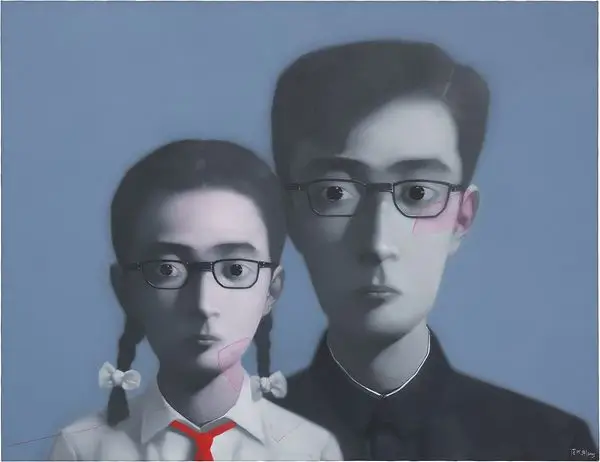
Within the practice of Zhang Xiaogang, Bloodline Series – Father and Daughter (2005) occupies a position that feels both deeply personal and structurally emblematic. It is not simply a portrait; it is a distilled psychological system. The painting belongs to the broader Bloodline cycle initiated in the early 1990s, a body of work that has come to define Zhang’s global recognition, particularly in the context of post–Cultural Revolution visual language in China.
At first encounter, the image appears composed, even serene. A father and daughter face forward, suspended against an indeterminate grey ground. Their expressions are subdued to the point of neutrality—eyes slightly widened, lips pressed in a calm but ambiguous stillness. Yet the longer one looks, the more the painting reveals itself as an architecture of tension: between individuality and conformity, intimacy and distance, biological inheritance and ideological imprint.
The work does not offer narrative in the traditional sense. Instead, it proposes a condition—one that feels frozen, suspended, and quietly haunted.
view
Emerging in the aftermath of the Cultural Revolution, Zhang’s paintings draw heavily from found family photographs, particularly studio portraits from the Maoist era.
These photographs were themselves highly controlled images—composed to project ideological stability, familial unity, and social harmony. Zhang appropriates this visual grammar but disrupts it through subtle distortions.
In Father and Daughter, the faces are rendered in smooth, almost porcelain-like greys, devoid of warmth. The tonal flattening erases the individuality that might otherwise emerge through complexion or gesture. The figures appear both hyper-present and strangely absent, as if they are reproductions rather than living subjects.
psych
There is a peculiar stillness in Zhang’s work, and Father and Daughter intensifies this quality. The figures do not interact in any conventional sense. They are positioned together, yet psychologically isolated. The daughter does not lean toward the father; the father does not acknowledge the daughter. Instead, both face outward, as if presenting themselves for inspection.
This compositional choice transforms the painting into something akin to an official record or archival document. It recalls the rigid frontality of identification photography, where individuality is subordinated to classification.
Yet within this rigidity, subtle emotional disturbances emerge. The eyes—slightly enlarged, almost glassy—carry an uncanny weight. They suggest awareness without expression, presence without communication. The effect is not overtly dramatic, but deeply unsettling.
show
Zhang Xiaogang has often spoken about memory not as a stable archive, but as something fragmented, unreliable, and subject to reconstruction. Father and Daughter operates within this framework. It does not attempt to document a specific relationship; instead, it constructs a generalized image of familial connection under historical pressure.
The repetition of similar faces across the Bloodline Series reinforces this idea. Many of Zhang’s figures appear almost interchangeable, differentiated only by minor variations. This visual strategy mirrors the homogenizing forces of the Maoist period, where individual identity was often subsumed under collective ideology.
At the same time, the painting resists complete erasure of individuality. Small details—a slight asymmetry in the eyes, a faint tonal shift in the skin—hint at personal difference. These details are subtle, but they disrupt the otherwise uniform surface.
sequence
The influence of photography on Zhang’s work is profound. The Bloodline Series is often described as “photo-based,” but this description only scratches the surface. Zhang does not simply replicate photographs; he transforms them into something more ambiguous.
In Father and Daughter, the photographic origin is evident in the composition and lighting. The frontal pose, the neutral background, and the even illumination all recall studio portraiture. However, the painting diverges from photographic realism through its treatment of texture and tone.
The skin is rendered with a smooth, almost artificial sheen, as if it were lacquered. This surface quality creates a sense of distance, turning the figures into objects rather than subjects. They appear preserved, like relics or specimens.
At the same time, the painting introduces elements that disrupt photographic logic. The red line, for instance, has no counterpart in reality. It exists purely within the symbolic realm, overlaying the image with an abstract dimension.
This interplay between photographic reference and painterly intervention allows Zhang to operate in a space between documentation and imagination. The figures are grounded in reality, yet they feel spectral—like memories that have been reconstructed rather than remembered.
min
The father-daughter pairing is significant. Within traditional Chinese family structures, the father often represents authority, lineage, and continuity. The daughter, meanwhile, occupies a more complex position—both within and peripheral to the family line.
In Zhang’s painting, these roles are not explicitly articulated, but they are subtly encoded. The father figure appears slightly larger, more central. His presence anchors the composition. The daughter, while equally frontal, carries a different kind of weight—one that feels more vulnerable, more contingent.
The red line connecting them underscores this relationship. It suggests inheritance, but also obligation. The daughter is linked to the father not just biologically, but structurally—within a system that defines her position.
Yet the painting does not resolve this relationship into a clear narrative. Instead, it leaves it suspended, open to interpretation. The figures are connected, but not reconciled. Their bond is visible, but its meaning remains ambiguous.
idea
One of the most striking aspects of Zhang’s work is his treatment of skin. In Father and Daughter, the grey tones create a sense of uniformity, but they also evoke a kind of lifelessness. The figures appear drained of vitality, as if their individuality has been absorbed into the surface.
This effect is heightened by the smoothness of the paint. There is little visible brushwork, no expressive gesture. The surface is controlled, almost mechanical. This aligns with the broader themes of the Bloodline Series, where control—both social and psychological—is a central concern.
At the same time, the surface is not entirely uniform. Subtle variations in tone create a sense of depth, suggesting that something lies beneath the exterior. These variations can be read as traces of suppressed emotion, or as remnants of individuality that resist complete erasure.
fwd
Perhaps the most compelling aspect of Father and Daughter is its negotiation of intimacy and distance. The subject matter suggests closeness—a familial bond, a shared lineage. Yet the execution introduces a sense of separation.
The figures are physically close, but emotionally distant. They share a connection, but do not engage with one another. This paradox creates a tension that runs throughout the painting.
It is a tension that resonates beyond the specific context of Zhang’s work. It speaks to broader questions about how relationships are shaped by external forces—how identity is constructed not just through personal experience, but through social and historical frameworks.
In this sense, Father and Daughter is not just a portrait of two individuals. It is a portrait of a condition—a state of being in which connection and separation coexist.
sum
There is no dramatic climax in Zhang Xiaogang’s Bloodline Series – Father and Daughter (2005). The painting does not demand attention through spectacle or narrative. Instead, it operates through subtlety, repetition, and restraint.
Its power lies in its ability to linger. The image stays with the viewer, not because it reveals everything at once, but because it withholds. It invites prolonged looking, gradual recognition.
Over time, the painting begins to feel less like a representation and more like a presence—something that occupies space in the viewer’s conscious, quietly altering perception.