Zim & Zou: Analog Memory Rebuilt Through Paper, Where Sound Becomes Structure

April 10, 2026
2 hours ago
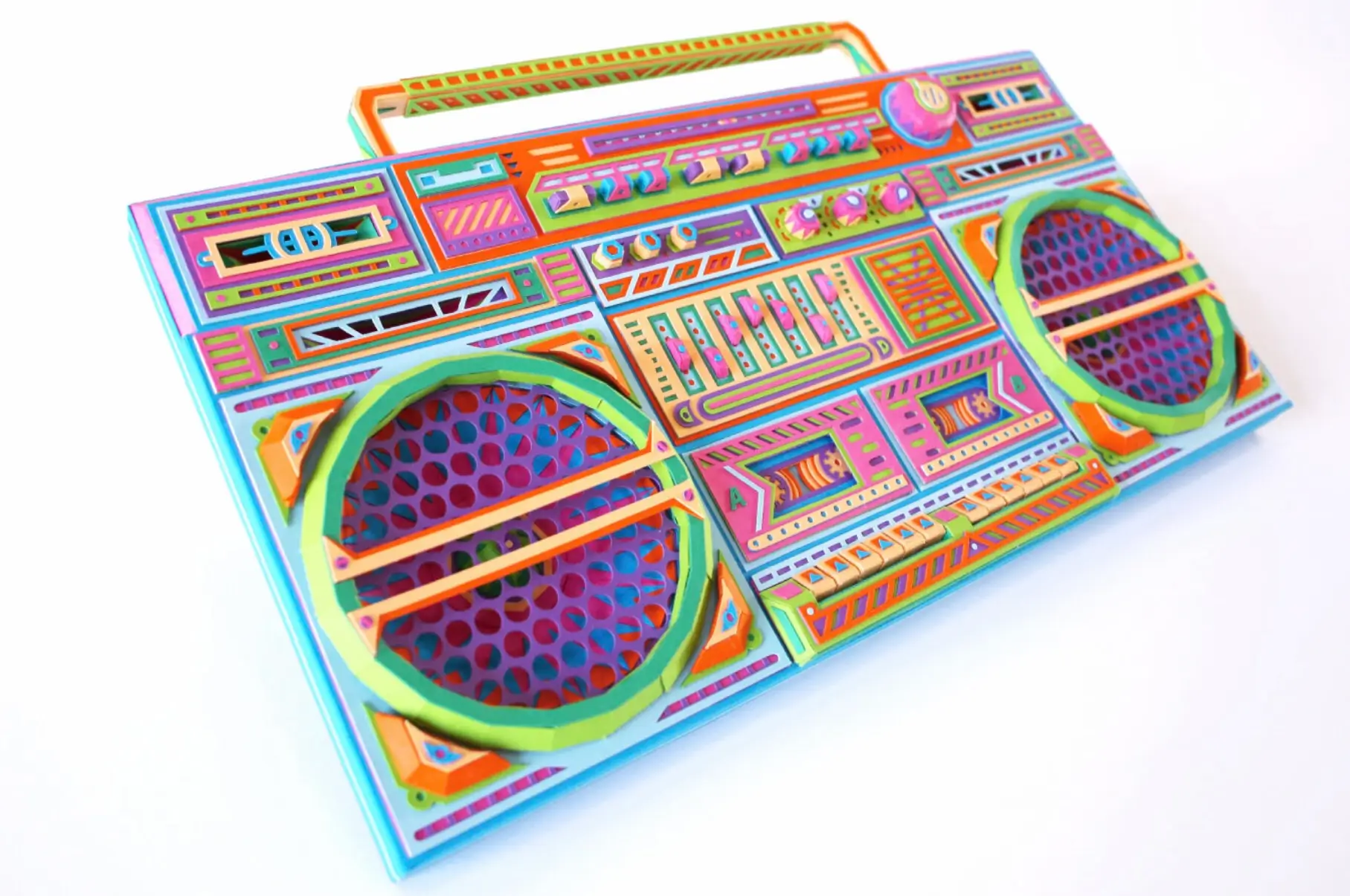
There is no illusion of function here—only structure. No circuitry, no sound, no playback. And yet, what Zim & Zouconstruct feels closer to the architecture of listening than the object itself.
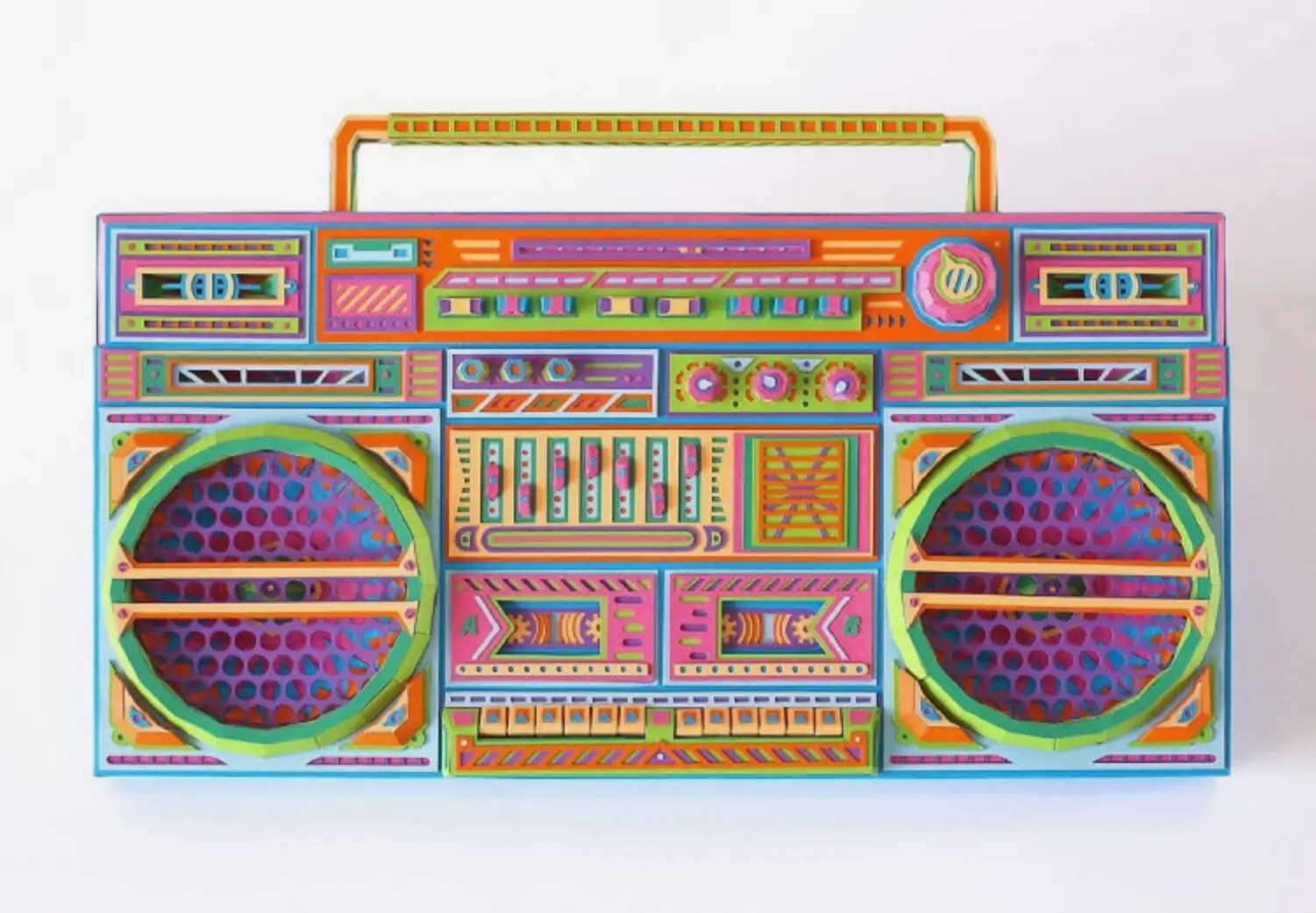
The boombox, once defined by volume and portability, is reassembled as a silent system of cuts, folds, and calibrated color. It does not attempt to replicate sound. It reconstructs how sound once occupied space—from views, to physical and cultural.
This is not nostalgia rendered softly. It is nostalgia dissected, flattened, and rebuilt with deliberate friction.
discip
At the center of the work is an insistence: paper is not a substitute material. It is the material.
Each sculpture is constructed entirely from colored sheets—no paint, no digital overlay, no shortcuts. Every gradient is solved through layering. Every shadow is structural. Every edge is cut by hand.
Lucie Thomas and Thibault Zimmermann, the duo behind Zim & Zou, operate within a practice that resists speed. Their process is slow, repetitive, and exacting. It is less about representation and more about translation.
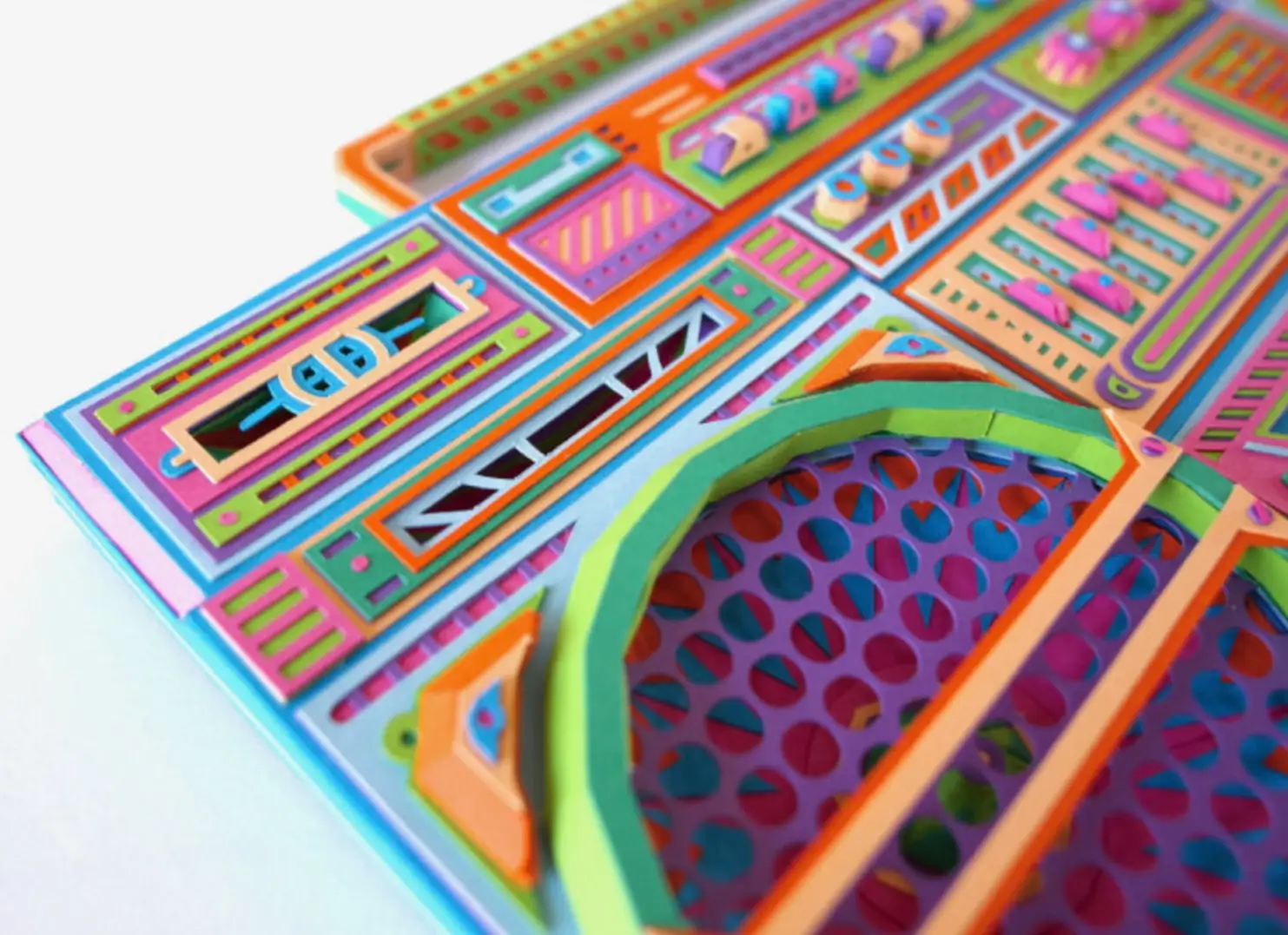
A speaker grille becomes a field of perforations—each hole cut, aligned, repeated. A cassette slot becomes a measured incision, thin and deliberate. Buttons are not printed—they are stacked, shaped, and labeled individually.
The result is not a copy of an object. It is a system of decisions that mirrors the logic of the original.
struct
The boombox anchors the series because of its complexity. It is not a minimal object—it is dense with function, divided into zones, layered with intention.
Zim & Zou approach it as a map.
The two speakers on either side are constructed through concentric rings and grids, each layer slightly offset to produce depth. The visual rhythm of sound—vibration, repetition—is translated into pattern.
At the center, the control panel becomes a study in segmentation. Buttons sit in rows, each separated by color blocks that define their function. Sliders are built from stacked strips, thin enough to suggest movement but fixed in place. Labels appear not as printed text but as embedded elements, integrated into the structure.
The cassette slot is reduced to a precise opening—a narrow horizontal line that implies insertion, absence, and possibility. It is one of the few moments where negative space carries as much weight as material.
What emerges is a reconstruction that feels more organized than the original object. The chaos of analog interfaces is refined into clarity.
View this post on Instagram
tincture
In traditional industrial design, color often follows branding or usability. Here, it becomes structural language.
Each section of the boombox is divided into distinct color fields. Bright yellows sit beside saturated blues. Reds interrupt neutral planes. Pastels soften mechanical zones.
These choices are not decorative. They are organizational.
Color replaces labeling. It defines boundaries. It creates hierarchy.
Where a real boombox might rely on typography and small icons, Zim & Zou rely on contrast and adjacency. The viewer reads the object through shifts in hue rather than text.
This approach transforms the sculpture into something closer to a diagram than a replica. It is an object that explains itself visually.
stir
If the boombox represents system, the cassette represents intimacy.
It is smaller, more contained, more personal. A device of storage rather than broadcast.
Zim & Zou treat it with the same rigor, but the scale changes the reading.
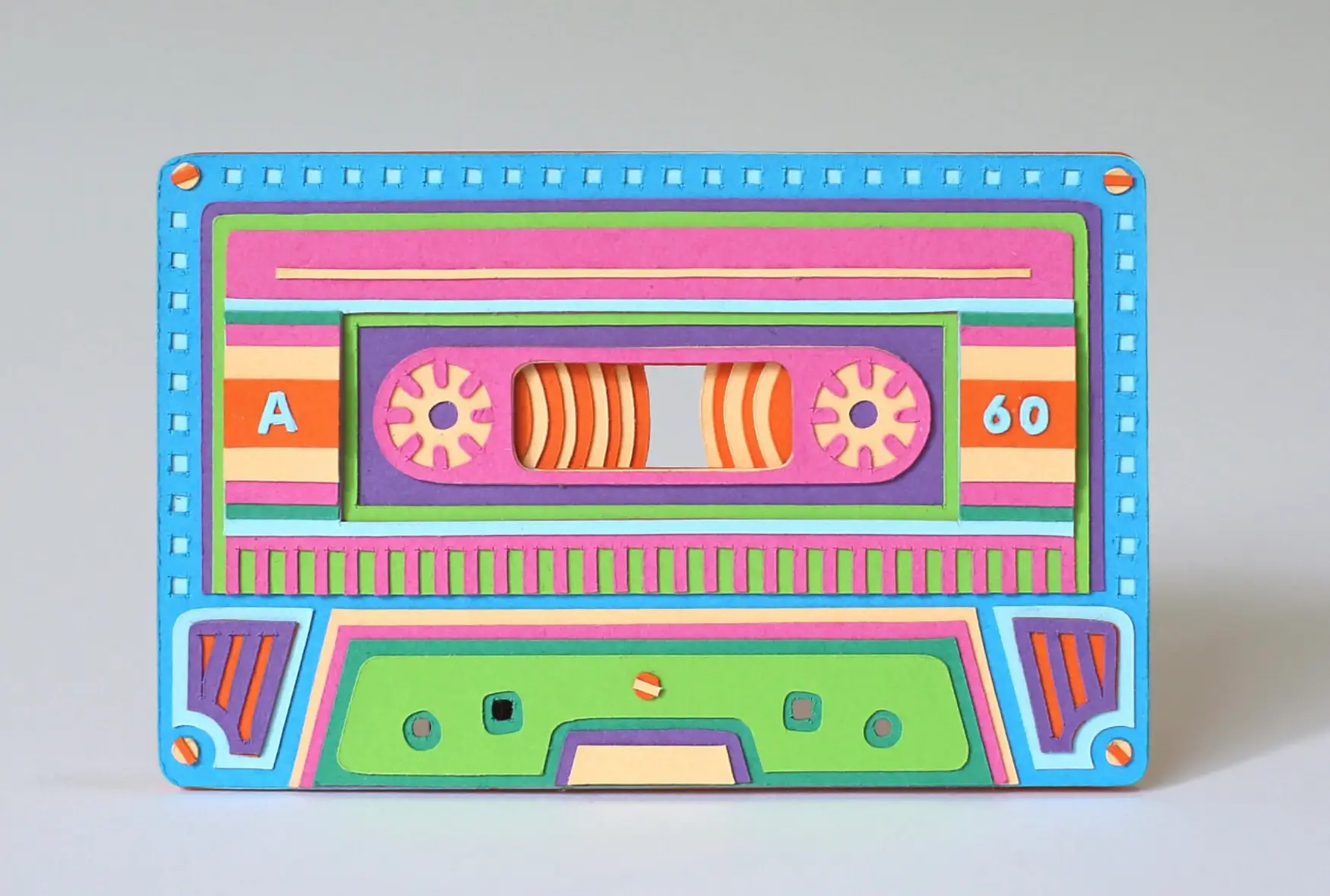
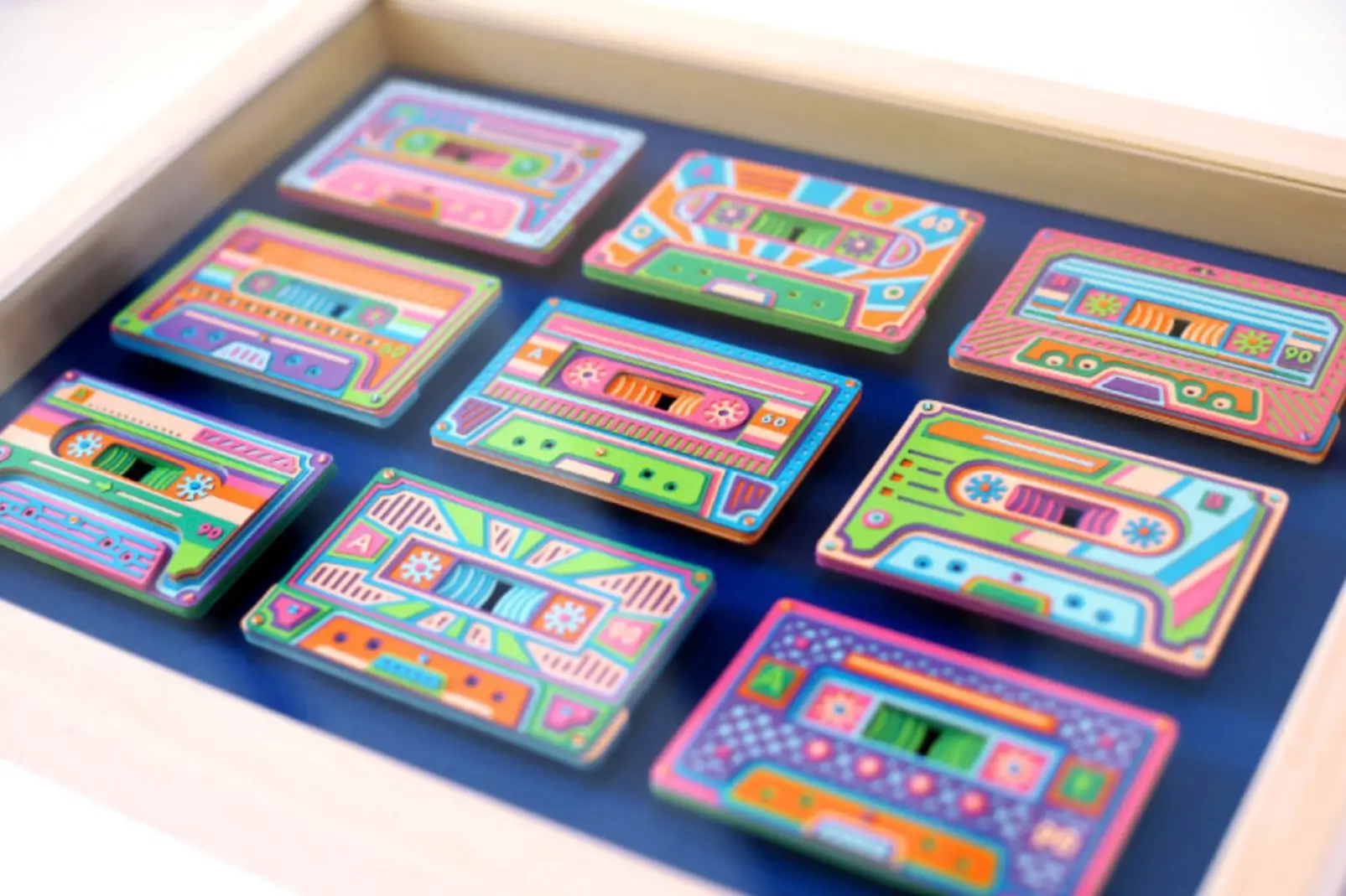
The reels are constructed from layered circles, each ring slightly raised to create depth. The tape itself is implied through thin, curved strips—suggesting motion without movement.
The casing becomes a transparent illusion built from opaque paper. Windows are suggested through cutouts and framing, not actual transparency. It is a translation of visibility, not a replication of it.
Details accumulate: tiny screws, labels, spools, edges. Each one built, not drawn.
The cassette becomes less about music and more about containment—the idea of something held, preserved, replayed.
flow
There is a rhythm to the making.
Cut, fold, place.
Cut, fold, place.
This repetition is not hidden. It is visible in the final work—in the alignment of lines, the consistency of spacing, the accumulation of micro-decisions.
Unlike industrial production, where repetition aims for invisibility, here it becomes texture. Slight variations remain. Edges reveal their construction.
The work carries its own making within it.
This is where Zim & Zou’s practice diverges from digital simulation. A rendered boombox could achieve perfect symmetry, seamless gradients, flawless surfaces. But it would lack resistance.
Paper resists. It bends, it thickens, it casts shadows unpredictably.
That resistance becomes part of the visual language.
idea
The sculptures occupy an ambiguous position.
They are physical objects, built in three dimensions. But they are often photographed head-on, flattening them into images.
In this flattened state, they begin to resemble illustrations—hyper-detailed, hyper-controlled, almost unreal.
This duality is intentional.
The viewer is never fully sure whether they are looking at an object or an image of an object. Depth exists, but it is compressed. Material is present, but it behaves like graphic design.
This tension reflects the broader shift in how objects are experienced today—through screens, through images, through curated representations.
Zim & Zou do not resolve this tension. They hold it.
craft
There is a quiet resistance embedded in the work.
In a culture defined by speed—digital production, instant replication, infinite scalability—Zim & Zou operate at the opposite end of the spectrum.
Their process cannot be rushed. It cannot be automated. It cannot be scaled without losing its core logic.
Each piece demands time—not just in making, but in viewing. The eye moves slowly across the surface, tracing lines, recognizing patterns, decoding structure.
This slowness is not nostalgic. It is structural.
It repositions craft not as heritage, but as method.
omission
The most striking aspect of the series is what is missing.
Sound.
The boombox, once a symbol of volume and presence, is silent. The cassette, once a container of music, holds nothing.
This absence is not a limitation. It is the point.
By removing sound, Zim & Zou shift attention to form. They ask the viewer to consider what these objects are when they are not performing their primary function.
What remains is design. Interface. Structure. Memory.
The sculptures become diagrams of use rather than tools of use.
theory
It would be easy to read the work as purely nostalgic—a return to analog objects, a celebration of pre-digital culture.
But Zim & Zou avoid sentimentality.
They do not age the objects. There is no artificial wear, no retro patina, no attempt to simulate time. Everything is clean, precise, almost idealized.
This positions the work closer to memory than history.
Memory simplifies. It organizes. It removes noise.
The boombox and cassette are not presented as they were, but as they are remembered—structured, legible, distilled.
lang
What ultimately defines Zim & Zou’s work is not the objects they choose, but the language they use to build them.
Cuts become lines.
Layers become depth.
Color becomes function.
Repetition becomes rhythm.
This language is consistent across their practice, whether they are building electronics, food, or architectural forms.
The boombox and cassette series simply make that language more visible, because the original objects are already systems.
why
The work stays because it operates on multiple levels at once.
It is visually immediate—bright, precise, satisfying.
It is technically impressive—complex, detailed, controlled.
It is conceptually layered—about memory, material, and translation.
But it does not announce any of this.
It remains quiet. Structured. Open.
There is no single reading, no fixed interpretation. Only a system that continues to reveal itself the longer it is observed.
end
Zim & Zou do not recreate the past. They reorganize it.
The boombox and cassette—once tools of listening—become frameworks for seeing. Their function is stripped away, leaving only the architecture behind.
What emerges is not a replica, but a reconstruction of logic.